Google Picked 10 African AI Startups. The Money Behind Them Is Still the Story.
On November 11, Google named the first cohort of its Africa Applied AI Lab, and Enza Capital closed $21 million for an AI Africa Fund on the same day. The Lab hands founders models and mentors. The fund hands them cheques, starting in 2027. Both point at the same pattern: African AI is being built for how people on the continent actually use technology.
 Ibrahim Denis FofanahData Scientist & AI Researcher11 min read·Building AI in Africa · Analysis
November 11 was the busiest single day for African AI funding news in months, and it produced two announcements that belong in the same story. Google named the 10 startups in the first cohort of its Africa Applied AI Lab. Enza Capital, a Nairobi-founded pan-African venture firm, reported a first close of about $21 million for its third fund, an AI Africa Fund. One announcement hands founders models and mentors. The other hands them money, eventually. Read together, they say something useful about where African AI is actually going, and about how far it still has to go.
The cohort: 10 startups, 4 countries, 1 pattern
Google opened applications in July. The window closed on August 31 with thousands of entries from startups across more than 45 African countries. Ten made the cut. The Lab is run by the Google AI Futures Fund together with Google Research, and it is based at the Accra AI Community Centre in Ghana. The cohort gathers there in December for a demo day.
Here is the full list, with Google's own descriptions:
| Startup | Base | What it does |
|---|---|---|
| AethexAI | Pan-African | Fast, responsive AI voice agents for banks, telecoms, and customer support centres |
| Agrails | Pan-African | AI-powered insurance infrastructure for farmers, gig workers, and small borrowers |
| Crane AI Labs | Uganda | Offline, on-device AI tools for health workers and schools on affordable phones |
| Intron | Nigeria | Clinical and enterprise speech recognition that understands African accents and code-switched speech |
| Satlyt | Kenya | Turns satellites into connected computing nodes so data can be processed in orbit |
| Smile ID | Pan-African | Computer vision to verify identity and help financial services onboard customers securely |
| Termii | Nigeria | Customer verification, messaging, and operational alerts for financial services |
| Tolbi | Senegal | Satellite imagery plus voice guidance to help smallholder farmers improve yields |
| Vendy | Nigeria | Lets businesses run storefronts and take payments directly inside WhatsApp |
| Viamo | Pan-African | Generative AI for people without smartphones, delivered through basic phone calls in local languages |
Three of the ten are Nigerian, the largest national group. One each comes from Uganda, Kenya, and Senegal. Four are listed as pan-African. Nigeria having the most startups in the cohort fits a pattern I have noted before: Lagos is now one of the main AI building hubs on the continent, alongside Nairobi, Kampala, and Dakar.
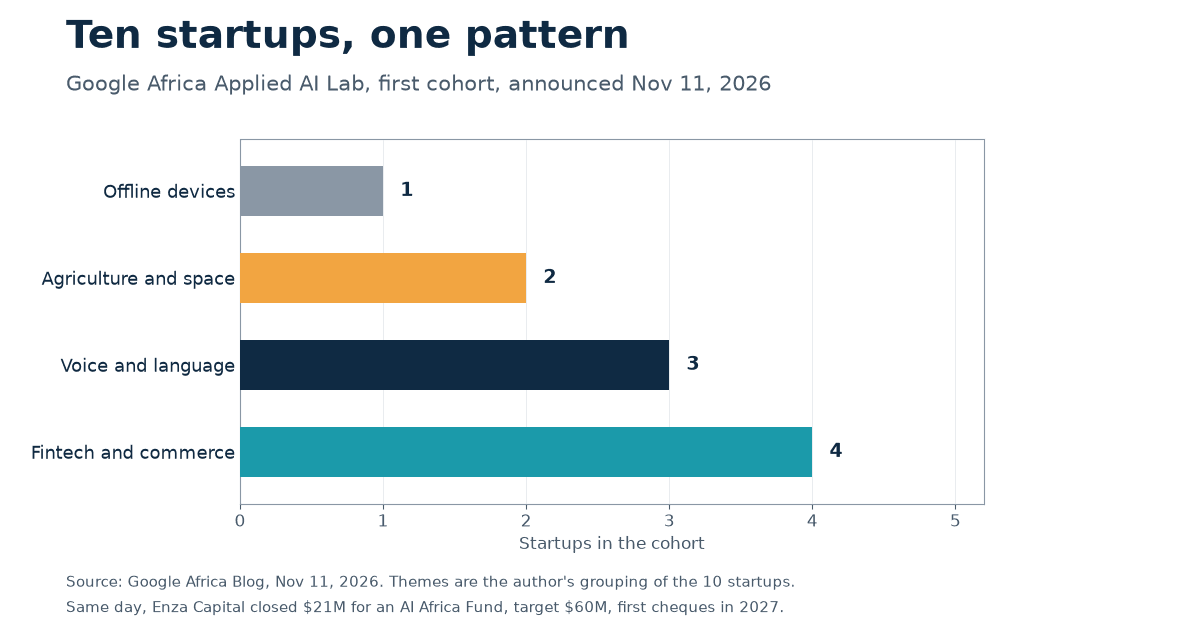
Group the ten by what they build, and the pattern sharpens. Four work in fintech and commerce: Agrails, Smile ID, Termii, and Vendy. Three work in voice and language: AethexAI, Intron, and Viamo. Two work with agriculture and space: Satlyt and Tolbi. One works on offline devices: Crane AI Labs.
That is not a random spread. Seven of the ten deal with voice, phones, or payments, the three things African users already do every day. A nurse in a rural Ugandan clinic checks symptoms on a cheap phone with no internet. A woman in Nigeria who has never touched a smartphone dials a number on a basic handset, asks a question in Hausa, and hears the answer read back. A farmer in Senegal gets a voice message telling her when to water and when to harvest, based on satellite images of her field. Those three examples come straight from Google's own announcement, and they are the point. These products are built for how people on the continent actually use technology.
What the Lab actually gives founders
The Lab gives each startup early access to Google's AI models, including Gemini and Gemma, and time with Google engineers, research scientists, and product leaders. Four venture firms are partners: 4DX Ventures, Norrsken22, Novastar Ventures, and Ventures Platform. They advise the founders on taking products to market and building sustainable businesses.
Google's announcement does not give a cash figure or a cloud-credit figure. Some reports have mentioned credit amounts, but Google has not confirmed them, so treat any number you see with caution until the company says it. That matters, because the gap between "early access to models" and "funded to build" is exactly the gap African founders keep falling into. Access to Gemini is useful. It is not a runway.
The selection itself is a filter worth noting. Google says it reviewed each team's technical plans and traction, and that some of the selected companies already run AI at scale for banks, retailers, and telecoms providers. This cohort leans toward companies that already have products and customers, not ideas on a whiteboard. That is a reasonable choice for a first cohort, and it also means the Lab is not mainly a discovery mechanism. It is an accelerator for teams that have already survived the hardest part, finding a first customer.
The money: $21 million, with a 2027 start date
Enza Capital's announcement landed the same day, November 11. The firm reported a first close of about $21 million for Enza Capital III LP, its AI Africa Fund. The target is $60 million, with a hard cap of $80 million, so the first close is 35 percent of target. The firm expects further commitments before the end of 2026, a final close in 2027, and first investments in 2027. Initial cheques will run from $250,000 to $3 million, from pre-seed through Series B, with capital reserved for follow-ons.
A first close is a commitment, not a deployment. The $21 million is money limited partners have promised to the fund, not money that has reached a startup. Nothing from this fund reaches a company until 2027. That is worth saying plainly, because first-close headlines are routinely read as funding news for founders. This one is funding news for a fund. The founders get the cheques next year, if the final close lands.
Even so, the timing is useful. African AI funding is in a trough. Earlier this year I reported that only 190 companies raised $100,000 or more in the first half of 2026, the lowest count since 2021, and that about 14 percent of first-half funding was AI-related while under 2 percent went to genuinely AI-native companies. Silicon Africa, reporting on the Lab announcement, cited industry data showing disclosed investment in African AI companies fell by more than 90 percent between 2025 and the first half of 2026. Against that background, a dedicated AI fund closing its first $21 million, and Google putting its models and engineers behind 10 local teams, are both real signals. The question is whether they are the start of a pipeline or a one-week headline.
Five things to watch before the demo day
The demo day in Accra in December is the first real test. Here is what I will be watching, and what any practitioner following this should track.
1. Who follows up with money. The Lab's venture partners are 4DX Ventures, Norrsken22, Novastar Ventures, and Ventures Platform. Watch whether any of them lead or join a round for a cohort company within six months of demo day. Introductions are cheap. Term sheets are the test.
2. Whether the models stay accessible. Early access to Gemini and Gemma is the Lab's core offer. Watch whether the cohort companies still have workable access, and at workable prices, after the programme ends. A lab that ends with founders priced out of the models they built on has not solved the problem it named.
3. Whether voice and offline products ship measurable results. Intron, Viamo, AethexAI, and Crane AI Labs all make claims about accents, code-switching, offline use, and basic phones. The demo day should show accuracy, latency, and usage numbers, not just demos. For speech products, ask for word error rates on African accents specifically, not generic benchmarks.
4. Whether Enza's final close lands. The fund needs another $39 million to reach its $60 million target. If the final close slips past 2027, the first investments slip with it, and the $21 million becomes a headline with no deployment behind it. The firm has said it expects further commitments before the end of 2026, which gives a near-term marker to check.
5. Whether a second cohort opens. Google says it will share the cohort's progress on its Africa blog and social channels in the months ahead. A second intake, announced with a date, would say the Lab is a programme. Silence after demo day would say it was an event.
In favour
The cohort is well chosen. Voice, offline, and fintech are the three areas where African builders have a genuine edge, because they are solving problems Silicon Valley products do not solve well: accents and code-switching, no connectivity, and payments inside WhatsApp. The selection bar, technical plans plus traction, means these are companies with customers, not pitch decks. And the two announcements reinforce each other: the Lab de-risks the technology, the fund de-risks the capital, and both land in the same week that the funding data looks worst. That is how a pipeline starts.
Against
The gaps are the story. Ten startups from thousands of applications is an acceptance rate around 0.5 percent or lower, and most applicants got nothing. The Lab gives model access but no disclosed funding, and the fund gives funding but no cheques until 2027. The demo day is in December, which is weeks away, and a single demo day does not make an ecosystem. The funding trough is real: 190 companies raising $100,000 or more in a half year is a thin market, and a $60 million target fund, even if it closes in full, is small against the scale of the gap. There is also a concentration risk worth naming: Google is the model provider, the mentor, and the convenor. If the Lab works, it works on Google's terms, with Gemini and Gemma at the centre. That is a fair trade for the founders, but it is a dependency, not independence.
What would make me wrong
- If three or more cohort companies raise priced rounds within six months of demo day, the Lab will have done more than introduce founders to investors. That would make my caution about introductions look too cynical.
- If Enza closes the full $60 million and starts writing cheques in the first half of 2027, the funding pipeline is real, and the first close was a beginning, not a peak.
- If the cohort companies publish real accuracy and usage numbers for African accents, offline use, and basic-phone access, the "built for local realities" claim will have evidence behind it. If they only show demos, it will not.
- If Google announces a second cohort with a date before the middle of 2027, the Lab is a programme. If there is no second cohort by then, it was a one-off.
Sources
- Google Africa Blog: Meet the 10 startups joining the first Google Africa Applied AI Lab cohort
- Silicon Africa: Google Picks 10 African Startups for First Applied AI Lab
- Disrupt Africa: Google selects 10 startups for inaugural Africa Applied AI Lab cohort
- Disrupt Africa: Pan-African VC firm Enza Capital reaches $21m first close of AI Africa Fund
- Business Tech Africa: Enza Capital Raises $21 Million for Africa-Focused AI Fund
Related on Everyday Data Science
- A $1 Billion AI Data Centre Is Coming to Egypt. The Telcos Are Now Africa's Compute Builders.
- Africa's Startups Raised $2 Billion This Year. The First Check Is Still Missing.
- Africa's 12,000 GPUs and the Compute Gap Nobody Talks About
If you are building AI for African users, which matters more to your next project: early access to a frontier model, or a cheque that lands in 2027?
Sovereign AI Got Hardware This Week: Two Deals, Two Very Different Tests
Next →Africa's AI Fortnight Was About Small Models and Speech Data. That Is the Point.
About the writer
Data Scientist & AI Researcher
Data scientist and AI researcher at Pace University. I coined Artificial Frictional Unemployment, and built the first machine learning model for crop yield prediction in Sierra Leone. Author of Understanding Agentic AI. I write about agentic systems and applied ML, with a bias toward what actually works, and who gets left out when it doesn't.
Found this useful? Passing it on to someone who builds is the best way to help the publication grow.
Built something worth sharing? Write it up for us →