Sovereign AI Got Hardware This Week: Two Deals, Two Very Different Tests
On October 21 and 22, Africa got an enterprise sovereign platform in Johannesburg and a compute credit network spanning 53 countries. Both use the word sovereign. They will be judged on different evidence.
 Ibrahim Denis FofanahData Scientist & AI Researcher10 min read·Building AI in Africa · Analysis
Sovereign AI is an easy phrase to say and a hard one to cash in. This week it stopped being only a phrase.
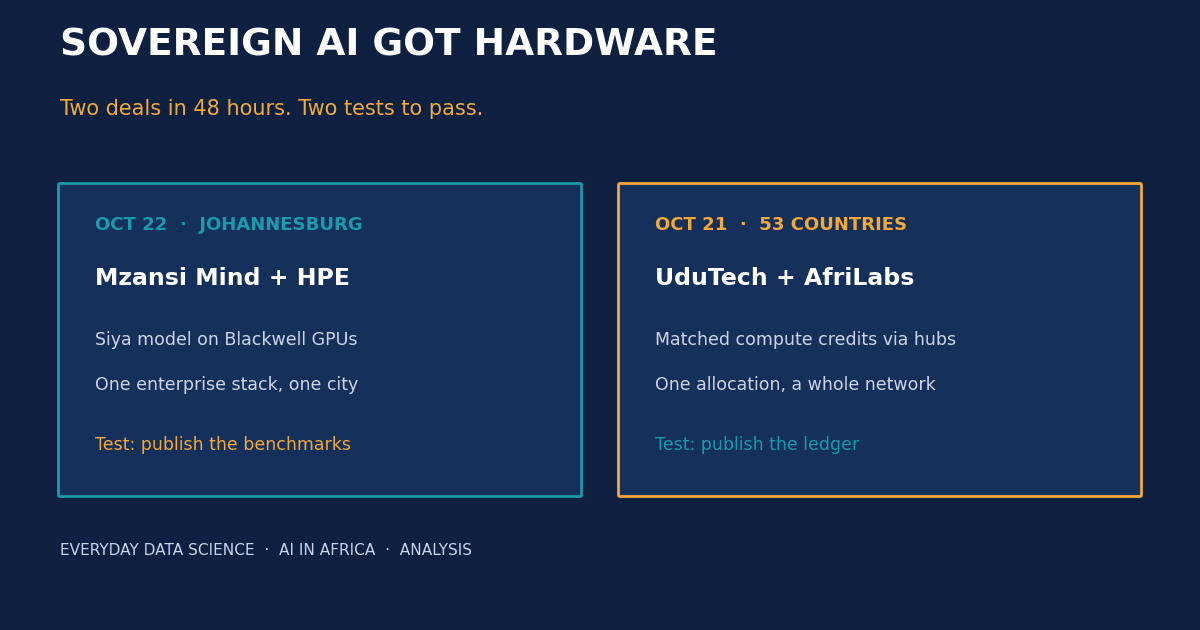
On October 22, HPE announced that Mzansi Mind, a sovereign enterprise AI platform from Solcon Capital, had selected HPE servers and switches to power its Siya language model and its agentic AI framework, hosted at Equinix in Johannesburg. One day earlier, on October 21, Nigerian company Udu Technologies announced a partnership with AfriLabs, the pan-African hub network, to route AI compute to early-stage startups through a dedicated allocation on UduTech's platform.
Two deals, two theories of what sovereignty means. One buys control of a single stack for enterprise customers. The other spreads access across a network and asks funders to help pay for it. Both deserve to be taken seriously, and both should be graded on evidence that has not been published yet.
Deal one: one stack, one city, enterprise buyers
Mzansi Mind's pitch is specific about use cases and vague about scale, which is the normal shape of an enterprise launch.
What the announcement does say:
- The platform supports all official South African languages, and pairs the Siya model with an agent framework that can reason, use tools, and carry out multi-step tasks across enterprise workflows.
- The named agents cover financial research and compliance, legal services, human resources, customer service, and executive decision support.
- The hardware is HPE ProLiant Compute DL380a Gen12 servers with NVIDIA RTX PRO 6000 Blackwell Server Edition GPUs, built for inference, plus HPE Juniper Networking QFX5120 switches for low-latency connectivity between servers, storage, and compute.
- The stack sits in Equinix's colocation facility in Johannesburg, supplied through HPE Platinum partner Datacentrix, with HPE Tech Care support.
- The stated design goals are local language coverage, regulatory fit, and data residency: organisations run AI in the languages their staff and customers speak, under South African rules, on infrastructure physically located in the country.
Pramod Venkatesh, CEO Director for the Mzansi Mind Sovereign AI project at Solcon Capital, put the ambition plainly: an agentic ecosystem that understands South Africa, from its languages and regulatory environment to the requirements of local organisations, and that is sovereign. HPE's Ahmad Alkhallafi framed the deal as scalable infrastructure for multilingual enterprise agents with control and security. Equinix South Africa's Sandile Dube pointed to connectivity and resilience in Johannesburg as the base for sustainable growth.
Read that as a data-residency and procurement play first, and a model play second. The buyers for this are banks, law firms, and large employers who cannot send regulated work to a foreign cloud region and who need support contracts, audits, and a local counterparty. Whether Siya is a good model is a separate question, and nothing in the release answers it. No benchmark, no evaluation set, no language-by-language quality numbers were published.
Deal two: compute as an allocation problem
UduTech and AfriLabs are solving a different bottleneck. Their problem is not where a bank's data sits. Their problem is that a small team in a secondary city cannot afford the GPU hours to test an idea at all.
The agreement, announced October 21, works like this:
- AfriLabs brings a network of innovation hubs in 53 African countries. UduTech brings high-performance computing capacity.
- A dedicated AfriLabs Compute allocation sits on UduTech's platform. Partner organisations and development funders can contribute to it or match AI credits, so selected startups and hubs get compute that would otherwise be prohibitively expensive.
- The target sectors are financial services, healthcare, education, and agriculture.
- AfriLabs Academy will train hub managers to guide entrepreneurs on where AI fits a local market, and UduTech will join AfriLabs' annual gathering with governments, universities, businesses, and development organisations.
- The two organisations have worked together before, on AI BRIDGE, a compute-backed research project on reducing gender bias in datasets and on the underrepresentation of African languages in AI resources. AI BRIDGE received recognition in the Digital Frontiers category at the 2026 Digital@UNGA Awards, organised by the ITU and UNDP.
The honest summary of this model: access depends on an allocation, and allocations depend on who funds them and who selects the recipients. That can work well. Hub networks know their local founders better than any distant cloud credit programme does. It can also quietly become a queue that nobody outside the network can inspect. The announcement gives no credit total, no price per GPU hour, no selection criteria, and no date for the first allocations.
Four tests that separate sovereignty from branding
Practitioners evaluating either offer, or the next ten like them, can use the same four questions.
1. Where does the data actually sit, and under whose law? A Johannesburg rack answers this cleanly for South African enterprise data. A credit on a platform answers it only when the platform states where its machines are and which jurisdiction governs them. Ask for the region, in writing.
2. Who can switch it off? Local hosting reduces one kind of dependence and keeps others. Mzansi Mind's stack still runs on US-designed GPUs, US networking software, and a global colocation operator. That is normal, and it is also the limit of the claim. Sovereignty here means operational control and legal residency, not independence from foreign suppliers. Any vendor using the word should be pressed on which of those two meanings it intends.
3. Where is the language evidence? Supporting all official South African languages is a strong claim. It should come with per-language evaluation results: transcription accuracy for speech, task success for agents, failure rates by language. African-language AI has a long record of headline coverage numbers that shrink under testing. Publish the table or expect the claim to be discounted.
4. What does a unit of compute cost, and who got it? For the AfriLabs allocation, the credibility test is a public ledger in plain form: how many credits exist, what a credit buys in GPU hours, which startups received allocations, and what they built. Matched funding is a good mechanism. It becomes a great one when outsiders can audit the matching.
What this means for data and AI practitioners
- Budget for the residency conversation early. If you build for African enterprise clients, expect procurement to ask where inference runs and which law applies, in the first meeting rather than the last. Having a Johannesburg or in-country option, and a clear answer on data flows, is now a competitive feature.
- Apply for the allocation, and document your compute costs either way. If your startup sits in an AfriLabs hub country, the AfriLabs Compute allocation is worth pursuing when it opens. Keep your own cost log regardless: credits end, and a model that only works on subsidised compute has a pricing problem waiting for it.
- Demand per-language numbers before you build on a sovereign model. If Siya or any peer model will carry customer-facing work, test it yourself on your own prompts in each language you ship. A small internal evaluation set of 100 real tasks per language will tell you more than any launch quote.
- Treat matched compute as a funding round. Funders matching credits will ask the same questions investors ask: what will you train or run, what will it cost at market rates afterwards, and who uses the result. Write that one-pager before the application window opens.
In favour
Two serious structures appeared in two days, aimed at two real constraints. Enterprise buyers got a locally hosted, locally supported stack with named hardware, a named facility, and a named systems partner. Early-stage founders got a distribution channel for compute that runs through hubs in 53 countries instead of through a single application portal in one capital city. The prior collaboration behind the second deal has outside recognition. This is what ecosystem building looks like when it involves purchase orders and allocations rather than communiqués.
Against
Launch language ran ahead of launch evidence in both cases, and the pattern is familiar. In my analysis of Africa's 12,000 announced GPUs, the gap between announced capacity and usable compute was the whole story: power, pricing, skills, and access decide what a GPU announcement means for a working practitioner. Neither of this week's releases closes that gap on paper. One gives no scale figure at all. The other gives no credit figure at all. Until those numbers exist, both stories are about who controls future capacity, not about capacity a practitioner can use today.
What would make me wrong
- If Mzansi Mind publishes per-language Siya evaluations and a priced enterprise offer within the next quarter, the "model evidence missing" criticism expires and the platform becomes the reference point for sovereign enterprise AI in South Africa.
- If UduTech and AfriLabs publish the allocation size, the selection criteria, and the first recipient list with delivered GPU hours, the allocation model proves it can be transparent at network scale, and my audit concern is answered.
- If either party shows sustained utilisation numbers six months from now, paying customers on the Johannesburg stack or startups shipping products from matched credits, then the launch releases undersold the story and the capacity was real from the start.
Sources
- HPE: Mzansi Mind advances South Africa's sovereign AI ambitions with HPE infrastructure (October 22, 2026)
- ITWeb Africa: UduTech, AfriLabs expand African AI access (October 21, 2026)
- Innovation Village: AI Africa Intelligence, October 1-13, 2026 (World Bank advice, 18% population and 0.6% data centre capacity context)
Related on Everyday Data Science:
- Africa's 12,000 GPUs and the compute gap
- African-language AI is a data-pipeline problem
- Africa's AI funding and the first-check gap
If you are building on African infrastructure right now: which of the four tests above does your current provider pass, and which one have you never actually asked about?
A 125M-Parameter Model for 11 Languages Is Not a Small Story
Next →Africa's AI Fortnight Was About Small Models and Speech Data. That Is the Point.
About the writer
Data Scientist & AI Researcher
Data scientist and AI researcher at Pace University. I coined Artificial Frictional Unemployment, and built the first machine learning model for crop yield prediction in Sierra Leone. Author of Understanding Agentic AI. I write about agentic systems and applied ML, with a bias toward what actually works, and who gets left out when it doesn't.
Found this useful? Passing it on to someone who builds is the best way to help the publication grow.
Built something worth sharing? Write it up for us →