12,000 GPUs Are Landing in Africa. The Real Bottleneck Was Never Just the Hardware.
Cassava is deploying Nvidia GPUs across five countries, Microsoft keeps writing nine-figure cheques, and the continent still holds about 1% of global digital infrastructure. What the compute buildout changes for the people actually training models, and what it does not.
 Ibrahim Denis FofanahData Scientist & AI Researcher7 min read·Compute · AI in Africa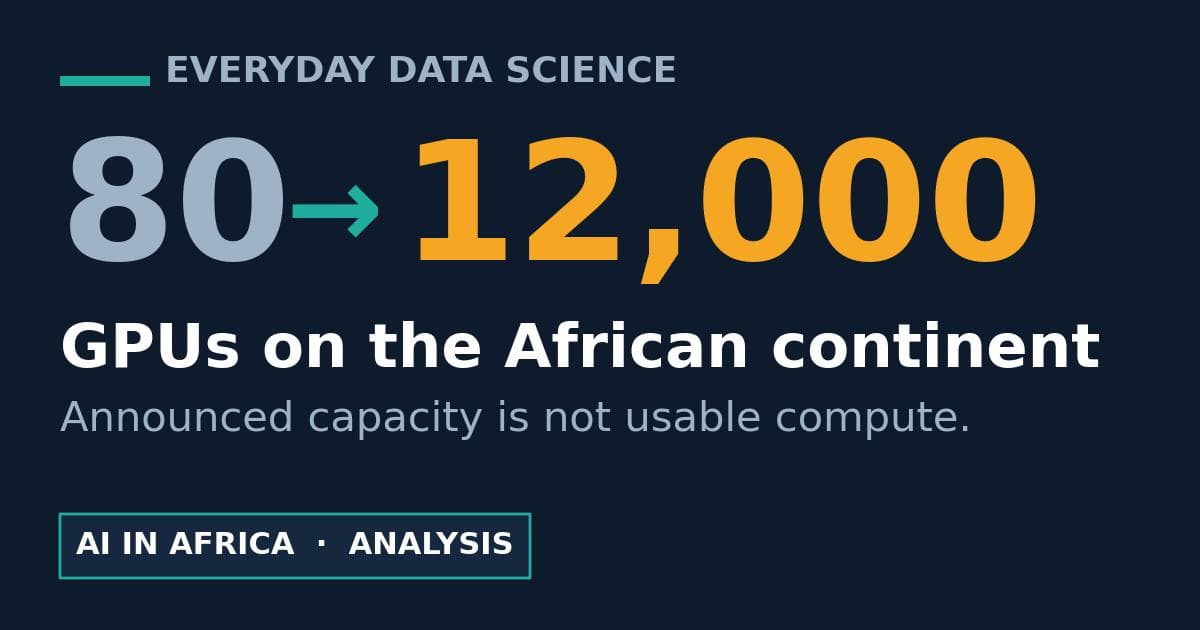
At AfricaCom 2025 in Cape Town, Strive Masiyiwa told a story about a trip to Silicon Valley. He had gone to meet Nvidia CEO Jensen Huang to talk about compute for Africa. According to Masiyiwa, Nvidia's team told him there were only 80 GPUs on the entire African continent. His answer: "I told Mr Huang, I wanted 12,000."
Twelve thousand GPUs are now being distributed across five Cassava sites in South Africa, Nigeria, Kenya, Egypt and Morocco. Cassava has become Nvidia's first preferred cloud partner in Africa. In November 2025 it launched the continent's first GPU-as-a-service offering built on Nvidia hardware.
That is the most concrete step yet in a buildout that has been gathering speed for two years. Whether it changes anything for the people actually training models on the continent depends on a harder question: the gap between announced capacity and usable compute.
What is actually being built
The list of commitments is long, and the cheques are large:
- Cassava Technologies committed $720 million with Nvidia to build what it calls Africa's first AI factory, with the South Africa deployment live and expansion planned for Egypt, Kenya, Morocco and Nigeria. Its CAIMEx platform gives developers unified access to models and tooling, with stated plans to support AI development in African languages starting with Swahili and expanding to Zulu and Afrikaans.
- Microsoft announced another $329 million for its South Africa data centre operations in April 2026, on top of a previous $1.2 billion commitment to the country. Separately, Microsoft and G42 committed $1 billion to a geothermal-powered data centre in Kenya that anchors a new East Africa Azure region.
- Google opened its first African cloud region in Johannesburg. AWS has operated its Cape Town region since 2020.
- Teraco, one of the continent's largest independent operators, is building four new facilities backed by almost $900 million, and started construction of a 120 MW solar plant in the Free State to power its data centres, with commercial operation targeted for 2026.
The Atlantic Council's interim "Unlocking Compute in Africa" report catalogues the same momentum, and adds a smaller but telling data point: Udu Technologies went live with the first dedicated GPUs explicitly for rent and purchase by AI researchers in Africa.
This is real money and real concrete. It is also worth keeping in proportion. Africa accounts for roughly 1% of global digital infrastructure while holding about 20% of the world's population, according to Turner & Townsend's industry analysis. The buildout starts from a base so small that twelve thousand GPUs spread across five countries is modest next to the clusters where frontier models are trained.
The gap the announcements do not close
Four constraints decide whether a GPU in a Johannesburg data centre becomes usable compute for a builder in Lagos, Nairobi or Accra. None of them is solved by a press release.
1. Power. AI data centres are power-hungry in a way that collides directly with African grids. Turner & Townsend's analysts flag power availability as a critical barrier, with grid connection lead times and competition for power adding pressure. Teraco building its own 120 MW solar farm is not a sustainability flourish. It is what you do when you cannot assume the grid will be there.
2. Price and access. A GPU-as-a-service menu existing is not the same as a startup being able to afford it. Cassava says its model will democratize access and lower AI development costs, and the logic is sound: local compute should beat renting in Virginia once you count data transfer and latency. But published, transparent pricing for African GPUaaS is still thin, and until builders can compare a per-hour price in Johannesburg against one in Ohio, "democratize" is a promise, not a fact.
3. Skills. Twelve thousand GPUs need people who can run distributed training, and the talent pipeline is the slowest thing to build in this stack. The compute announcements keep arriving with training pledges attached, Microsoft's million-South-Africans skilling commitment for instance, which tells you the hyperscalers know the hardware is the easy part.
4. Where the models get built. Compute without local model development just makes Africa a cheaper place to run inference on other people's models. Cassava's language plans, Swahili first, then Zulu and Afrikaans, and its CAIMEx exchange are the interesting part of the story for exactly this reason: the bet is not just on hosting, but on African developers fine-tuning and deploying with regional data and languages.
What this means for data and AI practitioners
If you build in Africa, the practical read is narrower than the headlines:
- Fine-tuning locally is about to become plausible. The workloads that matter most for African use cases, adapting models to local languages, accents, agricultural conditions and clinical settings, do not need frontier-scale clusters. They need reliable access to tens of GPUs with local data residency. That is precisely what the Cassava buildout targets.
- Data sovereignty stops being theoretical. Regulated sectors like health, finance and government have had a real reason to keep workloads offshore or on-prem: there was nowhere compliant to put them. In-country GPU capacity plus policies like South Africa's National Data and Cloud Policy, which mandates domestic storage for sensitive public-sector data, change the default answer.
- Latency-sensitive products get simpler. Voice interfaces, the actual product surface for millions of African users, are latency-sensitive. Local inference trims the round trip to Europe or the US. For the Krio, Swahili and Yoruba voice products people are building, that is a product difference, not an infrastructure footnote.
- Price-check everything. Until transparent per-hour pricing exists for on-continent GPU rental, benchmark every "local is cheaper" claim against your current provider, all-in. Announcements do not invoice.
In favour
Compute was the binding constraint, and binding constraints are worth attacking first. You cannot train people on hardware that does not exist, and you cannot keep data in-country without somewhere to put it. The direction of travel is right, the money is real, and the Nvidia partnership gives the buildout a credibility that press-release data centres often lack.
Against
Announced GPUs are not operational GPUs, and operational GPUs are not affordable GPUs. The five-country footprint still leaves most of the continent's 54 countries untouched. Power remains the unglamorous veto on the whole project. And the history of African tech infrastructure is full of ribbon-cuttings that never became ecosystems.
What would make me wrong
Three things would falsify the skeptical half of this piece within eighteen months: published per-hour GPU pricing from at least two on-continent providers that undercuts US and EU cloud pricing all-in; a documented case of an African startup training or substantially fine-tuning a production model on in-country GPUs; and utilization data showing the new capacity actually filling up rather than sitting as prestige infrastructure. If all three appear, the bottleneck really was hardware, and I will say so.
Sources
- Gadget, Africa Tech Festival: Cassava reveals AI factory plans (AfricaCom 2025)
- BusinessDay, Strive Masiyiwa's Cassava pushes AI factory investment
- iAfrica, Cassava Technologies Deploys AI Factory in South Africa
- Connecting Africa, Cassava Technologies, AXON Networks to co-develop OaaS platform
- Atlantic Council, Unlocking Compute in Africa interim report, June 2025
- edgen.tech, Microsoft Invests $329 Million to Expand AI Data Center Footprint
- TechRadar, Microsoft and G42 are building a $1 billion data center in Africa powered by geothermal energy
- Wesgro, Overview of the Global and African Data Centre Landscape (April 2026)
- Property Review / Turner & Townsend, Power constraints threaten global data centre expansion
What is the first workload you would move onto African GPUs if the price were right, and what is stopping you today?
About the writer
Data Scientist & AI Researcher
Data scientist and AI researcher at Pace University. I coined Artificial Frictional Unemployment, and built the first machine learning model for crop yield prediction in Sierra Leone. Author of Understanding Agentic AI. I write about agentic systems and applied ML, with a bias toward what actually works, and who gets left out when it doesn't.
Found this useful? Passing it on to someone who builds is the best way to help the publication grow.
Built something worth sharing? Write it up for us →