A $1 Billion AI Data Centre Is Coming to Egypt. The Telcos Are Now Africa's Compute Builders.
On November 10, Vodacom confirmed a $1 billion sovereign AI data centre in Egypt with Cassava Technologies and Elsewedy Electric, the first phase delivering 20 megawatts within three years. The same week brought a rival move from MTN, a Zambian AI data centre courting Chinese backing, a four-month slip in South Africa's AI policy, and a Google.org programme to train 30,000 students. The builders have changed. The open questions have not.
 Ibrahim Denis FofanahData Scientist & AI Researcher12 min read·Building AI in Africa · News
For two years, Africa's AI compute story has been told by governments and development banks. The World Bank, the African Development Bank and UNDP announced shared-compute plans in October. Korea lent Tanzania $170 million for an AI education centre last week. Now the telecom operators have stepped in, and they are moving faster than the planners.
On November 10, Vodacom disclosed in its interim results that it will build what the partners describe as Egypt's largest data centre and its first sovereign AI data centre, together with Cassava Technologies and Elsewedy Electric. Vodacom Group chief executive Shameel Joosub put the total cost at about $1 billion over the next couple of years, with Vodacom-controlled Vodafone Egypt holding about 30 percent of the venture. The shares rose nearly 5 percent in Johannesburg trading on the news.
The announcement matters for a simple reason. Africa holds under 1 percent of global data centre capacity, despite having the world's fastest-growing and youngest population. Every AI workload an African company runs today mostly runs somewhere else. The companies that own the networks, the enterprise customers and the billing relationships are now the ones building the capacity. That changes who decides what gets built, and for whom.
The Egypt deal: $1 billion, staged, and one-third Vodacom's
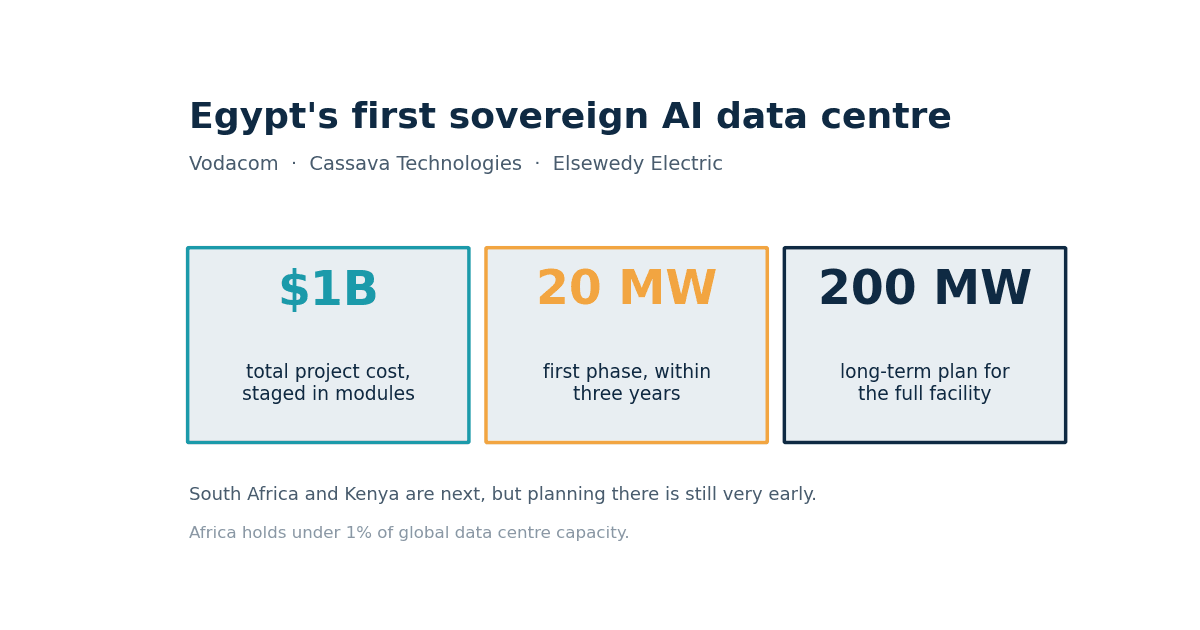
The headline number needs reading carefully, because Joosub was careful about it himself. The $1 billion is the total cost of the project, not Vodafone Egypt's share, and it will not all be spent upfront. The facility will be built in modules, with capacity added as demand materialises. "The number is big, but it won't be $1-billion immediately," he said. "You roll it out as you need to."
The first phase is expected to attract about $200 million in foreign direct investment and deliver 20 megawatts of capacity within three years. The longer-term plan is to expand the facility to 200 megawatts. That tenfold gap between phase one and the full build-out is the honest part of the announcement. It says the partners are committing to a site and a structure, not to a finished 200-megawatt facility on day one.
Each partner brings something the others do not have. Vodacom brings the telecom network and the enterprise customer base that will buy the capacity. Elsewedy Electric, an Egyptian cables, electrical equipment and energy infrastructure group, brings the engineering and the power work. Cassava brings data centre operations and AI computing experience, plus its Nvidia relationship. Cassava said in April 2025 that it planned to build what it called Africa's first AI factory with Nvidia, and named Egypt as one of five countries for the roll-out. It is also working on a plan to deploy 12,000 Nvidia GPUs across South Africa, Egypt, Kenya, Morocco and Nigeria, valued at up to $720 million.
Egypt is the first of what Joosub sees as three regional hubs. "Ideally, we look at South Africa, Kenya and Egypt as the three big markets," he said, with smaller data centres in Vodacom's other markets. Planning for South Africa and Kenya is still very early. Vodacom already runs data centres in its markets, but they were not built for hyperscalers, the big cloud and AI providers. Any new builds would follow the Egyptian model: secure the property, then build in stages as demand grows. "Most important is to make sure you've got the power."
The reliance on partners is not a preference. It is a balance-sheet fact. Vodacom's net debt rose by R78.8 billion to R135.6 billion in the year to September, after absorbing the Safaricom deal, and Joosub said the group is "not looking at anything" major in mergers and acquisitions. For infrastructure such as fibre, towers and data centres, Vodacom is looking at "more co-builds going forward, so off-balance-sheet-type stuff", bringing in partners "because we just don't have the money to do everything".
That constraint is also why the deal is credible. Vodacom is not announcing a vanity project. Vodafone Egypt is one of the group's biggest growth engines. Its service revenue rose 36.3 percent in local currency in the six months to September 30, and it contributed 24.8 percent of group service revenue and R11 billion of group earnings before interest, tax, depreciation and amortisation. The company that sells the capacity is also the company that owns a third of it.
The rival: MTN is building too
Vodacom is not alone. Its domestic rival MTN Group has also entered the AI data centre business, partnering with a Middle Eastern investment platform founded by Tarek Al Ashram to build AI data centres in Nigeria and South Africa. The move was reported by Bloomberg on the same day as Vodacom's announcement.
Two rival telecom operators building AI data centres in the same markets is a different competitive shape from the one Africa has seen so far. The earlier wave was led by specialist data centre operators and hyperscalers. The telcos bring something those builders do not: millions of existing enterprise relationships, billing systems that already work in local currency, and fibre networks that already reach the customers. If the capacity is real, the telcos can sell it faster than anyone else.
The risk runs the other way too. Two operators building in the same three markets can easily produce duplicated capacity in Johannesburg, Lagos and Cairo while the rest of the continent stays dark. The test is not who announces first. It is who signs paying customers, and where.
Zambia wants in, with Huawei in the room
The same week, Zambia moved to join the same race from a very different starting point. The country is seeking Chinese backing for a national AI data centre that would bring advanced computing power onshore, supporting copper mining and agriculture alongside public administration. Zambia's existing infrastructure centres on data storage. It lacks the processing capacity needed to train and run AI systems at scale.
Huawei is among the Chinese firms under consideration for the project. On November 2, Huawei Technologies Zambia and the Smart Zambia Institute launched a five-day AI training programme for public-sector officials, covering national AI strategy, large language models, AI-powered data centres and prompt engineering. The training signals that Zambia is building state capacity ahead of any infrastructure rollout.
Mining offers the clearest commercial case. AI-assisted mineral exploration could identify copper and cobalt deposits faster and at lower cost, and Zambia ranks among Africa's top copper producers. Agriculture is the second market, with AI systems assisting everything from crop selection through to yield management.
What Zambia does not have yet is the deal itself. No cost, no timeline and no named backer have been published. The government is preparing AI guidelines, which must align with existing cyber security and personal data protection laws. Three factors will determine whether the facility ever gets built: financing, reliable electricity and a skilled workforce. Without sustained domestic demand from government agencies and private users, utilisation rates will constrain returns.
The policy lag: South Africa's AI policy slips four months
While the builders move, the rule-makers are moving slower. On October 29, Jeanette Morwane, project manager for South Africa's national AI policy, set out a revised timetable. The drafting team must submit a revised policy and discussion document to Communications Minister Solly Malatsi by November 30. Cabinet is due to approve the policy in March 2027.
In May, the government had given Parliament November 2026 as the Cabinet date. The new date is four months later. Morwane said the team is "working really under pressure."
The delay matters because the policy is supposed to answer the questions the builders are already deciding on their own: who owns the data, where it must sit, and what counts as sovereign. A $1 billion data centre in Egypt and a policy that arrives in March 2027 are on different clocks. The builders are not waiting.
The skills counterweight: 30,000 students, four countries
The week's most concrete delivery was not a data centre at all. It was a classroom. On November 9, South Africa launched the AI Research Foundations programme at the Biomedical Research Institute on Stellenbosch University's Tygerberg campus in Cape Town, the start of a five-day training workshop for university lecturers and researchers.
The programme, known as AIRF, is backed by Google.org and aims to reach 30 universities and about 30,000 students across four African countries: South Africa, Ghana, Kenya and Nigeria. South Africa will have ten participating universities. Nigeria's FATE Foundation is the main grant holder, and the African Institute for Mathematical Sciences South Africa is the academic implementation partner. Google DeepMind developed the curriculum, and University College London contributed teaching expertise.
Unlike introductory AI programmes, AIRF teaches advanced material: deep learning, neural networks, generative language models and transformer technology, with practical experience building and fine-tuning language models and training in responsible AI. The courses are free on Google Skills. The model is train the trainer: lecturers learn the material, then introduce it at their own universities and supervise student research projects. The Stellenbosch workshop is one of four planned training activities in South Africa, following similar in-person initiatives in Ghana, Nigeria and Kenya.
It is worth putting the two numbers side by side. The Egypt data centre is about $1 billion of hardware. AIRF is about 30,000 students learning to build models. One without the other is a building with no one to use it, or a workforce with nowhere to run its work. The week delivered both, from different actors, with no coordination between them.
Five things to watch
- A named customer for the Egypt facility. The first real proof is not a foundation stone. It is a signed enterprise or government customer buying capacity. Watch for Vodafone Egypt announcing one.
- The 20-megawatt phase one, on a date. The first phase is promised within three years, at about $200 million. Any slip past 2029, or any quiet cut to the megawatt figure, tells you demand did not materialise.
- MTN's named partners and sites. MTN has announced a partnership but not the details. Named investors, named locations and a construction start date are the next checkpoints.
- South Africa's November 30 submission. The revised policy and discussion document is due to the minister by November 30. A missed date pushes Cabinet past March 2027.
- AIRF's first student numbers. The programme targets 30,000 students. The first real figure to watch is how many lecturers complete the training and how many universities actually teach the curriculum in 2027.
In favour
The telco entry is the strongest signal yet that African AI compute has a business model, not just a development case. Vodacom and MTN have the customers, the billing and the fibre. Cassava has the Nvidia relationship and the operating experience. The staged, modular build is the right structure for a market where demand is real but unproven. And the AIRF programme attacks the other half of the problem at the same time: 30,000 students is a serious number, and train the trainer is the only model that scales across 30 universities.
Against
Three of the five stories this week are announcements with no money committed yet. Vodacom's $1 billion is a total project cost spread over years, with only the first $200 million phase described in any detail. MTN has named a partner platform but no figures at all. Zambia has no backer, no cost and no date. South Africa's policy slipped four months while the builders moved ahead without it. And the concentration risk is real: Egypt, South Africa, Kenya and Nigeria keep getting the announcements, while the rest of the continent gets the press releases about them.
What would make me wrong
If Vodafone Egypt signs a named anchor customer and breaks ground on the first 20-megawatt phase within twelve months, the sceptical reading of this announcement is wrong and the telco model is working. If MTN names its investors and sites before the end of the year, the competition is real rather than positional. If Zambia publishes financing terms and a construction date, the Huawei courtship was a negotiation, not a wish. If South Africa's policy reaches the minister by November 30 and Cabinet by March 2027, the four-month slip was a delay, not a drift. If AIRF publishes how many lecturers completed training and how many universities adopted the curriculum in 2027, the skills half of the story is real. If none of those things happen, this week was a press-release week, and the compute gap is exactly where it was.
Sources
- TechCentral: Vodacom eyes SA and Kenya for AI data centre hubs after Egypt
- Billionaires.Africa: Strive Masiyiwa expands AI data centre ambitions
- Bloomberg via Economy24: Vodacom aims for partnerships to build AI data centers throughout Africa
- FurtherAfrica: Zambia AI data centre courts Chinese backing for mining
- Innovation Village: AI Africa Intelligence, October 22 to November 4, 2026
- SA Varsity Newz: South Africa launches pan-African initiative to expand advanced AI education
Related on Everyday Data Science
- Korea Just Lent Tanzania $170 Million for AI. The Real Test Is Who Gets to Use It.
- Three Plans to Share Africa's AI Computing Power Landed in Six Days. The Hard Numbers Are Still Missing.
- Sovereign AI Got Hardware This Week: Two Deals, Two Very Different Tests
The telcos now own the build. Who owns the use?
East Africa Just Approved a Shared AI Module for Every Degree. Adoption Is Still Voluntary.
Next →Sunflower V2 Covers 67 African Languages. The Speech Results Are the Real Story.
About the writer
Data Scientist & AI Researcher
Data scientist and AI researcher at Pace University. I coined Artificial Frictional Unemployment, and built the first machine learning model for crop yield prediction in Sierra Leone. Author of Understanding Agentic AI. I write about agentic systems and applied ML, with a bias toward what actually works, and who gets left out when it doesn't.
Found this useful? Passing it on to someone who builds is the best way to help the publication grow.
Built something worth sharing? Write it up for us →