Africa's AI Fortnight Was About Small Models and Speech Data. That Is the Point.
Between October 1 and 13, the World Bank urged low-cost AI, a 1.5-billion-parameter model for 12 African languages shipped, Togo started paying people to record Ewe, Kabiye and Moba, and Nigeria set a 200MW data centre target it cannot meet without power.
 Ibrahim Denis FofanahData Scientist & AI Researcher9 min read·Building AI in Africa · News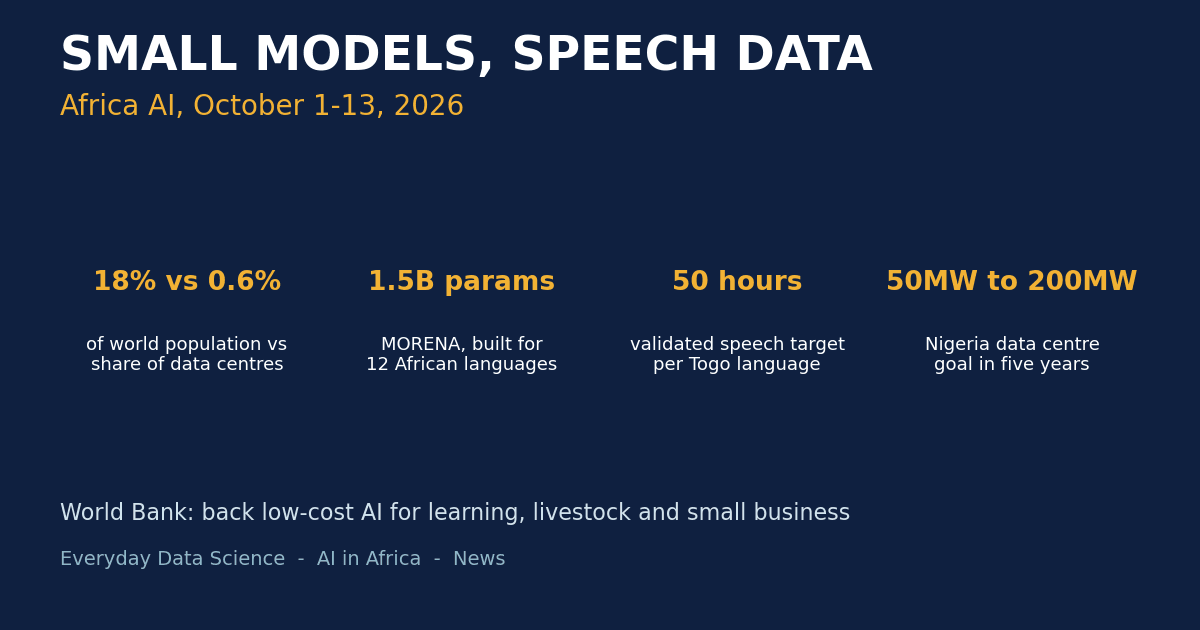
Africa holds 18% of the world's population and 0.6% of its data centre capacity. That single gap explains most of what happened in African AI between October 1 and 13, and it shaped the World Bank's advice when it published its Africa Economic Update on October 6.
The Bank raised its 2026 growth forecast for the region to 4.3%, up from 4.1% in April. Andrew Dabalen, its chief economist for Africa, urged governments to back low-cost AI that solves everyday problems, naming tools for student learning, livestock disease detection and small-business accounting. The Bank also recommended shared data centres and stronger data protection laws to speed adoption.
That advice is easy to nod at and hard to act on. Low-cost AI still needs three things most markets on the continent are short of: data in local languages, compute close to users, and steady electricity. The rest of the fortnight was, in effect, a set of attempts on each of those three.
A 1.5-billion-parameter bet on African languages
In South Africa, Vambo AI released MORENA, a 1.5-billion-parameter open-weight model built from scratch for 12 African languages, as well as English and French. The company says the model processes African languages more efficiently, which makes it cheaper to run and adapt, and one report of the launch said it claims to outperform a Google model eight times its size.
Read that claim the way you would read any launch claim. Innovation Village, in its October 1 to 13 roundup, noted plainly that the company has not yet published its licence terms or benchmark results. Until both appear, MORENA is a promising release, not a proven one. A small model that is cheap to fine-tune matters only if independent tests show it holds up on real tasks in the languages it claims to serve, and if the licence actually lets local teams build commercial products on it.
The direction is still right. A 1.5-billion-parameter model can run on modest hardware, be adapted by a small team, and be audited in a way a closed frontier model cannot. For a school, a clinic or a local government service working in a language that large models handle poorly, that trade is often the correct one.
Togo is paying for speech, not scraping it
Togo began collecting data for AI in its national languages on October 2. Through the Voix du Togo platform, paid contributors record, transcribe and translate phrases in Ewe, Kabiye and Moba. The target is 50 hours of validated speech and 6,000 translated sentence pairs per language, with plans to cover about 50 languages over time.
Fifty hours sounds small next to the corpora behind large commercial models. For a language with almost no validated speech data at all, 50 clean hours and 6,000 checked sentence pairs is a starting asset that researchers can actually build on. The payment detail matters too. Contributors are paid, and the work is recorded, transcribed and translated by people who speak the languages, which is how you get data you can trust later.
Voice data is also a business, and it sells outward
Ocular AI, founded by Zimbabweans Michael Moyo and Louis Murerwa, raised $2 million in pre-seed funding led by Drive Capital, with Y Combinator among the backers. The company does not build consumer apps. It sells voice datasets and model evaluations to large AI labs.
That is a real business, and it proves the market value of African speech data. It also raises the question practitioners should ask of every data deal: who keeps the long-term value? Selling datasets to large labs brings revenue and skills home now. It does not, on its own, guarantee that the models trained on that data will serve the languages the data came from, or that local teams will get access on workable terms. Both things can be true at once: the deal can be good for the company and incomplete for the ecosystem.
Nigeria named the constraint out loud
In Nigeria, APC national chairman Nentawe Yilwatda set out a goal to grow the country's data centre capacity from about 50MW to 200MW within five years. A separate report put a target of $750 million in private cloud infrastructure investment over 24 months alongside it. He cautioned that the target depends on power supply, in words worth quoting exactly: "An AI strategy without an energy strategy is incomplete."
That sentence should be printed on every national AI strategy on the continent. Models, datasets and training programmes all assume electricity that stays on and compute that a local team can afford. Shared data centres, as the World Bank recommended, only help if they are powered, connected and priced for local use, not just announced.
Morocco offered a quieter proof that applied AI already pays in government work. Its customs authority has used AI risk-analysis tools to audit imports worth about 650 million dirhams, roughly $65 million, and recover nearly 50 million dirhams, roughly $5 million, in duties and fines, according to sources familiar with the matter. No official statement has been released, so treat the figures as reported, not confirmed. The shape of the use case is still instructive: narrow, high-volume, with a clear financial return.
Ghana, in the same period, introduced mandatory centralised technical reviews for all government AI acquisitions, aimed at data sovereignty, cybersecurity and preventing vendor lock-in, while its One Million Coders Programme passed 141,950 registrations. Governance of buying may sound dull next to model launches. It decides whether public money buys tools the country can control or contracts it cannot leave.
What this means for data and AI practitioners
- Build for the 1.5-billion-parameter class first. If your users work in African languages on limited hardware, a small model you can fine-tune, test and run cheaply will beat a large model you can only call through an API you do not control.
- Treat language data as an asset with terms. Before you collect, sell or share speech or text data, write down who can use it, for what, and whether local teams keep access. Togo's paid, validated model and Ocular AI's commercial model are two different answers. Know which one you are signing.
- Ask for benchmarks before you adopt. MORENA may prove excellent. The correct response to an unpublished benchmark is to wait, or to run your own small evaluation on your own tasks and publish what you find.
- Put power and price in the project plan. If a proposal has no line for electricity, connectivity and per-request cost, it has no deployment plan, whatever the model scores.
- Watch government buying rules. Ghana's central review and Morocco's customs work show where steady, funded demand for applied AI skills is forming: procurement, audit, risk analysis and public services.
Against
The low-cost framing can become an excuse to give African users second-tier tools while wealthy markets get the best systems. Shared infrastructure has been recommended for years and delivery has lagged announcements before, Nigeria's own capacity target included. And dataset businesses that sell outward can repeat an old pattern in a new form: raw material leaves, finished value returns at a price.
In favour
The fortnight's work was concrete in a way strategy documents often are not. A model shipped. A national data collection programme started with named languages, paid contributors and numeric targets. A data company raised money from serious backers. A senior Nigerian political figure tied AI ambition to power supply in public. Those are checkable facts, and checkable work is what compounds.
What would make me wrong
- If Vambo AI publishes full benchmarks and a permissive licence and MORENA still sees little adoption by local teams, the constraint is distribution and skills, not model size or language coverage, and this reading overweights the model.
- If Togo's Voix du Togo data is not released in a form researchers and local builders can use, the programme is collection without access, and the public-work framing fails.
- If Nigeria reaches anything close to 200MW on schedule with reliable power, the energy caution in this piece was too pessimistic.
- If large frontier models close the African-language quality gap quickly and cheaply through APIs, the case for building small local models weakens, and effort should shift to evaluation and access instead.
Sources
- Innovation Village, AI Africa Intelligence, October 1 to 13, 2026, Vol. 26
- Africa AI News, Vambo AI releases language model; Nigeria targets 200MW, October 9, 2026
Related on Everyday Data Science:
- African-language AI is a data-pipeline problem
- Africa's 12,000 GPUs and the compute gap
- UNDP and GSMA partner on African-language AI
If you are building in an African language today, what is your binding constraint in practice: data you can trust, compute you can afford, power you can rely on, or a model that actually performs in your language?
About the writer
Data Scientist & AI Researcher
Data scientist and AI researcher at Pace University. I coined Artificial Frictional Unemployment, and built the first machine learning model for crop yield prediction in Sierra Leone. Author of Understanding Agentic AI. I write about agentic systems and applied ML, with a bias toward what actually works, and who gets left out when it doesn't.
Found this useful? Passing it on to someone who builds is the best way to help the publication grow.
Built something worth sharing? Write it up for us →