Sunflower V2 Covers 67 African Languages. The Speech Results Are the Real Story.
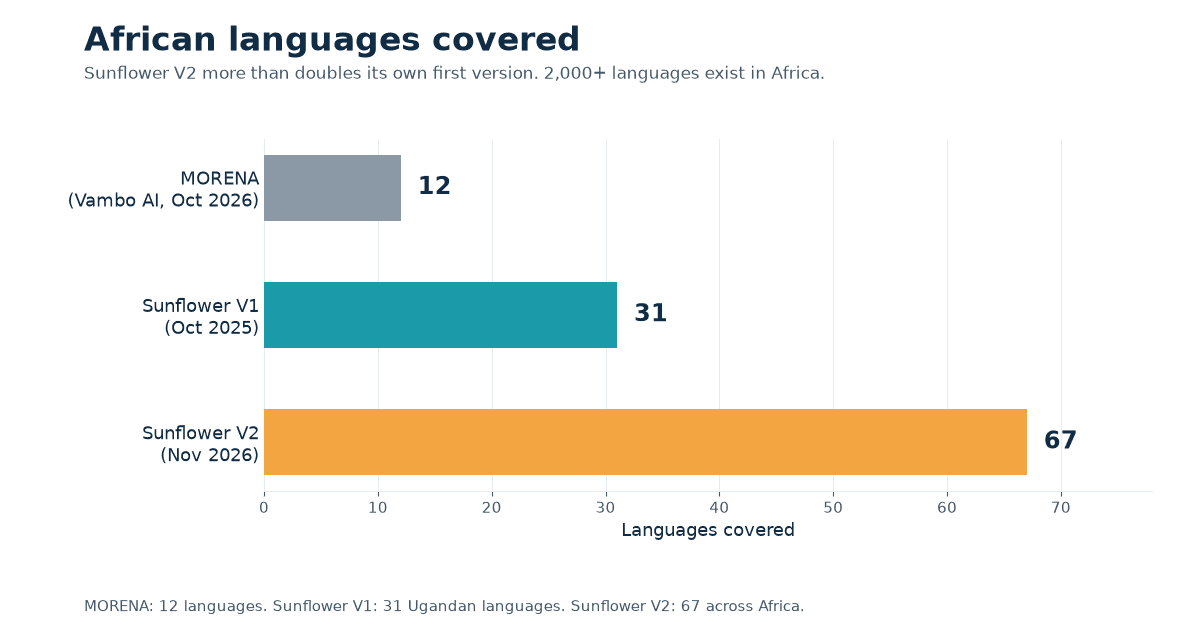
Uganda's Sunbird AI took Sunflower from 31 Ugandan languages to 67 across Africa, added speech recognition for 51 languages and text-to-speech for 20, and shipped a lightweight version that runs on a mid-range phone. The coverage number is the headline. The word error rates are the evidence.
 Ibrahim Denis FofanahData Scientist & AI Researcher9 min read·Building AI in Africa · News
:::tip TL;DR: Sunbird AI's Sunflower V2 expands from 31 Ugandan languages to 67 across Africa, adds speech recognition for 51 languages and text-to-speech for 20, and runs a lightweight model on mid-range phones. Its speech model posts a 0.227 macro word error rate on AfriVox-v2, the best published number on that benchmark. Coverage is moving fast. A separate benchmark published the same week says no model scores above 31% on Nigerian facts, so the knowledge gap is now the binding constraint, not the language list. :::
One year, 31 languages to 67
Sunflower launched on October 11, 2025, in Kampala, unveiled by Dr. Aminah Zawedde, Permanent Secretary of Uganda's Ministry of ICT and National Guidance. The first version covered 31 Ugandan languages on Qwen 3 bases of 14B and 32B parameters, and the team published the method as a paper at the AI for African Languages Conference. A year later, the second version roughly doubles the language count and adds speech in both directions.
The announcement, reported by ITWeb's Brainstorm on November 2, has three parts: text models covering 67 African languages, a speech recognition model for 51 languages, and a text-to-speech model for 20 languages. The lightweight model runs on mid-range smartphones, which is the detail that matters most for deployment, since most African users reach AI on a phone, not a GPU server.
Sunflower started as a regional project with a regional argument. The paper behind version one says it plainly: more than 2,000 living languages exist in Africa, and the leading models prioritize the languages with the largest speaker populations, leaving the rest behind. A regionally focused builder, the argument goes, can cover a country's languages better than a global lab that treats them as a rounding error. Version two tests that argument at continental scale.
What V2 actually ships
The Hugging Face collection lists the pieces. The text models are Sunflower-Qwen3.5-9B, covering 67 African languages, and Sunflower-Qwen3.8-27B, whose card lists 68 languages with the deepest coverage of the 31 languages of Uganda. A Gemma-based model sits in the same collection, also covering 67 languages. SunflowerASR handles speech recognition for 51 languages. A text-to-speech model covers 20 languages, though the announcement does not name which 20.
The headline translation claim on the 27B card is bold: it calls itself the strongest open-weight model available for translation between English and African languages, says it matches Gemini 3.1 Pro when translating into African languages, and says it beats GPT-5.1 and Claude Sonnet 4.5 by a wide margin. The 9B card reports chrF 45.8 across the 68 languages, ahead of every other open model. On the SAHARA evaluation server, which runs 18 tasks in four clusters, Sunflower-27B is the top open-weight model on the board and sixth overall, behind five closed models.
Read those numbers the way the card itself invites you to: every score comes from Sunbird's public evaluation code, with the same sentences, prompts and output budgets for every model. That is better than a closed benchmark, and it is still the builder grading its own homework. Independent replication is the missing piece.
The speech numbers
The strongest evidence in this release is not the language count. It is the speech paper. SunflowerASR, described in arXiv:2610.30663 by Hu, Ouma, Akera and Quinn at Sunbird AI, takes Whisper-large-v3 (1.55B parameters), fine-tunes it on 7,412 hours of African speech, then runs a reinforcement learning pass with Group Relative Policy Optimisation that optimizes character error rate directly. The training corpus combines 110 dataset subsets across 51 languages, with per-language data ranging from 5.2 hours for Ruruuli to 1,392 hours for Kinyarwanda.
| Benchmark | Macro WER | What it covers |
|---|---|---|
| Sunbird Speech Benchmark (own) | 0.293 | All 51 languages |
| AfriVox-v2 | 0.227 | 14 languages scored, 111,051 clips, in-the-wild speech |
| SimbaBench | 0.372 | 19 languages in common |
The paper reports the best published macro-averaged word error rate on both independent benchmarks, AfriVox-v2 and SimbaBench. SunflowerASR has the lowest word error rate on 30 of the 51 languages and the lowest character error rate on 34. The model is public on Hugging Face.
Two honest readings belong in the same paragraph. First, 0.227 on AfriVox-v2 means roughly one word in four is wrong on spontaneous, in-the-wild speech across health, finance, government and agriculture domains. That is the best published number on that benchmark, and it is still a long way from the sub-5% error rates English speech recognition posts on clean read speech. Second, the per-language spread matters more than the average. Best on 30 of 51 languages means 21 languages where something else wins. If you build for a specific language, check its number before you build on it.
:::note The data range is the story behind the average. Ruruuli had 5.2 hours of training data. Kinyarwanda had 1,392. The paper finds the reinforcement learning gains are largest exactly where training data is scarcest and audio is noisiest, which is the realistic case for most African languages. :::
Why a regional builder matters
Compare this with the last African-language release covered here. Vambo AI's MORENA, a 1.5-billion-parameter model built from scratch for 12 African languages, shipped in October. Sunflower V2 covers more than five times as many languages, adds speech in both directions, and ships a phone-runnable version. The two releases are not competitors in any serious sense. Together they show a pattern: African teams are building the language layer themselves, in the open, instead of waiting for a global lab to add their language to a roadmap.
Three things make this release different from a press release with a big number attached. The weights are public. The evaluation code is public. And the speech model comes with a peer-reviewed style paper that names its training data, its method and its per-language limits. That is the standard every African-language release should be held to, and it is the standard this site has asked for since the MORENA story.
The counterweight: coverage is up, knowledge is not
The same week Sunflower V2 was reported, a new benchmark landed that reframes the whole story. NaijaFacts (arXiv:2611.06504, submitted November 4, 2026) asks 100 factual questions about Nigeria, authored by native speakers and grounded in official statistics, in five languages: English, Nigerian Pidgin, Yoruba, Igbo and Hausa. Each question is asked about three countries, giving 1,500 graded items per model. Across eight frontier and Nigeria-adapted models, the knowledge effect dominates the language effect. English-query accuracy is 49 to 50% for the US and UK but 20% for Nigeria. The strongest models reach 66 to 79% on the UK and the US, but none exceeds 31% on Nigerian statistics. Extending to all 54 African countries with the best frontier model shows the same profile continent-wide: 96% on culture and 98% on politics against 26% on statistics.
The implication is direct. Sunflower V2 solves the "can the model hear and speak my language" problem better than anything before it. It does not solve the "does the model know anything about my country" problem. A model that transcribes Yoruba flawlessly and then states the wrong Nigerian population figure is still wrong, and it is wrong in Yoruba now.
:::warning Vendor claims in this piece: the translation comparisons (matches Gemini 3.1 Pro, beats GPT-5.1 and Claude Sonnet 4.5) and the "outperform ChatGPT and Gemini 2.5 Pro" line from the ITWeb report all come from Sunbird or its own evaluation code. Treat them as a claim to replicate, not a result. The speech numbers are stronger evidence because they are published in a paper with named benchmarks and per-language tables. :::
Five things to watch
- Per-language word error rates, not the macro average. SunflowerASR leads on 30 of 51 languages. Your language may be one of the other 21.
- Whether the lightweight phone model covers all 67 languages or a subset. The announcement does not say, and a phone model that only speaks five languages is a different product.
- Independent replication of the translation claims. A lab with no connection to Sunbird running the same evaluation code would settle the Gemini and GPT-5.1 comparisons.
- Text-to-speech quality in the 20 languages. A TTS model with no published intelligibility scores is a press release, not a product.
- Whether knowledge benchmarks move. The next Sunflower release that pairs 67 languages with African factual knowledge would be a bigger story than this one.
In favour
The release is open in the ways that matter: public weights, public evaluation code, a paper with per-language tables. The speech results are the best published numbers on two independent benchmarks, and the method (reinforcement learning on character error rate) targets exactly the failure mode that hurts low-resource languages most. A phone-runnable model points at real deployment instead of demo screenshots. The regional-builder pattern is now two releases deep, not one.
Against
The translation claims are self-graded. The 67 versus 68 language count differs between the announcement and the 27B model card, which is a small inconsistency but the kind that should not exist in a launch. The TTS model ships without published quality numbers. The knowledge gap documented by NaijaFacts is untouched by this release. And 0.227 word error on in-the-wild speech, best published or not, is still one word in four wrong.
What would make me wrong
If an independent lab reproduces the translation scores and the Gemini comparison holds, the vendor-claim warning above was too cautious. If the phone model turns out to cover only a handful of languages, the deployment story is weaker than this piece assumes. If the next Sunflower release pairs the 67 languages with African factual knowledge and NaijaFacts-style scores jump above 50%, the knowledge gap framing in this piece becomes outdated. If per-language word error rates show the gains concentrated in the best-resourced languages, the headline average is flattering the release.
Sources
- ITWeb Brainstorm: Translation takes wing with new Sunbird AI model
- Sunflower collection on Hugging Face
- SunflowerASR model card: speech recognition for 51 African languages
- SunflowerASR paper, arXiv:2610.30663
- NaijaFacts, arXiv:2611.06504
- Sunflower paper, Proceedings of Machine Learning Research 314
- Uganda Ministry of ICT: Sunflower launch, October 11, 2025
Related on Everyday Data Science
- Africa's AI Fortnight Was About Small Models and Speech Data. That Is the Point.
- The Press Releases Promise African-Language AI. The Data Pipeline Is the Real Product.
- Sovereign AI Got Hardware This Week: Two Deals, Two Very Different Tests
If you build for African users, which matters more to your next project: one more language on the list, or one factual question the model finally gets right?
A 125M-Parameter Model for 11 Languages Is Not a Small Story
Next →East Africa Just Approved a Shared AI Module for Every Degree. Adoption Is Still Voluntary.
About the writer
Data Scientist & AI Researcher
Data scientist and AI researcher at Pace University. I coined Artificial Frictional Unemployment, and built the first machine learning model for crop yield prediction in Sierra Leone. Author of Understanding Agentic AI. I write about agentic systems and applied ML, with a bias toward what actually works, and who gets left out when it doesn't.
Found this useful? Passing it on to someone who builds is the best way to help the publication grow.
Built something worth sharing? Write it up for us →