Africa's AI Data Centres Are Being Announced Faster Than They Are Being Built
Cassava wants $1 billion for Nvidia chips. Vodacom signed a joint venture. Zambia signed a memorandum. In one week, Africa's AI buildout produced four headlines. The test that matters is megawatts, money, and a named power source.
 Ibrahim Denis FofanahData Scientist & AI Researcher13 min read·Africa's AI Buildout · Analysis
One week, four announcements
The week of November 10 was the busiest yet for African AI infrastructure news. Cassava Technologies, Vodacom, the Zambian government, and Teraco all made moves in the space of eight days. Africa Tech Festival, running November 17 to 19 in Cape Town, gave the whole week a stage. Vertiv is there showing modular data-centre systems, and its Africa managing director hosts a session on deploying AI data centres at speed.
Here is the week, scored against what was actually committed.
| Announcement | What was committed | Money named | Power named | Verdict |
|---|---|---|---|---|
| Cassava seeks $1B for Nvidia GPUs (Nov 18) | Talks with investors in the Middle East and US | Up to $1B, not closed | None | An option, not a build |
| Vodacom AI data-centre joint venture (Nov 10) | JV with Cassava and ElSewedy Electric, Egypt first, then South Africa and Kenya | None disclosed | None | A structure, not a build |
| Zambia national AI facility, Huawei MoU (reported Nov 10) | Feasibility study, AI services across 25 ministries, training 5,000 ICT professionals by 2028 | None | None | A memorandum, not a build |
| Teraco Digital Realty Innovation Lab (Nov 16) | Testing lab, Isando campus, Johannesburg, inside the JB3 data centre | Not disclosed | Grid-connected test facility, operational | Real and bookable |
Cassava is the headline of the week. Bloomberg reported, via TechCabal on November 18, that the company is in talks with investors in the Middle East and the United States to raise up to $1 billion to buy Nvidia GPUs and upgrade its fibre and data-centre networks for AI workloads. The same report is explicit that the fundraising is still under discussion and there is no guarantee it will close.
Cassava has earned the benefit of the doubt more than most. In 2025 it partnered with Nvidia to build what it called Africa's first AI factory, became Nvidia's first Cloud Partner in Africa, and began deploying AI infrastructure in South Africa, with plans to expand into Nigeria, Kenya, Egypt, and Morocco. It has also launched an AI Multi-Model Exchange, a platform that gives African developers access to different AI models. A $1 billion raise would be the largest single AI infrastructure financing on the continent. Until it closes, it is still a conversation.
Vodacom's announcement, on November 10, is a partnership strategy rather than a project. The telecom group will build AI data centres in Egypt, South Africa, and Kenya through joint ventures with Cassava Technologies and ElSewedy Electric. The centres will be funded with equity and debt inside the joint-venture structures, and Vodacom will handle most customer sales while holding a stake. Chief executive Shameel Joosub said the investment will be big, which is why partners are being brought in. No funding figure was disclosed. The market liked the shape of it: shares rose nearly 5 percent in Johannesburg trading, valuing the firm at $22 billion. Vodacom has 250 million customers across its markets.
Zambia's story, reported on November 10, is the thinnest of the four. The Smart Zambia Institute and Huawei signed a memorandum of understanding covering a feasibility study, AI services across 25 ministries, and training for 5,000 ICT professionals by 2028. A second memorandum, reported in June 2026, covered sovereign cloud and a co-invested national data centre. No financier, budget, capacity, or construction date has been named. The only firm timing is an implementation roadmap promised in the coming weeks. A five-day AI course for public-sector officials began on November 2, and that course is the most concrete step so far. The concept is a national facility that processes mining, agriculture, and government data inside Zambia. Existing state infrastructure was built mainly to store data, not to train or run AI systems at scale.
Teraco's news is the smallest headline and the most real. On November 16 the data-centre operator opened an AI infrastructure testing facility in Johannesburg, billed as Africa's first Digital Realty Innovation Lab. It sits inside the JB3 data centre at the Isando campus, supports workloads above 150kW per cabinet, and lets businesses test high-density computing, liquid cooling, and multi-vendor equipment under real operating conditions before deploying at scale. It is operational and accepting bookings. A lab is not a data centre, and Teraco does not pretend otherwise. It is the one announcement this week that a practitioner can use on Monday morning.
The baseline: 360 megawatts
The announcements sound large because the baseline is small. Africa accounts for just 0.6 percent of global data-centre capacity, according to the Africa Data Centres Association's 2026 report. Carnegie put the figure under 1 percent in 2024. The IMF's 2026 research on AI in Sub-Saharan Africa counts about 160 data centres, roughly 5.5 percent of global installations, with almost half concentrated in South Africa, Nigeria, and Kenya. Brookings estimated in June 2026 that Africa and Latin America together hold about 3 percent of AI compute.
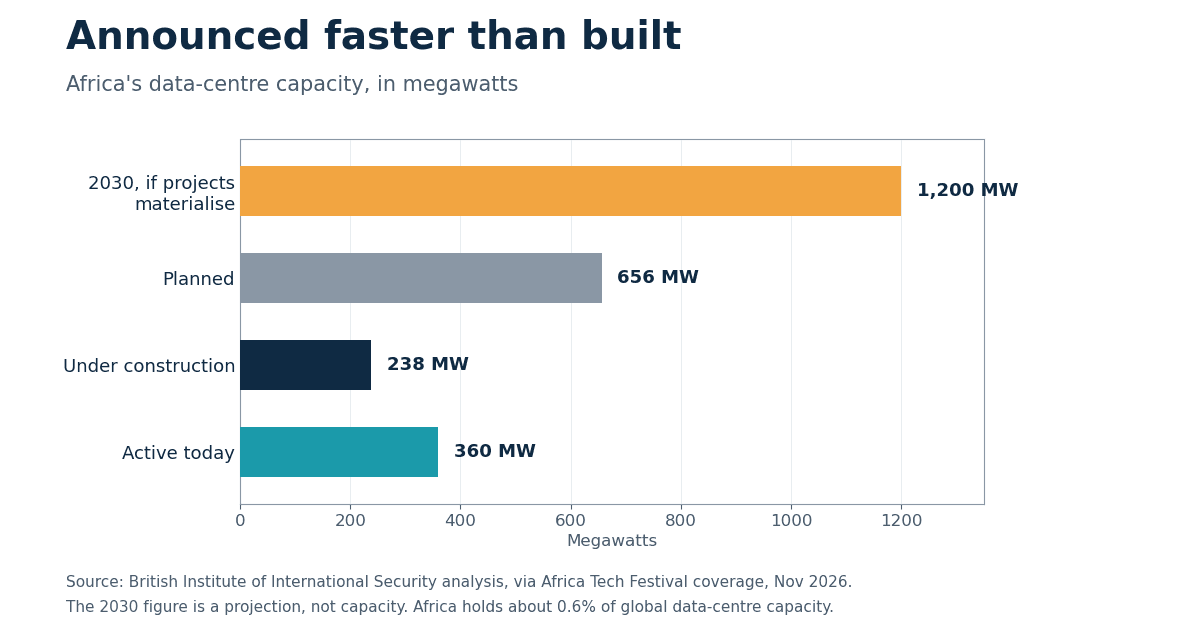
A British Institute of International Security analysis, cited in Africa Tech Festival coverage this week, puts numbers on the pipeline: 360 megawatts of active African data-centre capacity, 238 MW under construction, and 656 MW planned. A conventional data centre typically needs 10 to 25 MW. An AI facility can need 100 MW or more. The same analysis estimates the continent could reach about 1.2 gigawatts by 2030 if reported projects materialise. That "if" carries most of the weight in the sentence.
Demand is not the constraint. Electron Intelligence's Africa Data Centre Power Outlook projects electricity consumption by African data centres rising from 2.55 terawatt-hours in 2025 to 6.95 TWh in 2030 and 12.60 TWh in 2035 under its base case. The power has to come from somewhere, and that is where the week's announcements get thin.
Power is the binding constraint
Zambia shows why. Installed capacity stood at 4,118.71 MW at the end of 2025, and 77.11 percent of it is hydropower. Drought-driven load-shedding ran from about 8 hours a day in March 2024 to 19 to 20 hours at its worst. Nationwide load-shedding ended in December 2025, helped by new solar, thermal, and independent supply, and Chisamba solar has grown to 200 MW. But the 2024 drought showed that installed capacity is not dependable supply when three-quarters of it relies on rainfall.
Zambia also wants to triple copper output, from 890,346 tonnes in 2025 to 3 million tonnes a year by 2031. Industry executives cited by Reuters say at least 2,000 MW more may be needed to do that, and the IMF estimated a power deficit of nearly 707 MW in 2025. A high-density AI facility would compete for the same firm power as mines, smelters, and households. ZESCO's 2030 scenario envisions 11,630 MW in total, heavily diversified into solar at 4,126 MW and thermal at 3,234 MW. Until a Zambian AI proposal names its firm power source, it is a memorandum with a power problem attached.
Kenya offers the contrast. The planned Microsoft and G42 campus at Olkaria is anchored by dedicated geothermal power, a proposed 100-megawatt facility backed by a $1 billion investment announced in 2024. That project encountered delays in 2026, which is itself a data point: even a project with a named power source and a billion dollars behind it does not move on schedule. Kenya's National AI Strategy for 2025 to 2030 is organised around three pillars, AI infrastructure, data and governance, and research, innovation, and commercialisation. The strategy is real. The campus is still a plan.
The other big numbers in the sector follow the same pattern. AWS says it has invested more than $819 million in its South African cloud infrastructure since 2018, with another $1.5 billion committed by the end of 2029. The International Finance Corporation has committed $100 million towards expanding Raxio Group's data-centre operations across several African markets. The African Development Bank estimates inclusive AI adoption could contribute up to $1 trillion to Africa's GDP by 2035, under an ambitious adoption scenario, not as a guaranteed increase. The African Development Bank and the UN Development Program are advancing the AI 10 Billion Initiative, aiming to mobilise up to $10 billion over a decade, with an October 2026 update outlining a potential contribution of 25 million new jobs by 2035. Mobilisation targets are not financing. The World Bank's October 2026 Africa Economic Update, titled Building AI-Readiness, argues Africa's opportunity is adopting and adapting existing technologies rather than competing to build frontier models, and its new digital strategy includes an AI Infrastructure and Readiness Initiative built around shared, pay-as-you-go GPU infrastructure. That last idea may matter more than any single data centre: shared capacity is the model for countries that cannot justify a standalone national facility.
What counts as real
Announcements are cheap and construction is expensive, so practitioners need a scorecard. Five markers separate a build from a headline.
- Closed money. A signed raise, a disbursed loan, a committed budget line. Cassava's $1 billion is in talks. Vodacom disclosed no figure. Zambia named none.
- Named capacity. Megawatts, GPU counts, rack numbers. The week's announcements named none, except Teraco's 150kW per cabinet test capacity.
- A named power source. Geothermal at Olkaria, a contracted solar farm, a grid connection with firm supply. Zambia's proposal has none. Vodacom's has none.
- A construction date. A start date, a commissioning date. Zambia's roadmap is promised in the coming weeks. Vodacom gave none.
- An anchor tenant. A committed customer whose workloads pay for the facility. Vodacom's model depends on selling capacity to hyperscalers and regional customers, but no anchor tenant was named.
Apply the scorecard to the week. Teraco clears markers two and four in miniature: a real facility, operating now, with a stated capacity. Cassava clears none yet, but its 2025 Nvidia deployment gives it a track record the others lack. Vodacom clears none, but its joint-venture structure and 250 million customers make it the most credible future builder of the three. Zambia clears none, and its power arithmetic is the hardest of all.
In favour
The case for optimism is real. Capital is arriving, and it is arriving from more directions than before: telecom operators, hyperscalers, development finance, and Gulf and US investors talking to Cassava. The telecom entry matters most. Vodacom and MTN, which recently partnered with a Middle East-based investment platform to build AI data centres in Nigeria and South Africa, already own the fibre, the customers, and the billing relationships. They are the most plausible builders of African AI capacity because they can sell it the day it opens.
The technology is also getting cheaper to deploy in the places that need it. Teraco's lab exists precisely because high-density AI infrastructure is hard to get right the first time, and testing liquid cooling and multi-vendor setups locally beats learning on a live deployment. Modular data centres, the subject of Vertiv's Africa Tech Festival session, shorten build times where grid connections are slow. And the World Bank's shared GPU model points at a future where a country does not need its own national AI data centre to give its developers access to compute.
Against
The case against is the record. The Microsoft and G42 Kenya campus, announced in 2024 with $1 billion and dedicated geothermal power, hit delays in 2026. If a project with money, power, and a hyperscaler behind it slips, a memorandum with none of those should be read with care. Zambia's power numbers make the point sharper: a country that shed load for 19 to 20 hours a day in 2024, and needs 2,000 MW more to triple copper output, does not have spare firm power for an AI facility today.
There is also a concentration problem. Almost half the region's data centres sit in South Africa, Nigeria, and Kenya. The announcements this week reinforce that pattern: Egypt, South Africa, and Kenya for Vodacom; South Africa first for Cassava; South Africa for Teraco. A buildout that only deepens the existing three-country concentration leaves most of the continent renting compute from the same few hubs, at higher latency and cost. And the ownership question from the NM Media analysis still stands: if the infrastructure, the cloud services, the models, and the intellectual property stay predominantly foreign-controlled, a large share of the financial returns flows outside the continent.
What would make me wrong
This analysis would be wrong in a good way if, by mid-2027, Cassava closes its $1 billion raise and names the GPU count and the sites; if Vodacom's joint venture breaks ground in Egypt with a disclosed budget and a named power source; or if Zambia's roadmap arrives with a financier, a capacity figure, and a contracted power supply. Any one of those would move its announcement from the "talks" column to the "build" column, and I would update this scorecard gladly.
It would be wrong in a bad way if the Teraco lab stays busy while the big announcements quietly age: if Cassava's talks end without a close, if Vodacom's joint venture produces no construction date within a year, or if Zambia's roadmap arrives as another memorandum. Watch the same five markers. They do not move on press releases.
Sources
- TechCabal Daily, November 18, 2026: Cassava seeks $1 billion to buy Nvidia chips for AI data centres across Africa
- Vodacom seeks partners for AI data centers across Africa, November 10, 2026
- Discovery Alert: Zambia AI Data Centre, Huawei MoU lacks funding and power, November 2026
- ITWeb: New Teraco lab puts AI data centre designs to the test, November 16, 2026
- NM Media Africa: Africa's AI Race, six countries, billions in investment and the battle for digital ownership, November 16, 2026
- The African Times: Vertiv to showcase AI infrastructure at Africa Tech Festival 2026
Which of the five markers would you watch first, and which announcement from this week do you expect to clear it soonest?
Related on Everyday Data Science:
Three Plans to Share Africa's AI Computing Power Landed in Six Days. The Hard Numbers Are Still Missing.
Next →Sovereign AI Got Hardware This Week: Two Deals, Two Very Different Tests
About the writer
Data Scientist & AI Researcher
Data scientist and AI researcher at Pace University. I coined Artificial Frictional Unemployment, and built the first machine learning model for crop yield prediction in Sierra Leone. Author of Understanding Agentic AI. I write about agentic systems and applied ML, with a bias toward what actually works, and who gets left out when it doesn't.
Found this useful? Passing it on to someone who builds is the best way to help the publication grow.
Built something worth sharing? Write it up for us →