Africa's Startups Raised $2 Billion This Year. The First Check Is Still Missing.
Headline funding is healthy again. But the $100,000-to-$500,000 band that turns prototypes into companies has collapsed, and under 2% of the money is going to genuinely AI-native startups.
 Ibrahim Denis FofanahData Scientist & AI Researcher11 min read·Africa's AI Economy · Analysis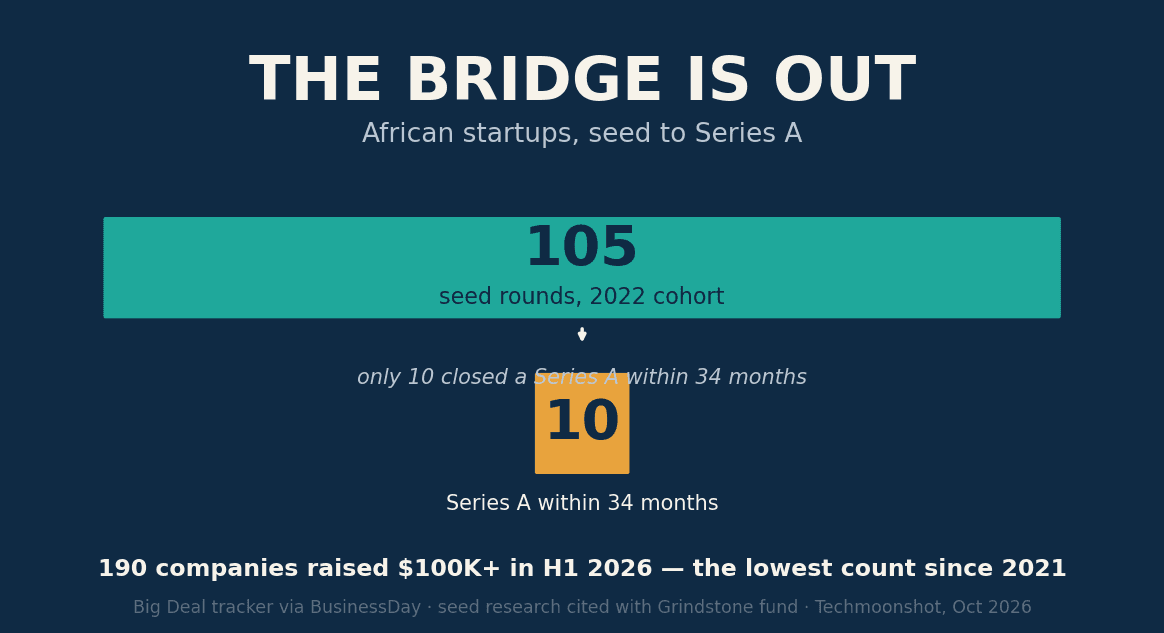
The best number in African tech this year is a real one. By the last week of September, the continent's startups had raised more than $2 billion in 2026, according to Africa: The Big Deal's tracker, reported by Tech In Africa. That crossed the milestone a few weeks later than 2025 and 2023 did, but it crossed it. The tracker's own forecast puts the year at roughly $3 billion if the fourth quarter behaves.
Now the worst number, from the same dataset. In the first half of 2026, only 190 companies raised at least $100,000. That is the lowest count since 2021, per Big Deal's figures as reported by BusinessDay. The headline says the money is back. The company count says it is back for far fewer companies than it used to be.
The headline is true, and it is not the story
Both numbers can be true at once because funding concentration is doing the heavy lifting. A mid-year industry report, summarized by bne IntelliNews, found that the 30 largest recipients captured about 84% of capital raised. Look at the biggest first-half rounds and the pattern is obvious: SolarAfrica at $94 million, Vaal at $64 million, Sistema.bio at $53 million. These are energy and infrastructure companies raising growth capital and debt. They are real businesses doing real things. They are not the startups that need a first check to hire their first five people.
This is the trackers-are-different-thresholds warning that applies to every funding conversation on the continent, so get it out of the way now. Disrupt Africa counts 137 startups and $1.39 billion year-to-date on its methodology, and projects a year-end beat over 2025. Techmoonshot's own count has $1.44 billion across 146 deals in the first half, roughly flat on the first half of 2025. The totals differ because the trackers use different inclusion rules for debt, small rounds, and exits. The trend inside each source points the same way: fewer companies are getting funded, and the money is concentrating at the top.
For AI-focused builders, there is a sharper version of this problem.
The first check is the problem
The round that matters most in African tech is the one that almost never gets discussed on stage: the first institutional check, typically $100,000 to $500,000. That is the money that lets a startup hire a small team, finish the product, and find out whether any customer will pay. Everything downstream depends on it existing.
That is the band that has collapsed. Only 190 African startups secured rounds worth at least $100,000 in the first half of 2026, against $1.36 billion in total first-half funding. A small number of mature companies raising large rounds can keep the total investment figure looking healthy while the number of startups receiving their first meaningful financing quietly falls. Headline funding totals are not a measure of ecosystem health. They are a measure of how well the biggest deals are doing.
The downstream evidence confirms it. Research cited alongside Grindstone Ventures' new fund announcement found that of 105 African startups that raised seed money in 2022, only 10 had closed a Series A within 34 months. And the seed supply itself is shrinking: seed rounds fell from 105 in 2022 to 46, then 31, then 42 in 2025. That 2025 number is a small rebound from the 2024 low, but it is less than half of the 2022 figure. The bridge from seed to Series A is not just narrow. At 10 out of 105, it is nearly out.
None of this is a complaint about the big rounds. Debt financing is doing more work than it used to, and that is a sign of institutional maturity: the Condia tracker for the first quarter showed debt and hybrid instruments accounting for more than $490 million of the quarter's roughly $705 million, against about $212 million in pure equity. Mature companies with assets can borrow. The problem is that there is no debt instrument for a two-person startup with a prototype and no revenue. For them, it is equity or nothing, and equity has moved upmarket.
The AI layer on top
Everybody is shouting "AI," but the money tells a quieter story. BusinessDay's analysis of Big Deal data found that about 14% of first-half funding went to AI-related companies, and genuinely AI-native companies got less than 2%. Most of the "AI funding" is fintech, insurance, fraud detection, and agritech businesses that use AI inside their operations. Those are fine businesses. They are not AI companies. They do not build models, datasets, or language infrastructure, and they do not carry the cost structure of doing so.
The first quarter of 2026 made the point cleanly. As a standalone category, AI saw two deals and $3.9 million, according to Condia's tracker: Ayadata's seed round in Ghana and Cybervergent's in Nigeria. That is the entire recorded AI-native deal flow for the quarter, in a continent where PwC's Africa workforce survey finds 64% of workers already using AI tools at work, above the 54% global average. The demand is there. The supply of funded companies to build for it is thin.
There are real AI-native companies working through this. Lelapa AI in South Africa has raised $2.5 million, with backing from Google and Radical Ventures, to build language models trained natively on African languages; its InkubaLM is designed for the code-switching that characterizes how people actually speak. Awarri in Nigeria and Amini in Kenya are working on language and data infrastructure. Tunisia-founded InstaDeep remains the proof that an African AI company can make it through the funding pipeline. But they are the exceptions that prove the structure: a continent-sized language-model opportunity, and a deal flow you can count on two hands per quarter.
Capital is arriving anyway
Here is the part that keeps the story from being bleak. New money is actively being aimed at the missing middle, or near it:
- Ventures Platform closed an $84 million Fund II in August, above its $75 million target, with EBRD and Norfund among the new LPs. It invests pre-seed through Series A, and reportedly already has five Fund II investments across Kenya, South Africa, and Egypt. It is no longer just a Nigeria-first fund.
- Grindstone Ventures closed a R500 million fund (about $31.2 million) targeting seed to Series A, with plans for 15 to 20 portfolio companies, mostly in South Africa. It is explicit about aiming for exits, not paper valuations.
- Madica wrote $200,000 cheques to five startups in September, including its first investments in Algeria and Cameroon. Two hundred thousand dollars is exactly the first-check band, and it is moving in Francophone and North African markets that usually get skipped.
- Askya's AI Growth Platform runs October 26 to December 4, a zero-equity six-week programme for 10 African AI startups, with at least $200,000 committed to one participant. Participants need a live product and early customers.
- Injini's AI for Education venture builder has twelve teams from Southern Africa, with five set to get $25,000 each in equity-free seed funding.
Beyond venture money, the development-finance queue is enormous: the Gates Foundation has reportedly pledged at least $1 billion over two years for AI in health, education, and agriculture; the AfDB and UNDP launched a $10 billion AI initiative in 2026; the African Union has floated a $500 million AI investment facility; South Korea unveiled a "K-AI Package" with a cloud-voucher scheme for African startups.
Treat the larger numbers as announced intent, not deployed capital. That is the honest reading, and it is the one Techmoonshot's own October analysis applies. But compute is also arriving in the physical sense: Cassava Technologies is rolling out an Nvidia-powered AI factory starting in South Africa, and in September it teamed up with Vodafone Business and Elsewedy Electric on what is billed as Egypt's first sovereign AI data centre, with potential capacity up to 200 megawatts and total investment that could reach $1 billion at full scale. Africa still holds under 2% of global data centre capacity, so there is a long way to go. The direction, at least, is finally correct.
In favour
The case that this is working: capital is concentrating because the market is maturing. Zombie startups are dying faster (59 tech companies have shut down since 2022 after raising a combined $465 million), and consolidation is up 91% year on year, with 63 mergers and acquisitions in the first half of 2026. Fewer, better-funded companies winning is what a maturing ecosystem looks like. The clearest exits of the last decade were capital-light B2B software companies that raised under $10 million and sold to foreign buyers. You do not need a wide seed funnel to produce outcomes; you need a few companies that actually reach the buyer.
On AI specifically, the under-2% figure may be roughly the right number. Most of AI's economic value on the continent will be captured by applied companies in health, agriculture, logistics, and finance, not by model-building startups. Funding AI-native companies is expensive and slow; funding companies that use AI to sell something real is how the returns get made. The money might be smarter than the headlines make it look.
Against
The case that it is not: concentration plus a broken first check means the ecosystem is eating its seed corn. Every mature company raising a growth round today once needed a first check to exist. If the 2022 seed cohort produced only 10 Series A companies in 34 months, the 2030 growth cohort will be smaller still, and the $3 billion headline of 2028 will belong to even fewer companies. Consolidation as an exit route only works if there is something to consolidate. A pipeline that narrows every year eventually narrows to nothing.
And on AI, the "applied AI is where the value is" argument assumes someone builds the underlying capability. If nobody funds African-language models, speech infrastructure, and local datasets, the applied companies will build on imported models and imported data, and the value that stays on the continent will be the integration margin. Lelapa AI's existence proves the demand; the two-deals-per-quarter flow proves the funding gap. The moat everyone wants (local data, local languages, local distribution) is exactly what the current capital structure does not fund.
What would make me wrong
This piece would be wrong, or at least outdated, if any of these show up in the 2026 full-year or 2027 first-half trackers:
- Big Deal's count of companies raising at least $100,000 rebounds above 220 for a half-year, recovering toward the 2021-era figure.
- Seed-round counts climb back above 60 per year and stay there.
- The AI-native share of African startup funding crosses 5% on Big Deal's or Condia's data, not on press releases.
- Any of the new funds (Ventures Platform II, Grindstone, Madica) can show twenty or more first-check rounds written to AI startups in a single year, disclosed with names.
Until then, the honest description of African AI funding is the one the numbers give: record totals at the top, a drought at the bottom, and almost no AI-native companies in between.
Sources
- AI Startups News, "Africa's AI startups grow, but early-stage funding drops 30% in 2026": https://aistartupsnews.com/news/africa-s-ai-startups-grow-but-early-stage-funding-drops-30-in-2026/
- Techmoonshot, "Tech Opportunities in Africa October 2026: Startup Money Is Back, but It's Choosier": https://techmoonshot.com/2026/10/06/tech-opportunities-in-africa-october-2026-startup-money-is-back-but-its-choosier/ (Big Deal figures via Tech In Africa; BusinessDay analysis of Big Deal data; Disrupt Africa Q3 figures; seed-to-Series A research cited alongside Grindstone's fund)
- The Condia, "African startups raise $705M in Q1 2026 as debt surges": https://thecondia.com/african-startups-funding-q1-2026/
- TechTrends Africa, "Africa's AI Moment Has Arrived" (continental intelligence report, Q1 2026): https://techtrends.africa/africas-ai-moment-has-arrived/
- Techpoint Africa, "African AI startups solving local problems that matter in 2026": https://techpoint.africa/guide/african-ai-startups-solving-local-problems/
Related on Everyday Data Science: Africa's 12,000 GPUs and the Compute Gap Nobody Talks About · UNDP and GSMA Bet on African-Language AI. The Press Release Is Missing Three Things. · African-Language AI Is a Data-Pipeline Problem, Not a Scale Problem
So here is the question: if you had $200,000 to put into one African AI startup this month, in the first-check band, where would it go, and what would you need to see before you wired it?
About the writer
Data Scientist & AI Researcher
Data scientist and AI researcher at Pace University. I coined Artificial Frictional Unemployment, and built the first machine learning model for crop yield prediction in Sierra Leone. Author of Understanding Agentic AI. I write about agentic systems and applied ML, with a bias toward what actually works, and who gets left out when it doesn't.
Found this useful? Passing it on to someone who builds is the best way to help the publication grow.
Built something worth sharing? Write it up for us →