Cheat Sheets
Visual references you can actually use, the concepts that matter, distilled to a page.
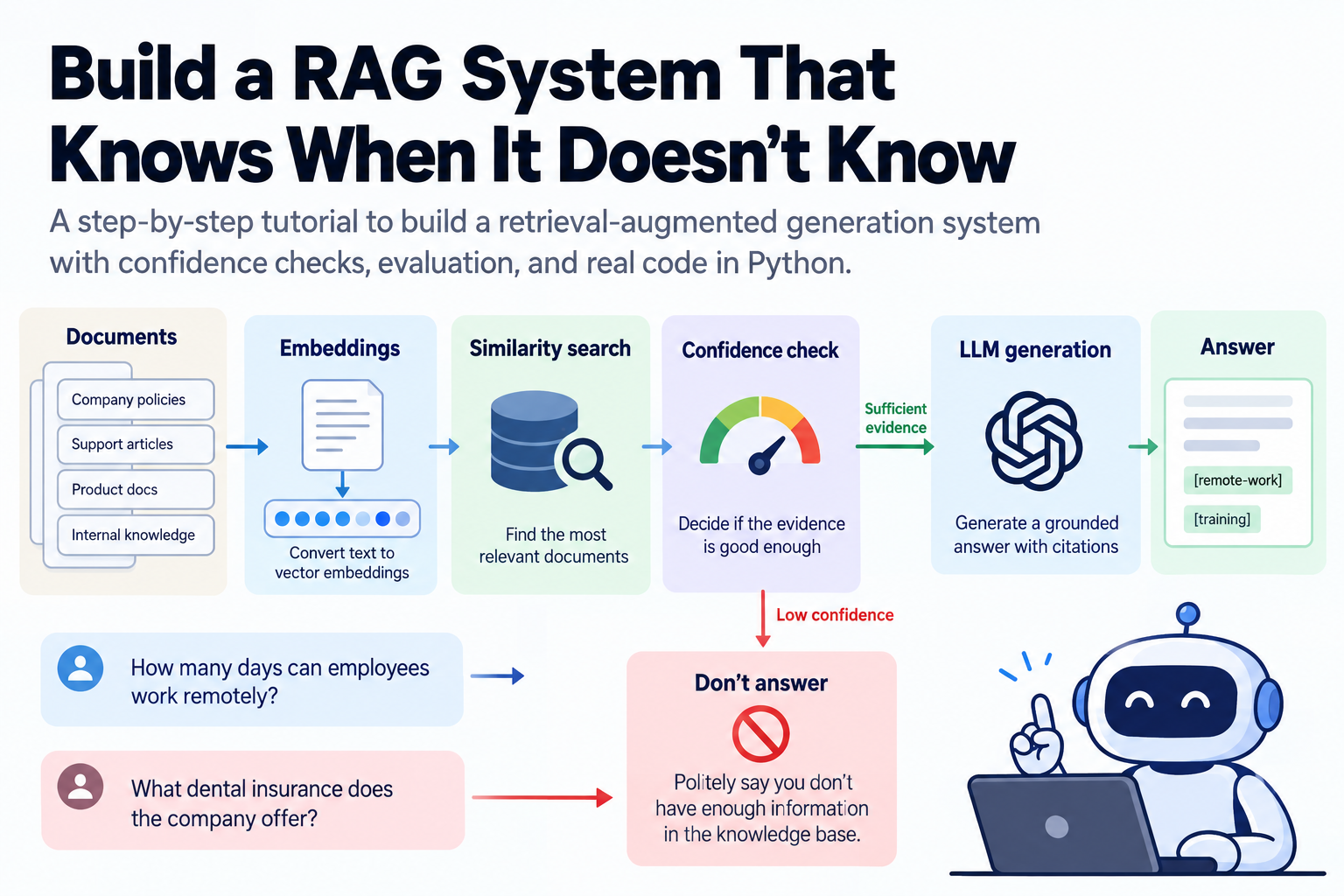
Build an AI Systems that knows
Build an AI Systems that knows when it does not know
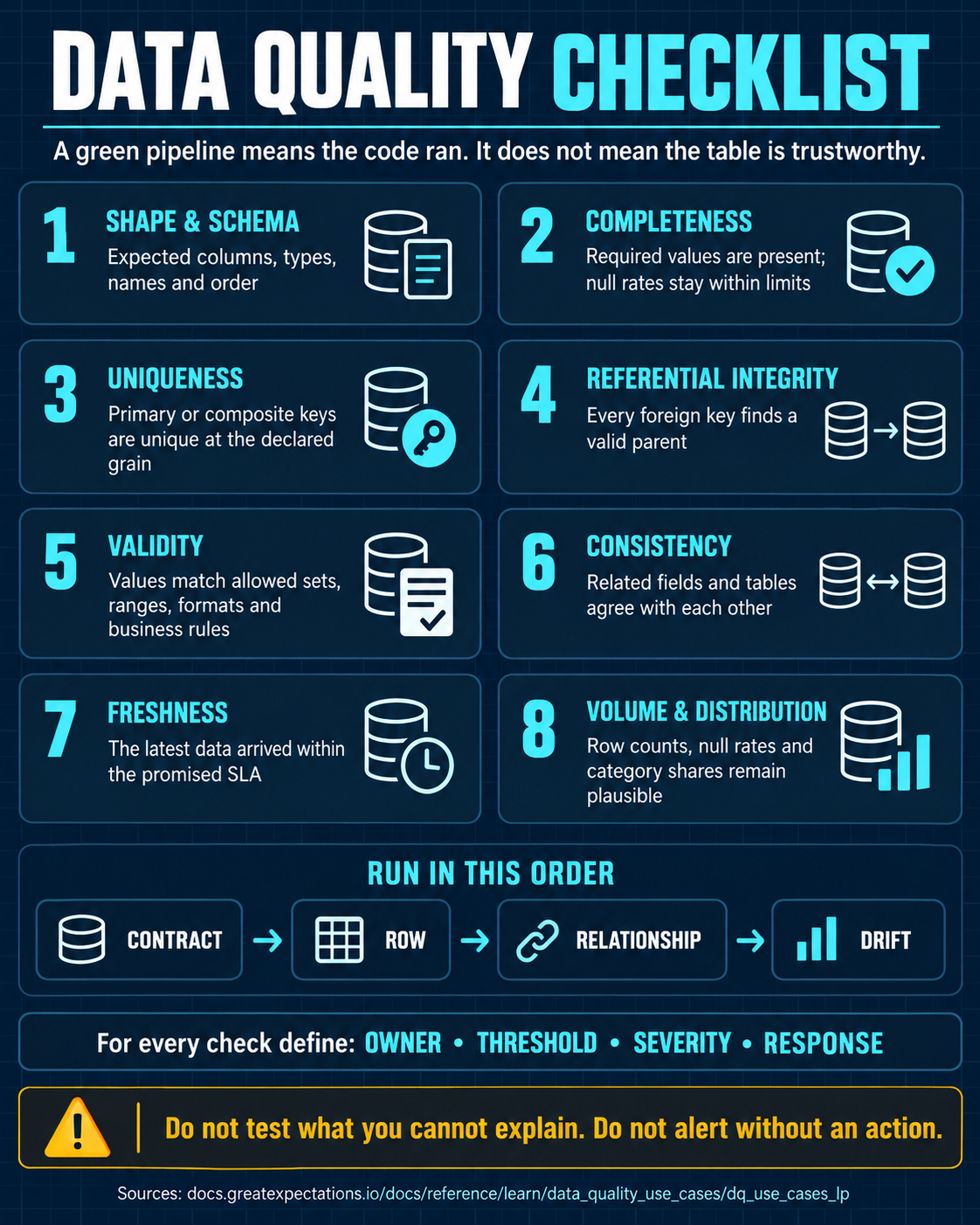
Before You Trust the Table: 8 Data Quality Checks
A practical eight-part checklist for validating a data product beyond a successful pipeline run: schema, completeness, uniqueness, referential integrity, validity, consistency, freshness, and volume or distribution drift. The infographic also gives a testing order and requires an owner, threshold, severity, and response for every check. Source reference: Great Expectations data-quality use cases, https://docs.greatexpectations.io/docs/reference/learn/data_quality_use_cases/dq_use_cases_lp/
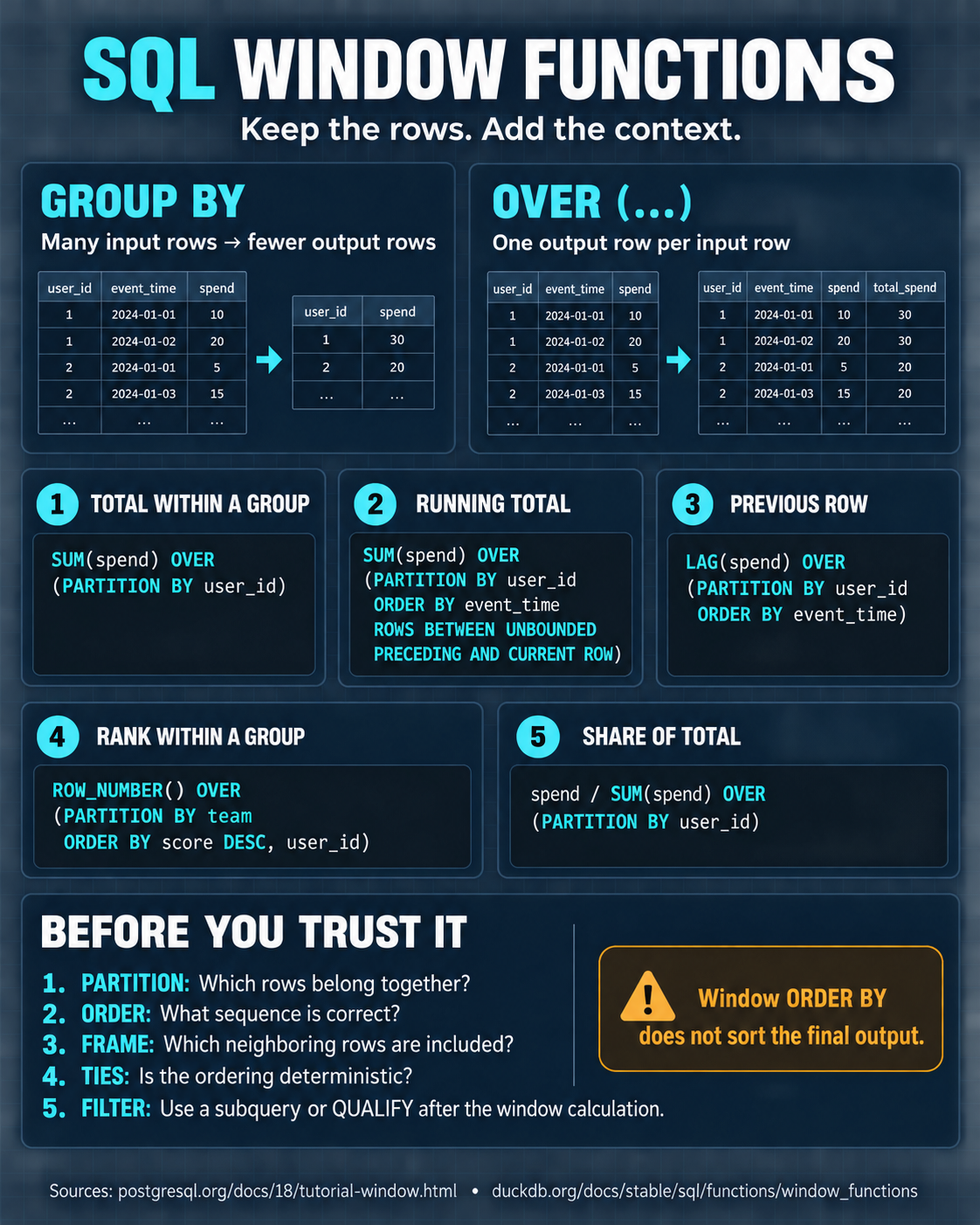
SQL Window Functions: Keep the Rows, Add the Context
A practical reference for choosing and checking SQL window functions: totals within a group, running totals, previous-row comparisons, ranking and share-of-total calculations. Includes the five questions that prevent most window mistakes—partition, order, frame, deterministic tie-breaking and filtering—plus the reminder that window ORDER BY does not sort final output. Verified against PostgreSQL 18 and DuckDB documentation: https://www.postgresql.org/docs/18/tutorial-window.html and https://duckdb.org/docs/stable/sql/functions/window_functions
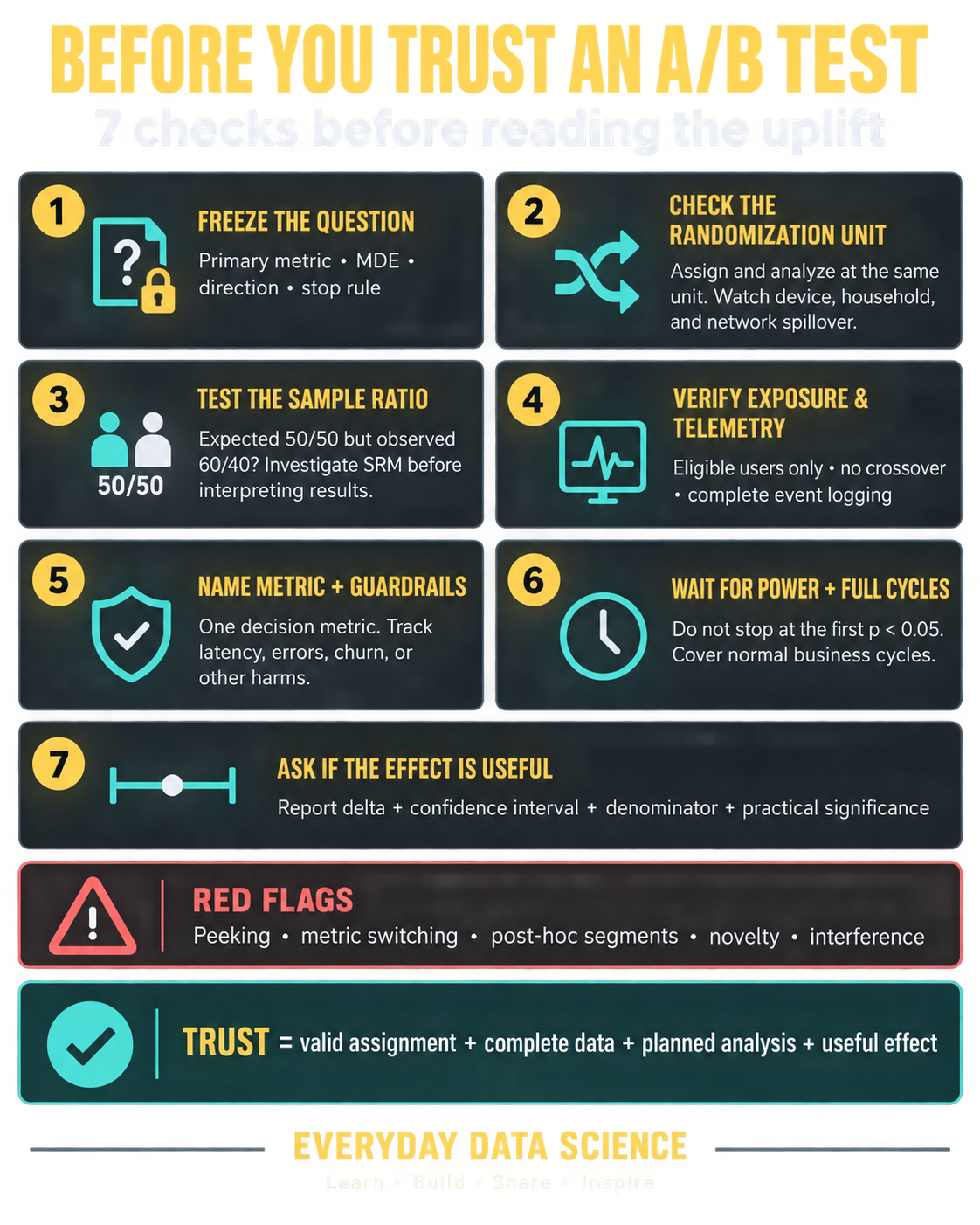
Before You Trust an A/B Test: 7 Diagnostic Checks
A practical pre-analysis checklist for trustworthy experiments: freeze the question, verify the randomization unit, detect sample-ratio mismatch, validate exposure and telemetry, define guardrails, wait for adequate power and full cycles, and judge practical significance.
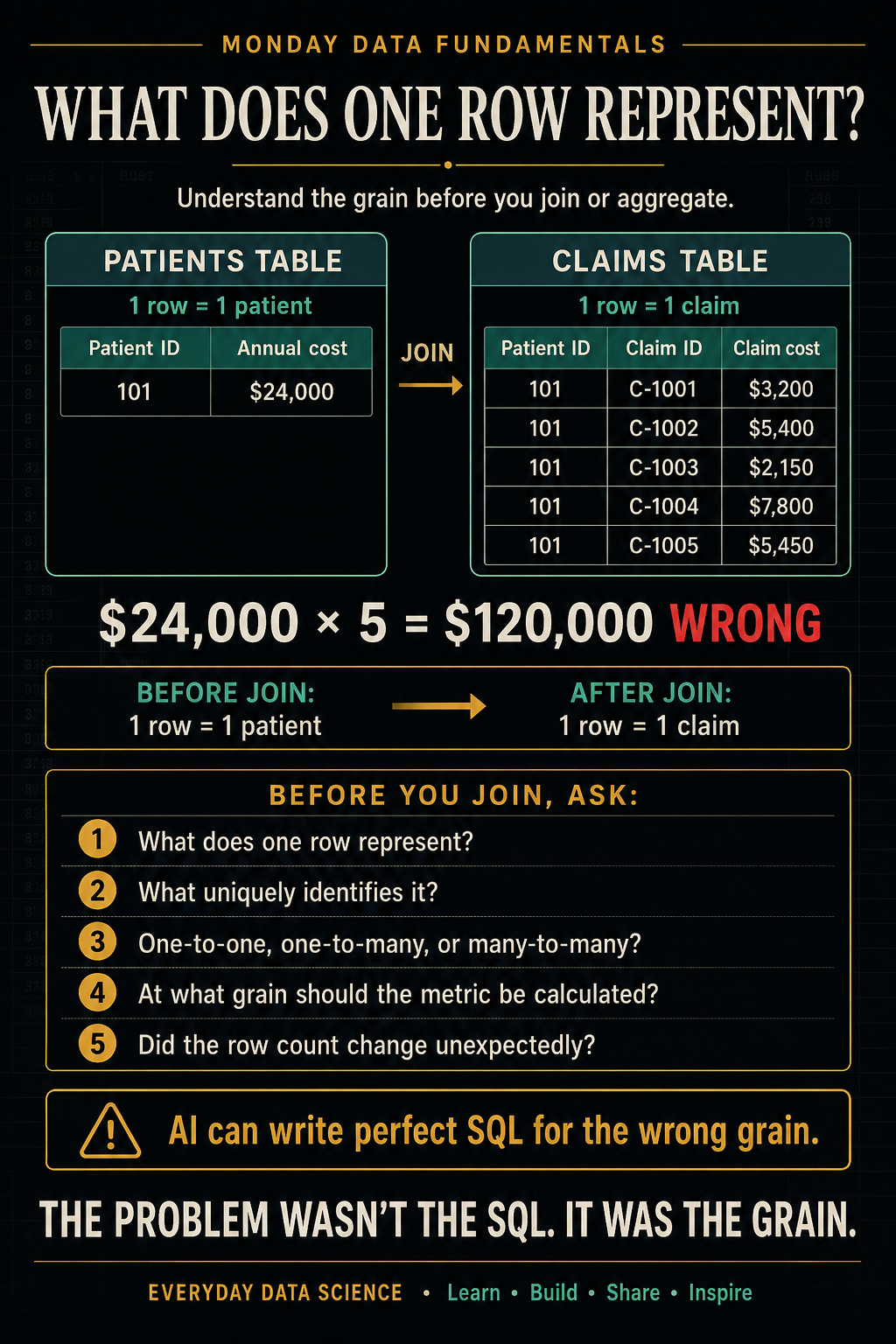
Healthcare Data Grain: What Does One Row Represent?
A visual guide to preventing inflated metrics when joining patient, claim, encounter, diagnosis, procedure, and medication tables. It explains how a one-to-many join changes the grain and gives five checks to run before aggregating.
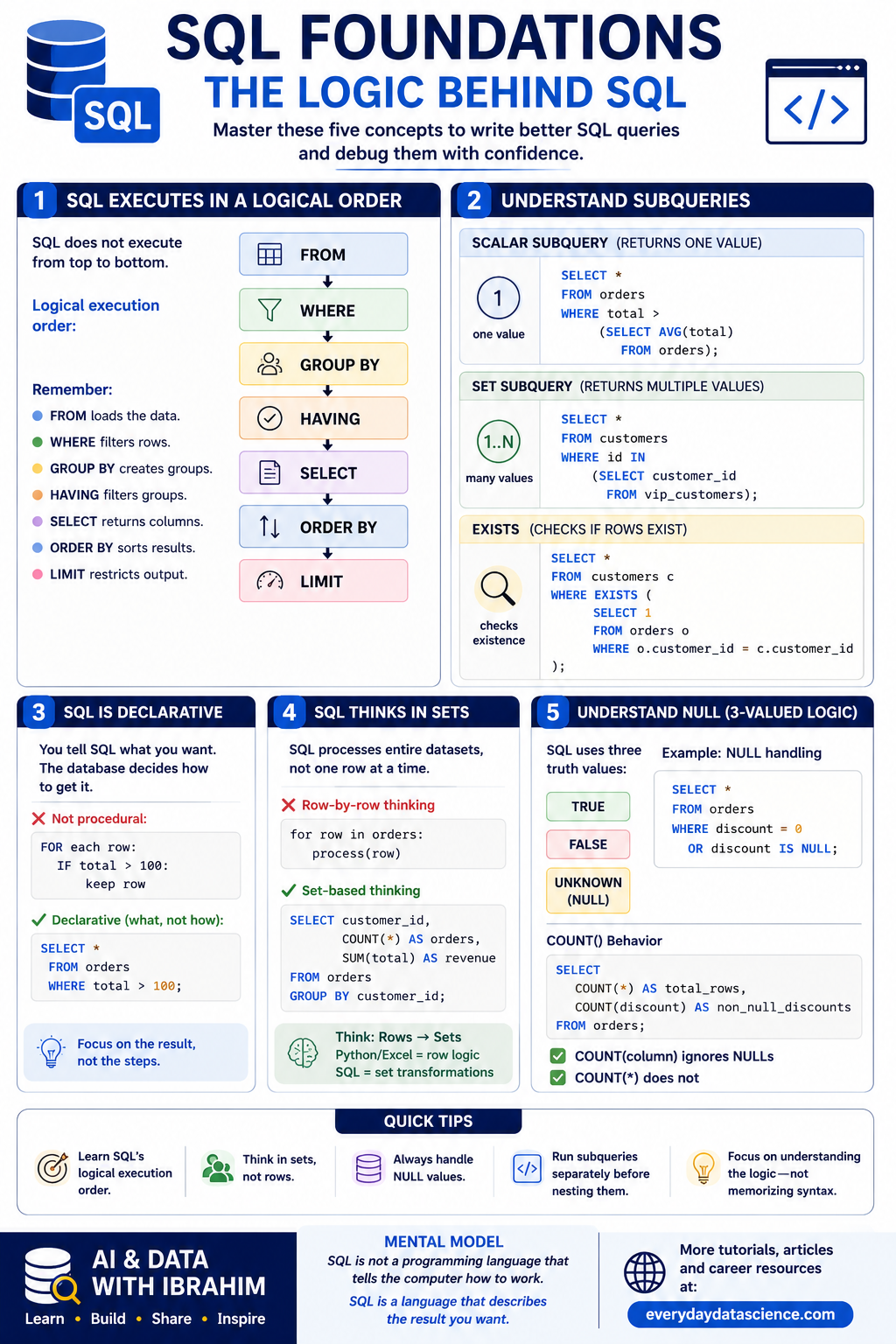
SQL Foundations: The Logic Behind It
The biggest breakthrough in SQL is not more syntax. It is understanding how SQL thinks. Five foundations every analyst should master: the logical execution order (FROM, WHERE, GROUP BY, HAVING, SELECT, ORDER BY, LIMIT), subqueries and query contexts, why SQL is declarative, why it thinks in sets not rows, and how NULL and three-valued logic actually work.
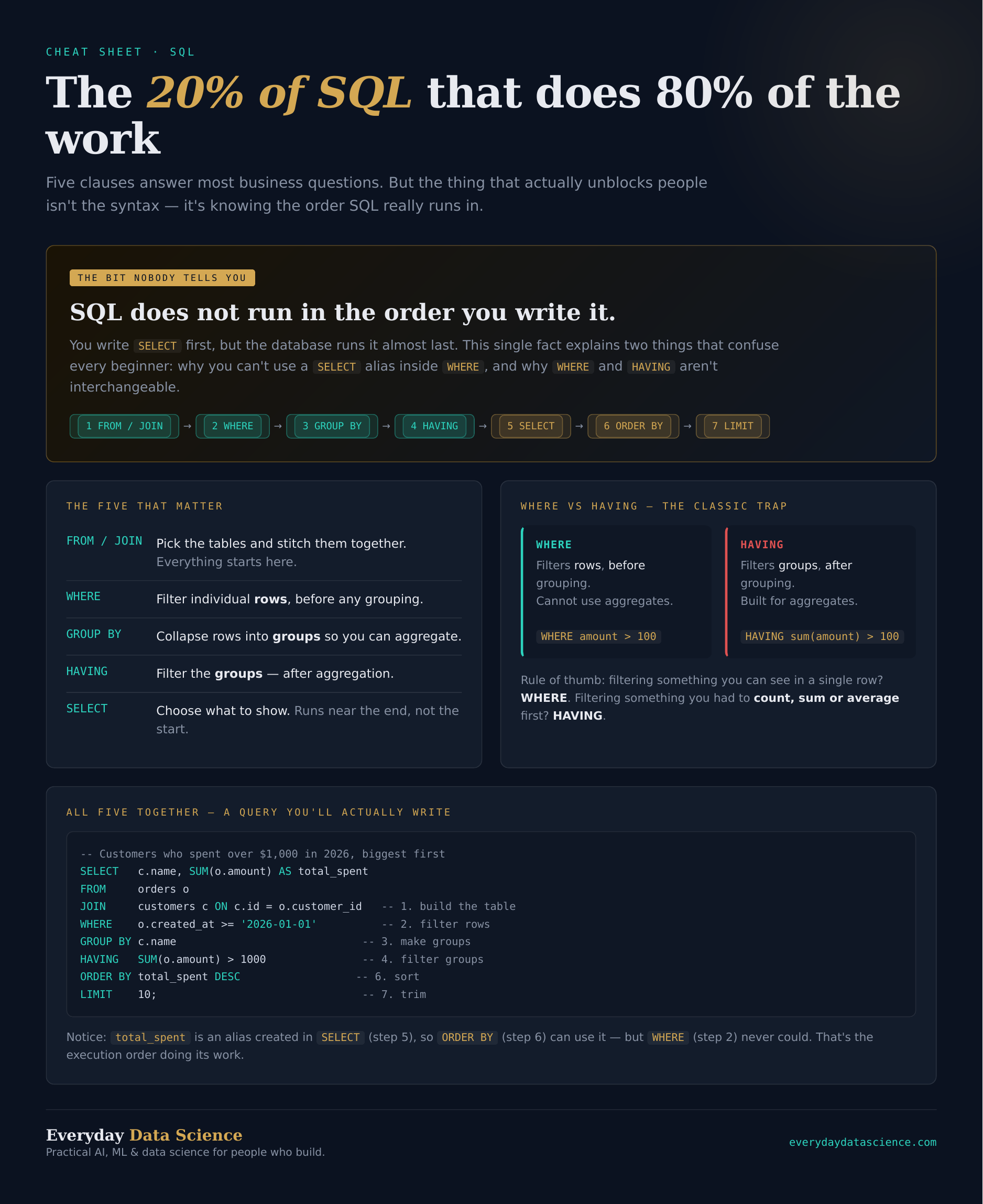
The 20% of SQL That Does 80% of the Work
Five SQL clauses answer most business questions: SELECT, WHERE, GROUP BY, JOIN and HAVING. But the thing that actually unblocks people isn't the syntax, it's knowing that SQL doesn't execute in the order you write it. This cheat sheet covers the five essential clauses, SQL's true execution order (FROM → WHERE → GROUP BY → HAVING → SELECT → ORDER BY), why WHERE and HAVING aren't interchangeable, and a worked query that uses all of them.

Prompt Engineering Reference
System prompts, few-shot, and structured output at a glance.

Agentic Design Patterns
Memory, planning, tool use, the building blocks of production agents.