Korea Just Lent Tanzania $170 Million for AI. The Real Test Is Who Gets to Use It.
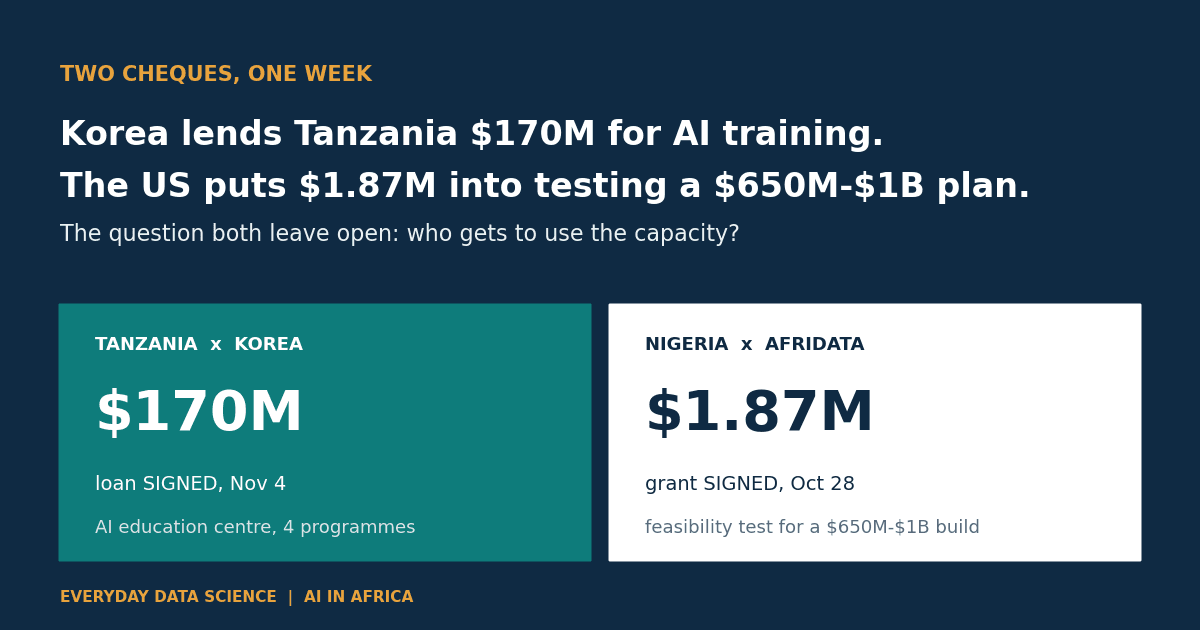
On November 4, Korea Eximbank signed a $170 million loan to build an AI education centre in Tanzania, the first AI project under Seoul's K-AI Package. A week earlier, a US agency put $1.87 million into testing whether a $650 million to $1 billion private data centre plan in Nigeria can be financed. Two cheques, two models, and the same unanswered question: who actually gets access, at what price, and on whose terms?
 Ibrahim Denis FofanahData Scientist & AI Researcher11 min read·Building AI in Africa · Analysis
African AI had a busy fortnight for announcements, and most of them were about sharing computing power. The World Bank, the African Development Bank with UNDP, and Nigeria all made their case between October 16 and October 22, and I wrote about those three plans last week. This week brought something different: not a plan to share computing, but two deals that put actual money on the table, one in Tanzania and one in Nigeria.
The money is real in both cases. What it buys is very different, and the gap between the two deals is the story.
The loan: Korea pays for training, Tanzania pays it back
The Export-Import Bank of Korea will lend Tanzania $170 million to build an artificial intelligence education centre. The loan agreement was signed in Dar es Salaam on Wednesday, November 4, by the bank's Senior Executive Vice President Lee Dong-hoon and Tanzania's Deputy Finance Minister Natu E. Mwamba. The bank announced it the following day.
Two firsts attach to the deal. It is the first AI project financed through South Korea's Economic Development Cooperation Fund, the government's concessional loan window for developing countries. It is also the first project under Seoul's K-AI Package, an initiative that pairs development financing with Korean AI technologies to support emerging economies and create overseas business for Korean companies. Both purposes are stated openly by the bank. That honesty is useful, because it tells you what to watch.
The centre will sit on a 35,000-square-metre site and run four programmes: AI, robotics, data analytics and the Internet of Things. The stated focus is training specialists in physical AI, the embodied kind that lives in robots and machines rather than in chat windows. It will have AI laboratories and advanced training facilities, and it will adopt Korean technologies and education systems for teaching, assessments and instructor training. The curriculum will also use cloud-based platforms for sharing courses and managing learning, with the stated aim of establishing a model for AI education in Tanzania.
The Tanzanian government plans to develop a large-scale AI data centre nearby and establish an AI cluster to attract technology companies. No size, budget or date has been published for either. Lee Dong-hoon was direct about Seoul's intent: "We will use this project as a first step toward establishing Korean AI technologies in Africa," he said, pledging continued support for Korean companies pursuing overseas infrastructure projects in AI, digital technology and other strategic sectors.
Read that as a package deal. Korea is financing the training centre, supplying the technology and the teaching system, and positioning its companies for the data centre and cluster that follow. Tanzania gets a real building, real labs and real instructors trained on a working system. It also gets a national AI education model built on someone else's stack, and a loan to repay.
The grant: $1.87 million to test a $1 billion idea
The Nigerian deal is the mirror image. On October 28, AFRIDATA and the US Trade and Development Agency signed a $1.87 million grant agreement, announced at a ceremony and stakeholder breakfast at the Transcorp Hilton in Abuja. AFRIDATA formally launched its Nigerian programme there on November 2.
The grant pays for a feasibility study, not construction. It will test whether two proposed AI-ready data centres can be financed and built: a primary facility in Lagos State and a disaster-recovery facility in Delta State. Together they are planned for 60 to 70 megawatts of combined capacity, with room to expand to 100 megawatts. The procurement notice describes 3,600 conventional server racks and 480 higher-density racks for graphics-processing-unit workloads. The Lagos site is intended to meet Tier IV reliability standards.
AFRIDATA estimates the build at $650 million to $1 billion. That figure is the company's estimate, not committed capital. The only money actually signed is the $1.87 million grant. The feasibility study will examine bankability, product-market fit, regulatory risk, project delivery strategy and the finance needed to move forward, and it will assess the commercial structure for serving cloud providers, banks, mobile-network operators and other organisations that need AI compute, cloud and colocation capacity.
AFRIDATA also says it plans an ICT business park and an academy focused on AI, data management and cybersecurity, and that Nigeria is the first phase of a wider platform spanning eight African markets. INFRAGORA Global Capital, which set up the Nigerian special-purpose vehicle in April 2026, says the broader programme could eventually involve $2 billion to $3 billion of infrastructure across the continent. The operator, the financing consortium and the final ownership percentages have not been announced. Neither have final sites, delivery dates, course capacity or funding arrangements for the business park and academy.
Two models, side by side
| Tanzania and Korea | Nigeria and AFRIDATA | |
|---|---|---|
| Money actually signed | $170 million loan | $1.87 million grant |
| What it buys | An AI education centre, labs and a training system | A feasibility study |
| The big number attached | None beyond the loan | $650 million to $1 billion build estimate |
| Who repays | Tanzania, on loan terms not yet published | Nobody, it is a grant; the build still needs private capital |
| Technology stack | Korean technologies and education systems | Operator not yet chosen |
| Follow-on ambition | A large AI data centre and cluster nearby | An 8-market platform, $2 billion to $3 billion |
| What is missing | Loan terms, data centre size, dates | Financial close, operator, anchor tenants, dates |
The table is the argument. One deal has the money signed and the building specified, but the stack is imported and the loan terms are unpublished. The other has a big headline number and a real feasibility process, but no construction capital, no operator and no tenants. Signed money with strings attached, or a tested idea with no money yet. Neither is a finished answer.
The question neither deal answers
Both deals are about capacity, and both are silent on access. That is the pattern I keep finding in African AI infrastructure announcements, and it is the question practitioners should ask first.
In Tanzania, the questions are: who sets the curriculum once the Korean instructors leave, does Tanzania own the course content and the instructor pipeline, and what does GPU time cost in the data centre planned next door? A training centre that teaches on a stack its graduates cannot afford to run is a classroom, not a pipeline. A data centre that prices its GPUs for foreign enterprise tenants is a landlord, not a public good.
In Nigeria, the questions are simpler and harder: who operates the Lagos facility, who are the anchor tenants, and what does a rack cost a Nigerian startup? A feasibility study that returns bankable terms is a real step. A feasibility study that returns a report and no financial close is a week of headlines.
There is a second question underneath the first. Korea's K-AI Package is explicit that it exists to create overseas business for Korean companies. The USTDA grant is explicit that it exists to test bankability for a project that will serve cloud providers, banks and telecom operators. Neither programme is a charity, and neither pretends to be. The honest test is not whether the funders have interests. It is whether African users end up with capacity they control, at prices they can pay, on terms they can renegotiate.
Five things to watch
- Tanzania's loan terms. Interest rate, tenor, grace period, currency of repayment. Concessional terms would make the $170 million a genuine capacity investment. Commercial terms would make it a debt-financed training contract.
- Curriculum ownership. Can Tanzanian instructors run the four programmes without Korean staff within a few years, and does Tanzania own the course content? The answer decides whether this is capacity or dependency.
- The data centre next door. Who builds it, who operates it, and what GPU time costs a Dar es Salaam startup. A cluster that only foreign tenants can afford repeats the pattern of the last decade.
- AFRIDATA's feasibility outcome. Bankable terms, committed equity and debt, and a formal financial close, or the $650 million to $1 billion stays an estimate. Watch for a named operator and anchor tenant contracts.
- A named end user. Both deals should eventually be able to name a Tanzanian or Nigerian team that used the capacity to ship something. Until then, both are infrastructure in search of a user.
In favour
The Tanzania loan is signed money for a real building with real labs, not a memorandum of understanding. Training specialists in physical AI, robotics included, is a concrete skill bet rather than generic AI literacy, and it fits a country that needs technicians as much as it needs researchers. A data centre next to a training centre is the right pairing: students learn on the machines they will later use. The AFRIDATA grant tests bankability before anyone pours concrete, which is the correct order for a $1 billion build, and the USTDA record is public, so the feasibility outcome can be checked.
Against
A loan for training capacity that runs on someone else's stack is a dependency dressed as capacity, and the loan terms are unpublished, so the public cannot judge the price. No prices appear anywhere in either deal: not for GPU time, not for course fees, not for rack space. Feasibility grants have a long history of producing reports rather than buildings, and the AFRIDATA plan has no operator, no tenants and no construction date. Two announcements in one week, and not a single named end user in either.
What would make me wrong
- Tanzania publishes the loan terms and a curriculum that Tanzanian instructors can run without Korean staff within three years.
- The data centre next to the Tanzanian centre opens with published GPU rental prices that a Dar es Salaam startup can actually afford.
- AFRIDATA reaches financial close with a named operator and anchor tenants, and breaks ground in Lagos.
- A Tanzanian graduate of the centre ships a product built on its training within two years.
- A Nigerian startup signs a published rack rate at the Lagos facility and says so publicly.
If three of those five happen, the scepticism in this piece was misplaced, and I will say so.
Related on Everyday Data Science
- Three Plans to Share Africa's AI Computing Power Landed in Six Days. The Hard Numbers Are Still Missing.
- Sovereign AI Got Hardware This Week: Two Deals, Two Very Different Tests
- 12,000 GPUs Are Landing in Africa. The Real Bottleneck Was Never Just the Hardware.
Sources
- The Investor: Korea Eximbank commits $170m to Tanzania's first EDCF AI project
- Abuja Business News: AFRIDATA Abuja Launch Unveils $1bn Data Centre Plan
- AfriPost: AFRIDATA, USTDA sign $1.87m deal for Nigeria data centre project
Two cheques landed in one week, one signed and one to test whether the bigger one can ever be signed. Which model would you bet on: the loan that builds the classroom, or the grant that tests the data centre? And what would you need to see before you called either one a win for the people who will actually use it?
About the writer
Data Scientist & AI Researcher
Data scientist and AI researcher at Pace University. I coined Artificial Frictional Unemployment, and built the first machine learning model for crop yield prediction in Sierra Leone. Author of Understanding Agentic AI. I write about agentic systems and applied ML, with a bias toward what actually works, and who gets left out when it doesn't.
Found this useful? Passing it on to someone who builds is the best way to help the publication grow.
Built something worth sharing? Write it up for us →