Three Plans to Share Africa's AI Computing Power Landed in Six Days. The Hard Numbers Are Still Missing.
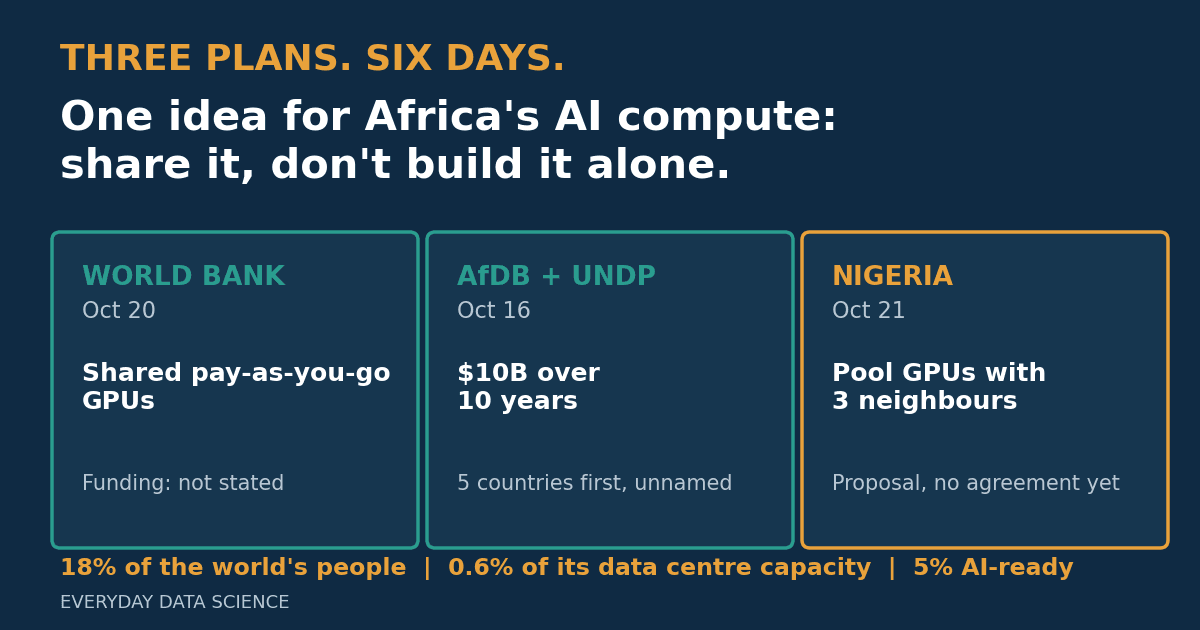
Between October 16 and October 22, the World Bank, the African Development Bank with UNDP, and Nigeria all told African governments the same thing: do not build your own AI data centre, share the computing instead. One plan has $10 billion attached. One has no funding figure at all. One is a proposal between four countries.
 Ibrahim Denis FofanahData Scientist & AI Researcher14 min read·Building AI in Africa · Analysis
Africa's AI debate changed shape this month, and it changed in a week.
For two years the argument has been about building: more data centres, more GPUs, more national capacity. The three announcements that landed between October 16 and October 22 argue the opposite. They say most African governments should not build their own AI data centre at all. They should rent computing power, share it with neighbours, and spend the money they save on the things that make AI useful: electricity, connectivity, data, and skills.
That is a serious shift, and it is worth taking seriously. It is also a shift announced mostly without numbers. This piece takes the three plans one by one, then lists what each one still has to prove.
Plan one: the World Bank will rent the GPUs
The World Bank Group launched its first digital strategy in Seoul on October 20, 2026, at its Global AI and Digital Summit. The strategy has four priorities: expanding reliable connectivity, making devices and data more affordable, strengthening digital services and skills, and building the foundations for countries to benefit from AI. Privacy, cybersecurity and fraud protection run across all four.
The AI piece sits inside the fourth priority. Alongside the strategy, the Bank announced the AI Infrastructure and Readiness Initiative: shared, pay-as-you-go access to GPU infrastructure for governments in emerging markets, as a practical alternative to building standalone national data centres. The initial focus is Africa and Latin America. The named knowledge partners are Cassava Technologies and NVIDIA.
The Bank's framing for what the computing is for matters more than the hardware. Its release talks about "small AI": tools adapted to specific tasks and local conditions, such as helping farmers identify crop disease, supporting health workers, or helping a business manage inventory. President Ajay Banga called it "the promise of small AI, AI for the people."
The numbers behind the strategy are stark. Over the next 10 to 15 years, 1.2 billion young people will reach working age in developing countries, while their economies are projected to create about 420 million jobs. More than 2 billion people were offline globally in 2025. Only 23% of people in low-income countries used the internet, against 94% in high-income countries.
What the announcement does not contain is equally specific. No funding figure. No list of participating countries. No price for the computing. No start date. No statement of where the shared GPUs would physically sit. Multiple outlets that covered the launch, including Ecofin Agency and TechSoma, flagged the same gaps independently. The Bank's own press release is silent on all five points.
Plan two: AfDB and UNDP start spending the $10 billion
Four days earlier, on October 16, the African Development Bank Group and the United Nations Development Programme said their AI 10 Billion Initiative had moved into its deployment phase. The announcement came during a visit by a UNDP delegation to the Bank's headquarters in Abidjan.
The initiative was first announced in February 2026. It is a co-designed partnership between the Bank, UNDP and private sector partners, aiming to invest $1 billion per year over the next decade across 54 African countries. In each country it works in three stages: diagnosing productivity opportunities through a single country analysis, identifying and preparing public and private projects until they are ready for financing, and convening a partnership investment platform that brings governments, investors and regional economic communities together.
Deployment starts with five countries and extends to 20 by the end of 2027. The joint statement did not name which five go first. Governments, development finance institutions, private investors and philanthropies are invited to join.
The headline outcome the Bank attaches to the plan is 25 million new jobs by 2035, through targeted investments that build AI foundations and catalyse broad adoption. A June 2025 Bank report estimated that inclusive AI adoption could add up to $1 trillion to Africa's GDP by 2035, with 58% of that coming from five sectors: agriculture, wholesale and retail, manufacturing, finance, and health. Solomon Quaynor, the Bank's vice president for private sector, infrastructure and industrialization, put productivity at the centre: with more than 300 million young Africans set to enter working age within ten years, productivity is the measure that matters.
Read the $10 billion figure carefully. It is a mobilisation target, $1 billion a year of investment aligned and catalysed across public and private capital, not a fund sitting in an account. That is how development banks work, and it is a fair way to describe it. It is also a figure that can only be judged once projects are named, financed, and built. The three-stage method is genuinely useful: a country diagnostic, then project preparation, then an investment platform is a better sequence than an announcement followed by a scramble. The test is whether the first five countries and their first financed projects appear on a public schedule.
Plan three: Nigeria asks four countries to pool their chips
The third proposal came from a government, not a development bank. At the Build 2026 conference in Abuja on October 21, Nigeria's Minister of Communications, Innovation and Digital Economy, Bosun Tijani, proposed pooling AI computing resources with Rwanda, Senegal and Kenya. He was represented at the event by Olubunmi Ajala, national director of the National Centre for Artificial Intelligence and Robotics.
The proposal is to connect Nigeria's GPUs with computing capacity in the other three countries, including capacity funded by the Gates Foundation in Rwanda, so researchers and developers across the four nations can aggregate computing power to train large language models and run other advanced systems that no single country could run alone.
Tijani named the constraints plainly: electricity, internet connectivity, cloud infrastructure and access to advanced chips. He also disclosed that Nigeria is working on a proposed regional data park with Togo, designed to use available electricity capacity to support digital infrastructure. Ajala noted that about 20 million Nigerians remain without internet access.
One number from the same conference sharpens the stakes. Luminate chief executive Melanie Hui said research her organisation commissioned puts the cost of Nigeria's reliance on foreign cloud providers at about $850 million a year.
This is a proposal, not an agreement. No reports say Rwanda, Senegal or Kenya have signed on, and no timeline or budget was given. That distinction matters, and it is the honest way to read it. But it is also the only one of the three plans that names countries, names a mechanism, and comes from a government that would itself be a user of the shared pool.
What the three plans share, and what none of them says
Put side by side, the three announcements agree on the diagnosis and disagree on almost nothing, which is itself notable. The shared diagnosis is that building a national AI data centre in every country is too expensive, too slow, and too power-hungry to be the default. The shared prescription is to pool computing power and spend on the basics around it.
The gaps are also shared. Here is what each plan has and has not published:
| Question | World Bank | AfDB and UNDP | Nigeria proposal |
|---|---|---|---|
| Money named | No | $10 billion over 10 years | No |
| First countries named | No | Five, unnamed | Yes, four proposed |
| Price for the computing | No | Not applicable, this is investment | No |
| Start date | No | Five now, 20 by end 2027 | No |
| Where the GPUs sit | Not stated | Not applicable | Pooled across four countries, proposed |
Two of the three plans have no price, no start date, and no named first countries. The one with a budget has not named its first five countries. None of the three has published a first real workload: a named ministry, a named model, a measured outcome.
Why sharing is the right idea, and where it breaks
Sharing computing power is the right answer to the arithmetic above. A ministry that wants a crop disease tool does not need a data centre. It needs a few hundred GPU hours, a labelled dataset in the right language, and a phone network that reaches the farmers. Pay-as-you-go fits that shape of demand. It also fits a budget reality: bilateral aid to the region fell by roughly a quarter in 2025, and debt service already limits what governments can spend.
But sharing has three failure modes that none of the three announcements addresses.
First, location. Shared GPUs sitting outside a country cannot host data that the country's law requires to stay inside it. Thirty-nine sub-Saharan African countries have data protection laws. The World Bank announcement does not say where its pooled capacity would physically sit, and that is the single most important missing detail for any government with residency rules. Nigeria's proposal avoids the problem by pooling capacity that already sits in the four countries, which is one reason it is the most concrete of the three.
Second, price. Pay-as-you-go helps only if the price is affordable for African institutions, and only if it is not set in dollars that strain local budgets. A shared pool priced like a Western cloud region is a shared pool that only the best-funded ministries and startups can use. None of the three plans has published a price, so none of them can yet be judged on affordability.
Third, control. A shared pool needs someone to run it, set access rules, and decide who gets priority when demand exceeds supply. The World Bank names Cassava Technologies and NVIDIA as knowledge partners, and Cassava is also building the continent's largest AI factory, 12,000 GPUs announced earlier this year. That is a real capability, and it is also a concentration of control. A pool run by one vendor, or priced by one vendor, can quietly become a dependency that looks a lot like the foreign cloud reliance Nigeria says costs it $850 million a year.
Five things to watch
- The AfDB's first five countries. Watch whether they are the usual suspects or include smaller states, and whether the first financed projects are named with dates. A diagnostic is not a delivery.
- The World Bank's first countries, price, and GPU location. All three are missing. The location matters most, because it decides whether data residency rules allow governments to use the pool at all.
- Whether Rwanda, Senegal and Kenya answer Nigeria formally. A proposal becomes a plan when the other parties sign something. Watch for a joint statement, not another speech.
- The first real workload from any of the three. A named ministry, a named tool, a measured result. Announcements are cheap. A crop disease model running on shared GPUs for named farmers is not.
- Whether the African Union or Smart Africa links these efforts. Three separate sharing schemes can become three separate queues. A coordinator that connects them is worth more than a fourth announcement.
In favour
In favour
- The diagnosis is right, and the arithmetic behind it is brutal. At 18% of the world's people and 0.6% of its data centre capacity, building a national AI data centre in every country was never a realistic default.
- The "small AI" framing is the correct one for this continent right now. A crop disease tool or a health worker assistant needs labelled local data and a working phone network far more than it needs a frontier model.
- The AfDB plan has a real method: diagnose, prepare, convene. That sequence is how investment actually happens, and it is a better design than a headline number followed by a scramble.
- Nigeria's proposal keeps control in African hands and pools capacity that already exists in the four countries, which sidesteps the data residency problem the World Bank plan has not addressed.
Against
- Two of the three plans have no price, no start date, and no named first countries. An announcement without those details is a statement of intent, not a programme.
- The $10 billion is a mobilisation target, not a fund. It will be judged on financed projects, and there are none named yet.
- Pay-as-you-go in dollars, priced like a Western cloud, would reproduce the same affordability problem it claims to solve. Nothing published so far rules that out.
- Shared pools concentrate control. Whoever runs the pool decides access, priority, and price. If that is one vendor, the dependency problem has moved, not disappeared.
- The three plans could fragment into three queues. Without coordination through the African Union or Smart Africa, each will build its own access rules and its own selection process.
What would make me wrong
- If the World Bank names its first countries, publishes a price per GPU hour, and states where the GPUs sit within the next few months, the "no numbers" criticism in this piece falls away.
- If the AfDB and UNDP name the five first countries and publish a first set of financed projects with dates, the $10 billion stops being a target and starts being a pipeline.
- If Rwanda, Senegal and Kenya formally join Nigeria's proposal with a shared schedule for pooled GPU use, the idea moves from a speech to a programme.
- If a named ministry runs a named tool on shared computing and publishes a measured result, the whole debate moves from announcements to evidence.
- If none of those things happens by mid-2027, and the next round of announcements is just a bigger number, then the sceptical reading in this piece was the right one.
Related on Everyday Data Science
- Sovereign AI Got Hardware This Week: Two Deals, Two Very Different Tests
- Africa's Startups Raised $2 Billion This Year. The First Check Is Still Missing.
- Africa's AI Fortnight Was About Small Models and Speech Data. That Is the Point.
Sources: World Bank Group press release, October 20, 2026; Developing Telecoms, AfDB and UNDP start deploying US$10b AI initiative, October 16, 2026; Business Post, Nigeria urges shared AI computing infrastructure, October 2026; Ecofin Agency, World Bank launches shared AI computing initiative, October 2026; Tech-ish, World Bank plans shared AI computing for Africa, October 23, 2026; Bantu Gazette, Africa's AI promise depends on the basics, World Bank says, October 2026
What would you rather see first: a published price for shared GPU hours, or a named first workload running on them?
A 125M-Parameter Model for 11 Languages Is Not a Small Story
Next →Africa's AI Fortnight Was About Small Models and Speech Data. That Is the Point.
About the writer
Data Scientist & AI Researcher
Data scientist and AI researcher at Pace University. I coined Artificial Frictional Unemployment, and built the first machine learning model for crop yield prediction in Sierra Leone. Author of Understanding Agentic AI. I write about agentic systems and applied ML, with a bias toward what actually works, and who gets left out when it doesn't.
Found this useful? Passing it on to someone who builds is the best way to help the publication grow.
Built something worth sharing? Write it up for us →