UNDP and GSMA Back African-Language AI. The Announcement Is Real; the Numbers Are Not
On 2 October, the UN development agency and the mobile industry body promised compute access, talent links, and local-language models for African AI. It is one of the more credible MoUs the continent has seen. It still says nothing about money or timelines.
 Ibrahim Denis FofanahData Scientist & AI Researcher6 min read·AI in Africa · News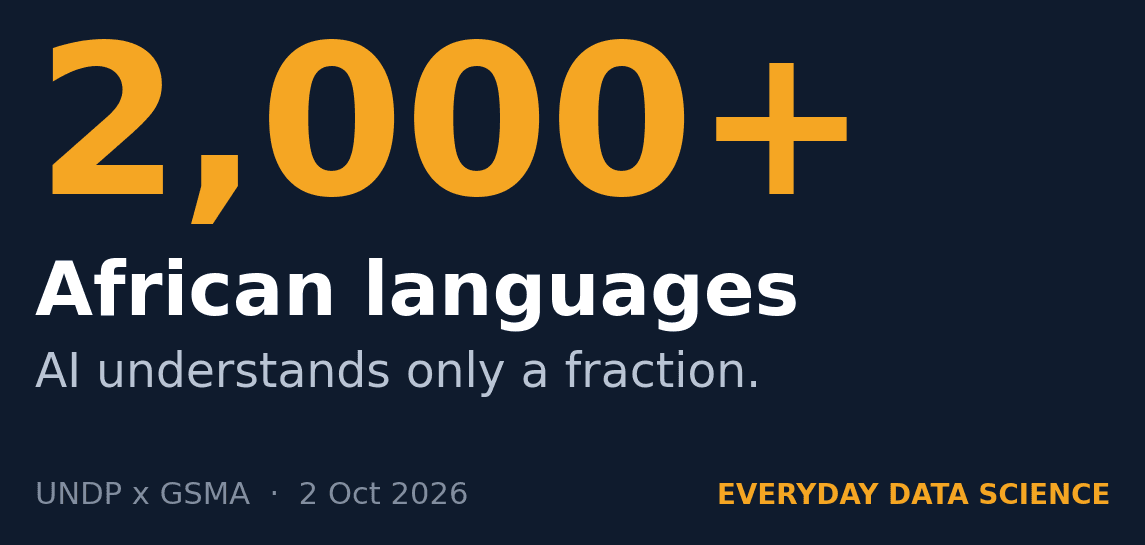
On 2 October 2026 in New York, the United Nations Development Programme and the GSMA announced a strategic partnership to strengthen Africa's artificial intelligence ecosystem. The headline commitment: accelerate African-led AI solutions, with African-language AI named as an explicit priority.
This is worth reading closely, because it gets the hard part right. Language is the binding constraint on AI adoption across the continent, and most AI policy announcements sail past it.
What the partnership actually promises
Sticking to what the two organizations put in writing:
- Through UNDP's timbuktoo initiative, they will "improve access to compute infrastructure for priority AI pilots" and connect African talent to real-world AI applications.
- They will support the deployment of locally developed AI solutions and "identify pathways for long-term sustainability and scale."
- The collaboration mobilizes talent across both networks, including the UNDP-supported University Innovation Pods (UniPods) network, AI Labs, universities, and ecosystem partners.
- It explicitly aligns with the GSMA's ATLAS Umoja AI work, launched in July 2026 with government and industry partners, which pools language data and expertise from across Africa for AI services that reflect local needs.
The two quotes on the record, from UNDP's Aissata De and GSMA's Angela Wamola, both center the same claim: Africa's AI future must be shaped by African talent, in African languages.
Why language-first is the right bet
Africa has more than 2,000 languages. AI understands only a fraction of them. That single fact, stated plainly on the ATLAS Umoja AI site, explains why so much "AI for Africa" work lands flat: a model that cannot hear or speak your language is not your tool.
ATLAS is not starting from a blank page, which is the main reason this partnership deserves more credit than a typical memorandum. The open platform already has three working layers: evaluation benchmarks built with language communities, multilingual models released openly on Hugging Face under open licenses, and a community of developers and startups building on top. Real things exist. A Nigerian team built SabiLaw, which explains Nigerian law in local languages. Farm Eyes pairs computer vision with multilingual, voice-first guidance for crop disease. Lauya mi is a tenant-rights assistant operating in Yoruba, Hausa, Igbo, and Pidgin.
The country-launch model matters too: a national ministry or research institution anchors the process, data is recorded, transcribed, and validated by native speakers, and the resulting model is released openly. That is the correct way to do language data, and it is rare to see it stated as policy.
I build voice-first tools myself, and the lesson keeps repeating: for users who cannot type, or who never learned to read, the interface is voice notes in and voice notes out. Language support is not a feature. It is the product.
What is missing
Here is the other side, stated with the same discipline. The official release contains:
- No funding figure. Not for compute, not for pilots, not for the UniPods network. "Improve access to compute infrastructure" is a sentence, not a budget.
- No timeline. No date for the first pilots, no date for compute allocations, no milestones.
- No selection criteria. Which countries, which languages, which teams get the "priority AI pilots"? Unstated.
- "Pathways for long-term sustainability" is the kind of phrase that survives every draft because nobody can argue with it and nobody can measure it.
This is not a reason to dismiss it. MoUs that ship with real artifacts behind them (ATLAS has benchmarks and open models; UNDP has timbuktoo and UniPods) convert more often than MoUs that ship with adjectives. But the conversion is not guaranteed, and the history of African tech announcements gives every reason to wait for receipts.
How to tell whether this one is real
Practitioners do not need to trust the press release. Watch for five concrete markers:
- A public call or application process for the "priority AI pilots," with named selection criteria.
- Named compute allocations: how many GPU-hours, for whom, on what infrastructure.
- Continued ATLAS model releases on Hugging Face under open licenses, with per-language benchmark scores.
- UniPods and AI Labs participation that shows up in actual pilot teams, not just partner logos.
- At least one deployed, sustained service in a language the big models currently mangle, with real usage numbers attached.
If those arrive, the partnership delivered. If six months pass and the only output is more events, it did not.
In favour
- The language-first framing targets the actual bottleneck, not the photogenic one.
- ATLAS Umoja AI is real infrastructure with open artifacts, not a slide deck.
- GSMA brings the mobile operators, which is the distribution channel: most African users will meet AI through a phone, on a mobile network.
- UNDP's timbuktoo and UniPods give it a path to talent outside the usual capital-city startup circuit.
Against
- No money and no timeline means this is a promise to coordinate, not a program to join.
- Partnerships between large institutions move slowly, and "sustainability pathways" can mean the funding never arrives.
- Language data collected badly (parachute corpora, no native-speaker validation) produces bad models; ATLAS's process is good on paper and unproven at continental scale.
- Compute access for "priority pilots" could easily concentrate in the two or three countries that already have infrastructure, repeating the pattern this claims to fix.
What would make me wrong
If, within six months, named pilots are running with published compute budgets and at least one openly released model shows benchmark gains on a language it previously handled poorly, then the skepticism above was misplaced and this post underestimated the partnership. If the next public output is a panel discussion, the skepticism was about right. Either way, the test is observable.
Sources
- UNDP and GSMA partner to scale African-led AI innovation (GSMA Newsroom, 2 Oct 2026)
- UNDP and GSMA partner to scale African-led AI innovation (UNDP press release, 2 Oct 2026)
- ATLAS Umoja AI (African Tongues and Languages at Scale; benchmarks, open models, and community builds)
- Africa's 12,000 GPUs and the gap announcements don't close (Everyday Data Science, 28 Sep 2026; background on the continent's compute bottleneck)
Which language that AI currently mangles would change the most lives in your community if it worked tomorrow?
Related on Everyday Data Science: Africa's 12,000 GPUs and the gap announcements don't close
About the writer
Data Scientist & AI Researcher
Data scientist and AI researcher at Pace University. I coined Artificial Frictional Unemployment, and built the first machine learning model for crop yield prediction in Sierra Leone. Author of Understanding Agentic AI. I write about agentic systems and applied ML, with a bias toward what actually works, and who gets left out when it doesn't.
Found this useful? Passing it on to someone who builds is the best way to help the publication grow.
Built something worth sharing? Write it up for us →