Brain Waves to Words: What Brain2Qwerty Actually Does, and What It Doesn't
 Ibrahim Denis FofanahData Scientist & AI Researcher6 min read·Neuroscience · Brain-Computer Interfaces
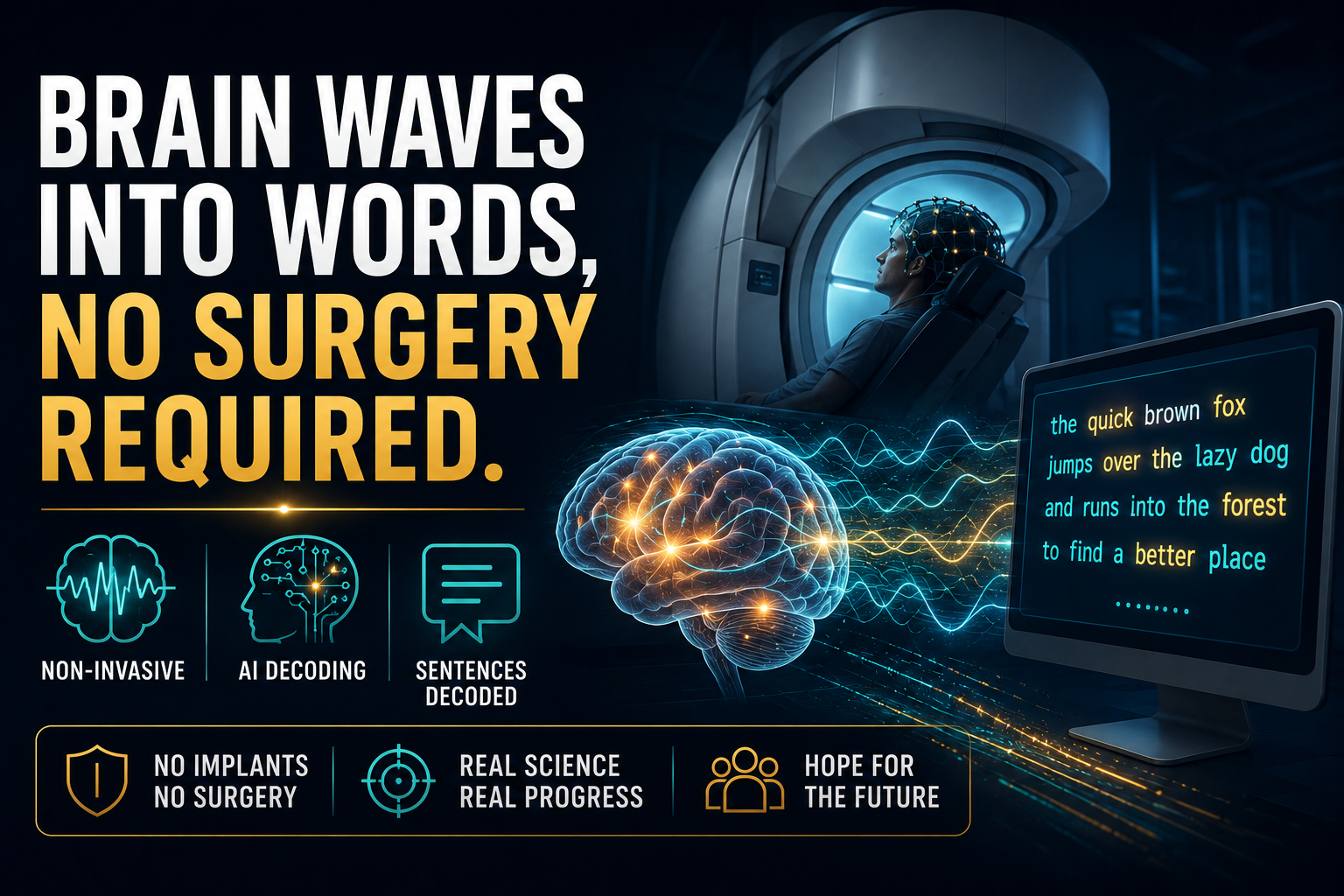 The headline writes itself: brain waves into words, no surgery required. Meta's Brain2Qwerty decodes typed sentences from brain activity without putting anything inside your skull, and it's published in Nature Neuroscience, this is real science, not a demo reel.
It is genuinely important work. It is also three steps further from your living room than almost every article about it will tell you.
Both of those things deserve saying carefully, because the people reading this most closely are people who have lost the ability to speak, and they have been promised things before.
What they actually built
The setup is elegant. Participants sat in a brain scanner and typed short memorized sentences on a QWERTY keyboard. Meanwhile their brain activity was recorded, with MEG (magnetoencephalography, which measures the tiny magnetic fields produced by neural activity) or EEG (electroencephalography, the familiar electrodes-on-the-scalp method).
A deep-learning model was then trained to reconstruct what they typed from the brain signal alone.
The scale is respectable: version 1 ran across 35 participants, covering hundreds of thousands of characters. Version 2, announced in 2026, trained on roughly 22,000 sentences from nine participants, about ten hours of recording each, and decodes in real time.
The numbers
Result v1, MEG 32% character error rate (average) v1, EEG 67% character error rate v2, MEG 61% average word accuracy, real-time
Version 2 is a substantial jump, and real-time decoding is a genuine milestone.
But sit with 61% word accuracy for a moment. It means roughly four words in every ten are wrong. Read a sentence where four words in ten are wrong and you'll find it's not a slightly degraded sentence, it's frequently a different sentence. This is impressive engineering and it is not yet communication.
The three things the headlines leave out
1. MEG is not a headset. It's a room.
This is the one that matters most, and it's the one almost always omitted. Magnetoencephalography requires a magnetically shielded room and a machine the size of a small car, because the magnetic fields produced by your neurons are around a billion times weaker than the Earth's own magnetic field. Any passing lift, any car in the street, any zip on your jacket will drown the signal.
You cannot wear this. You cannot take it home. Today it exists in a handful of research hospitals.
2. The participants were typing.
They physically moved their fingers on a keyboard. That means the model is substantially decoding the motor activity of typing: the brain planning and executing hand movements, not abstract, unspoken thought.
This is scientifically reasonable and it is a legitimate result. But it means the system has not yet been shown to work for the people who need it most: someone who cannot move their hands cannot generate the signal the model was trained on. That's not a small gap. It's the gap.
3. The portable option doesn't work.
EEG is cheap, wearable, and already in consumer headsets. It's also the version that came in at 67% character error rate: roughly two characters in three wrong. Effectively unusable.
So the field is stuck in an awkward place: the technology that works isn't portable, and the technology that's portable doesn't work.
Why it still matters enormously
Having said all that, the temptation now is to dismiss it, and that would be equally wrong.
Non-invasive is a genuinely huge deal. The state of the art in brain-to-text, the systems achieving genuinely usable accuracy, require electrodes implanted in the brain. That means neurosurgery, infection risk, and electrodes that degrade as the brain forms scar tissue around them. Every one of those is a hard ceiling on how many people can ever benefit.
A method that needs nothing inside the skull removes all of it. If it can be made to work, it scales in a way implants never can.
And the AI contribution is real. The hard problem here is representation: brain signals are extraordinarily noisy, vary enormously between individuals, and there's very little labelled data per person. Getting a model to extract a sentence from that is a serious achievement in decoding, the kind of problem that pushes the field forward regardless of whether this exact system ships.
Nature Neuroscience doesn't publish press releases. This cleared peer review.
The real bottleneck
Strip everything else away and the challenge is a single sentence:
MEG works but can't be worn. EEG can be worn but doesn't work.
Everything now depends on closing that gap, either by making MEG dramatically smaller (there's active work on optically-pumped magnetometers, which don't need the cryogenic cooling that makes today's MEG a room), or by making EEG decoding dramatically better.
The second question, and the harder one: can this work without the typing? Decoding attempted movement in someone who is paralysed is a different problem from decoding executed movement in someone who isn't. Implanted systems have shown it's possible in principle. Whether a non-invasive signal is strong enough to carry it is genuinely open.
Key takeaways
- The research is real: peer-reviewed in Nature Neuroscience, with real-time decoding at 61% word accuracy in v2.
- 61% word accuracy is not communication. Four words in ten wrong usually means a different sentence.
- MEG is a shielded room, not a headset. This is the omission that makes most coverage misleading.
- Participants physically typed: so this hasn't been shown to work for people who can't move.
- EEG, the wearable option, is at 67% character error. The portable path doesn't work yet.
- It still matters: non-invasive scales in a way implants never will. That's worth a decade of work.
The honest summary: this is a real step on a long road, reported as though it were the destination.
Where do you land, is non-invasive decoding the future, or will implanted systems get there first? 👇
Sources: Brain-to-Text Decoding: A Non-invasive Approach via Typing (Meta AI Research); Noninvasive decoding of typed sentences from human brain activity (Nature Neuroscience); Brain2Qwerty project page. Version 2 figures are from Meta's 2026 announcement.
About the writer
Data Scientist & AI Researcher
Data scientist and AI researcher at Pace University. I coined Artificial Frictional Unemployment, and built the first machine learning model for crop yield prediction in Sierra Leone. Author of Understanding Agentic AI. I write about agentic systems and applied ML, with a bias toward what actually works, and who gets left out when it doesn't.
Found this useful? Passing it on to someone who builds is the best way to help the publication grow.
Built something worth sharing? Write it up for us →