I Filed 49 Data Job Applications in Two Weeks. The Funnel Was the Hard Part.
Five rejections arrived in four days or less, a fifth of my applications stalled on portal plumbing, and the posted salary bands were wider than the job titles suggested. A real funnel, measured.
 Ibrahim Denis FofanahData Scientist & AI Researcher7 min read·The Job Hunt, Quantified · Careers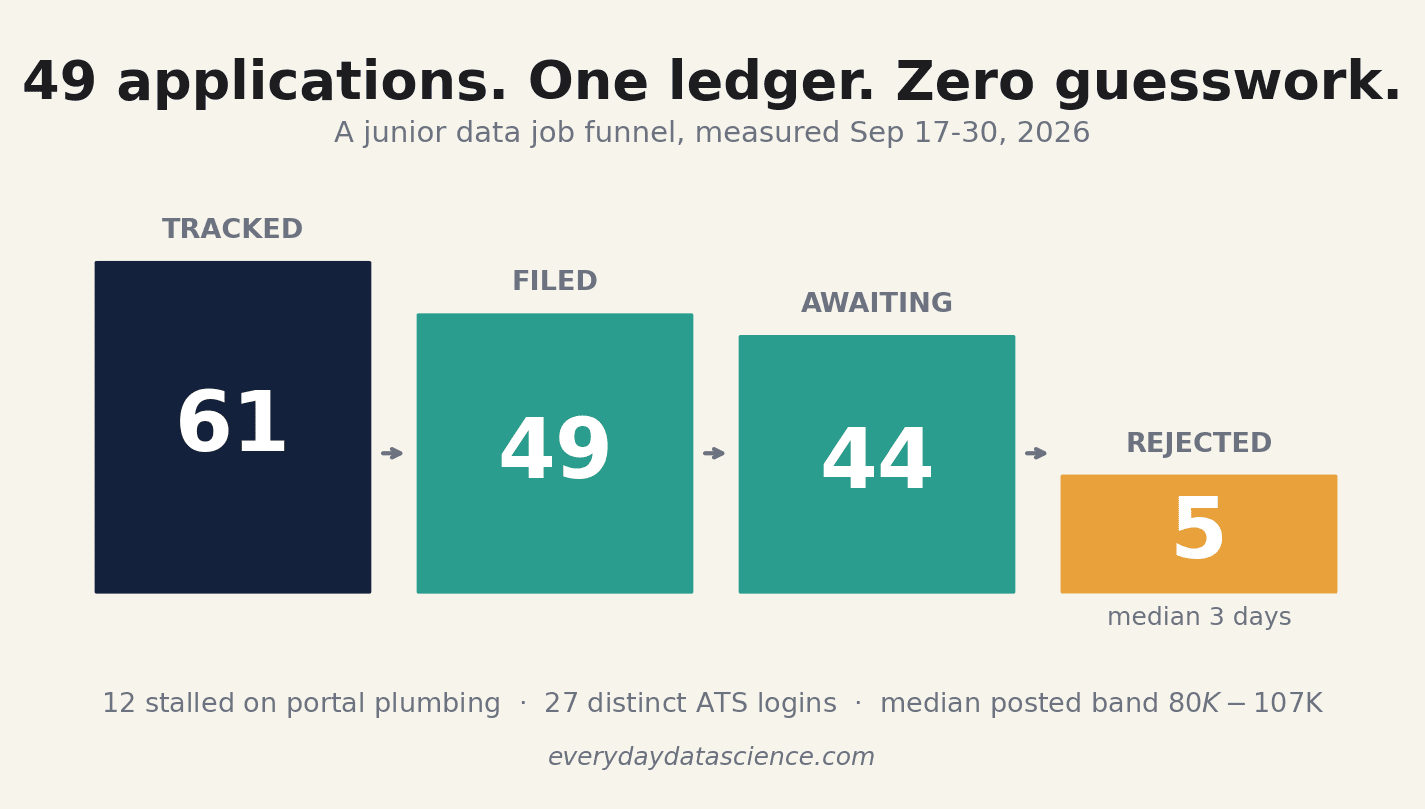
For the last two weeks of September, my job hunt ran like a pipeline with receipts. Every application went into a ledger: company, role, portal, date, salary band, confirmation text, and what happened next. Forty-nine filings later, the ledger is a dataset, and it says things about junior data hiring that no motivational post will tell you.
The setup matters, so here it is. All 49 applications went out between September 17 and September 30, 2026. Every one is a junior to early-career data role: Data Analyst, Data Scientist I or Associate, BI Analyst, Analytics Engineer, Research Analyst. Locations are New York City, New Jersey, or remote US. And every posting was scored against my resume before anything was filed. Only matches scoring 80 or above made the cut.
The ledger itself is simple: one row per posting, with columns for the portal, the date filed, the exact confirmation text, the posted salary, the match score, and a status that moves from filed to awaiting to rejected or stalled. It takes about two minutes per application to maintain, and it has already paid for itself twice. Once, a spam filter silently ate a submission, and the missing confirmation row caught it. Once, I needed the exact salary band from a posting that had since been taken down, and the ledger still had it.
1. Rejections arrive fast, or not at all
Five rejections so far. Every one landed within four days of filing: one after a single day, three after three days, one after four. The median rejection took three days.
Nobody strung me along. The pattern suggests screening at this level is largely mechanical: a recruiter or a filter reads the application, makes a call, and the no goes out quickly. The corollary is uncomfortable but useful. Silence after day four is probably not a pending decision. It is a queue you are sitting in, and the queue does not send updates.
2. A fifth of my applications never reached a human
Twelve of the 61 tracked rows are stalled, not rejected. Three sit behind hCaptcha walls. Five are waiting on account setup. One was defeated by form validation errors. One is parked on a sign-in link, one on a reCAPTCHA solve, one on a "how did you hear about us" dropdown.
That is roughly one in five applications dying on plumbing instead of merit. The application stack behind company career pages in my ledger spans 27 distinct portals and logins: Ashby, Greenhouse, four flavors of Workday, iCIMS, SmartRecruiters, and a long tail of one-offs. There is no one-click apply on the direct-source postings everyone tells you to prioritize. Budget an hour of plumbing for every three applications, or your funnel math will lie to you.
3. Salary transparency is better than the folklore, and the bands are enormous
Twenty-seven of the 49 postings showed a number: 23 posted ranges and 4 fixed salaries. The median posted band ran $80,000 to $107,098.
The spread inside that median is the real story. A healthcare analyst posting listed $49,430 to $107,098, more than doubling from floor to ceiling. A graduate data analyst role posted a flat $55,000. At the other end, an analytics engineer posting ran $150,000 to $250,000. Same two-week window, same applicant, "junior data role" on all of them.
Two practical notes. First, public-sector postings anchored the floor. The government bands with exact-to-the-dollar figures ($66,585.13 to $93,894.39) read like civil-service scales, because they are. Second, a $100K-wide band is not a salary. It is a negotiation range wearing a transparency law as a costume. Treat the bottom of the band as the likely offer and the top as marketing.
4. The first filter was not my resume. It was my work authorization.
Before any posting got scored, it had to survive an eligibility screen. Federal postings on USAJOBS require US citizenship or nationality. NJDOL postings state plainly that they do not accept OPT or CPT. NJ Treasury analyst-trainee postings carry the same exclusion. A university recruiting-analyst posting this week excluded OPT and CPT by name.
I am on OPT with a STEM extension. That is full US work authorization, and I will not need future sponsorship. It still shrinks the addressable market before the resume ever gets read. If you are an international graduate running this same funnel, the honest first step is a work-auth filter, applied before you spend a minute tailoring anything. The rejections you never receive are the cheapest ones.
5. Screening now happens in writing, before any human contact
One fund's process asked for three written screening answers (a data-leakage story, a data-validation approach, a research summary) before any call was scheduled. A hospital system's posting noted a behavioral assessment would follow within ten business days of applying. The take-home and the phone screen used to be steps two and three. Step one is now a form with essay questions.
This changes what "applying" costs. A tailored resume is thirty minutes. A tailored resume plus three grounded written answers is two hours. The funnel rewards people who can write about their work, not just do it.
What this means if you are in the funnel
- Track it like an experiment. Conversion by stage, days to rejection, stall rate on portals. You cannot fix a funnel you cannot see.
- Reallocate on fast rejections. A no in three days is information. Do not spend a week tailoring the next application to the same profile.
- Budget for plumbing. One in five of mine stalled on logins and captchas. That time is part of the cost of applying, so plan for it.
- Read eligibility before tailoring. Work-auth exclusions, location requirements, and degree rules are binary filters. Check them first.
- Treat wide bands as ranges, not offers. Anchor your expectation to the bottom third unless you have a competing reason.
In favour
Every number here comes from filed applications with confirmation receipts, not from recalled survey answers. The salary bands are quoted from live postings captured at the time of application.
Against
This is one applicant, one fortnight, one metro area, pre-filtered to postings that scored 80 or above against one resume and survived a work-auth screen. Zero interviews have happened yet, so this is a study of the screening stage only. The funnel from application to offer may tell a different story.
What would make me wrong
If interview-stage data reverses the picture (slow rejections that convert, or portals that turn out to predict success), the conclusions change. If a second cohort runs the same ledger and gets a 10-day median rejection, my 3-day finding is a September artifact, not a rule.
Sources
Primary source: the author's application ledger, 49 filed applications, September 17-30, 2026. Salary bands quoted from the live postings at time of application. Work-auth exclusions quoted from the postings named (USAJOBS federal postings, NJDOL, NJ Treasury analyst-trainee postings).
Related on Everyday Data Science: I Benchmarked Pandas, Polars, and DuckDB on 3.5 Million Taxi Rows. Same measure-everything instinct, applied to dataframe engines.
What does your funnel look like? If you tracked every application for a month, which number would surprise you?
About the writer
Data Scientist & AI Researcher
Data scientist and AI researcher at Pace University. I coined Artificial Frictional Unemployment, and built the first machine learning model for crop yield prediction in Sierra Leone. Author of Understanding Agentic AI. I write about agentic systems and applied ML, with a bias toward what actually works, and who gets left out when it doesn't.
Found this useful? Passing it on to someone who builds is the best way to help the publication grow.
Built something worth sharing? Write it up for us →