The Everyday Brief · Issue #17
The Everyday Brief #11: five NULL traps that delete rows, the best agent still fails 63% of long tasks, and a $125,000 fellowship closing December 17
A NULL in a blocklist turned a 10-row answer into zero. WorkflowArena shows the best orchestration setup still resolves only 36.95% of long-horizon tasks. Vodacom and Cassava plan a $1B AI data centre in Egypt, and the Mozilla Fellowship letter of intent closes December 17.
November 17, 2026
Welcome to the Everyday Brief. Six things, sixty seconds, every Tuesday.
Cheat sheet of the week
Five NULL Traps That Quietly Delete Your Rows
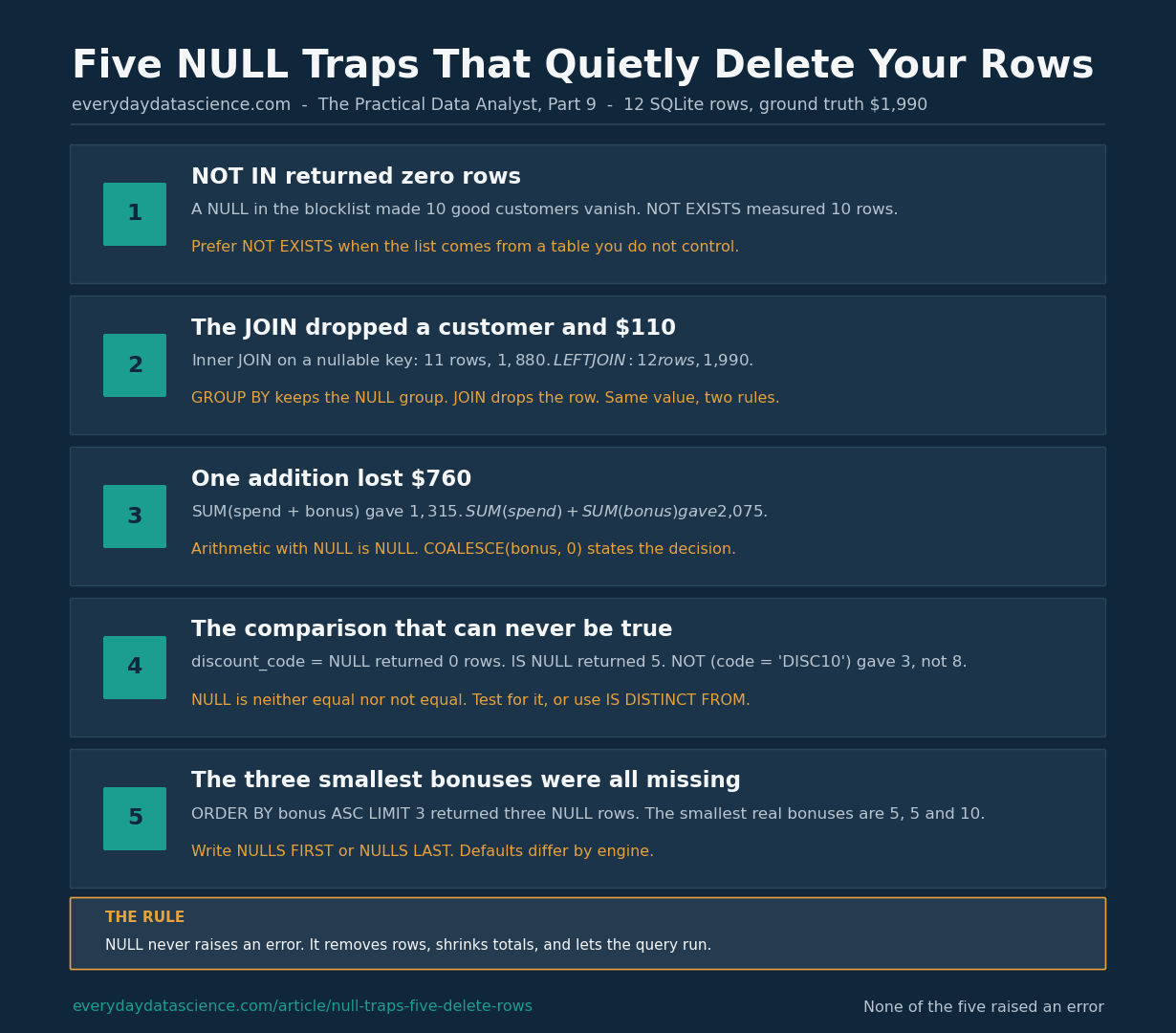
From the site this week: five NULL traps, each measured on one 12-row SQLite table. NULL never raises an error. It just removes rows and shrinks totals while the query runs clean.
Link: https://everydaydatascience.com/article/null-traps-five-delete-rows
Five traps, every number measured, not guessed. A NULL in the blocklist turned a 10-row answer into zero, and one plus sign erased $760 from a total. Keep the honest contrast in mind: GROUP BY keeps the NULL group, 1 row and $110, while an inner JOIN on the same key drops the row entirely. Same value, two rules, and the difference is which clause you are in.
One practical tip
Stop Trusting Accuracy — Tune the Decision Threshold Instead
On imbalanced data, stop trusting accuracy and tune the decision threshold instead. On synthetic fraud-like data, 10,000 rows with 2.36% positives, a baseline logistic regression scored 97.68% accuracy and caught 1 of 59 frauds. A threshold tuned on the training set, 0.1173, gave F1 0.277, the best score in the test set, flagging 42 rows and catching 14. Accuracy was the lie. The threshold was the fix.
Tune it on train, then apply it to test:
```python
from sklearn.metrics import f1_score
probs = model.predict_proba(X_train)[:, 1]
best_t, best_f1 = 0.5, 0.0
for t in [i / 100 for i in range(5, 95)]:
f1 = f1_score(y_train, probs >= t)
if f1 > best_f1:
best_t, best_f1 = t, f1
preds = model.predict_proba(X_test)[:, 1] >= best_t
```
Tune on train and apply to test. Tuning on the test set is peeking. And state the cost plainly: the tuned threshold flagged 42 rows to catch 14, so two of every three flags were false alarms. That is the trade.
Worth reading
The Best Orchestration Still Resolves Only 37% of Long Tasks
The Best Orchestration Still Resolves Only 37% of Long Tasks (arXiv:2611.12856, submitted November 9, 2026). WorkflowArena, from Navers Lab, Einsia.AI and Tsinghua, tests long-horizon agent work: 145 tasks across 8 domains, 25 configurations of 9 models. The best setup, Claude Opus 5.5, resolved 36.95% overall. The domain spread is the story: MATH 95.83%, software engineering 29.41%, law 0.00%, and finance never above 18.75%. More effort pays for Claude, Opus rising from 22.02% to 36.95% as effort increases, and barely for GPT, Astra moving only from 27.34% to 30.80%. Price reorders the ranking: GPT-6 Sol at low effort scored 27.59% at $3.61 per task, Opus at high effort scored 34.11% at $6.66, and Astra at extra-high effort scored 30.80% at $29.26, 4.4 times the Opus price for 3.31 points less. A good workflow also transfers: Opus-written workflows added 6.41 points on average to models that did not write them.
Why it matters for builders: long-horizon work is where agents earn their keep, and the ceiling is still 37%. If your agent runs multi-step workflows, test the whole workflow end to end, not single-step accuracy, and price the effort level before you ship it. Our full breakdown is on the site.
https://everydaydatascience.com/article/workflowarena-orchestration-best-model-37-percent
Africa AI
Vodacom, Cassava and Elsewedy Plan a $1B Sovereign AI Data Centre in Egypt
Vodacom, Cassava and Elsewedy plan a $1B sovereign AI data centre in Egypt. Announced November 10, 2026, the first phase is about $200M and 20MW within three years, with a long-term target of 200MW. Vodafone Egypt holds about a 30% stake, and South Africa and Kenya are named as next. The counterweight in the same week: South Africa's national AI policy slipped, with the draft now due to the minister by November 30 and Cabinet by March 2027, after a November 2026 target. And Google.org launched its AI Research and Future Skills programme, 30 universities and 30,000 students across South Africa, Ghana, Kenya and Nigeria. Concrete capacity is moving. The policy meant to steer it is still catching up. Our full analysis is on the site.
https://everydaydatascience.com/article/vodacom-cassava-egypt-billion-ai-data-centre
One opportunity
Mozilla Fellowship 2027-2028, letter of intent closes December 17, 2026 at 11:59 PM Pacific. Ten fellows, up to $125,000 over 12 months, starting June 2027. Two tracks: Embedded Fellows work with a host civil society organisation and receive up to $100,000; Independent Fellows pursue their own project and receive up to $125,000. Open worldwide to technologists, researchers and builders working on technology for the public good. Shortlisted applicants are invited to submit a full application by March 12, 2027. Apply through the Mozilla Foundation site before December 17.
https://www.mozillafoundation.org/ca/join-us/
Over to you
Have you ever had a query return zero rows and blamed the data, when the real cause was a NULL in the list?
What did it cost you, and what do you check first now? Hit reply. The best answers go in next week's Brief.
This issue features work by Ibrahim Denis Fofanah.