The Everyday Brief · Issue #14
The Everyday Brief #8: a mean shift that left AUC untouched, a harness swap that was mostly noise, and Girl Up awards closing October 31
A mean shift left AUC exactly unchanged at 0.8834 while accuracy fell from 0.80 to 0.60. Swapping agent harnesses flipped 13% of tasks, the same as rerunning the same harness. Three plans to share AI computing across Africa landed in six days. And Girl Up Project Awards of up to $1,000 close October 31.
October 27, 2026
Welcome to the Everyday Brief. Six things, sixty seconds, every Tuesday.
Cheat sheet of the week
One model, four scenarios, every number measured, not guessed
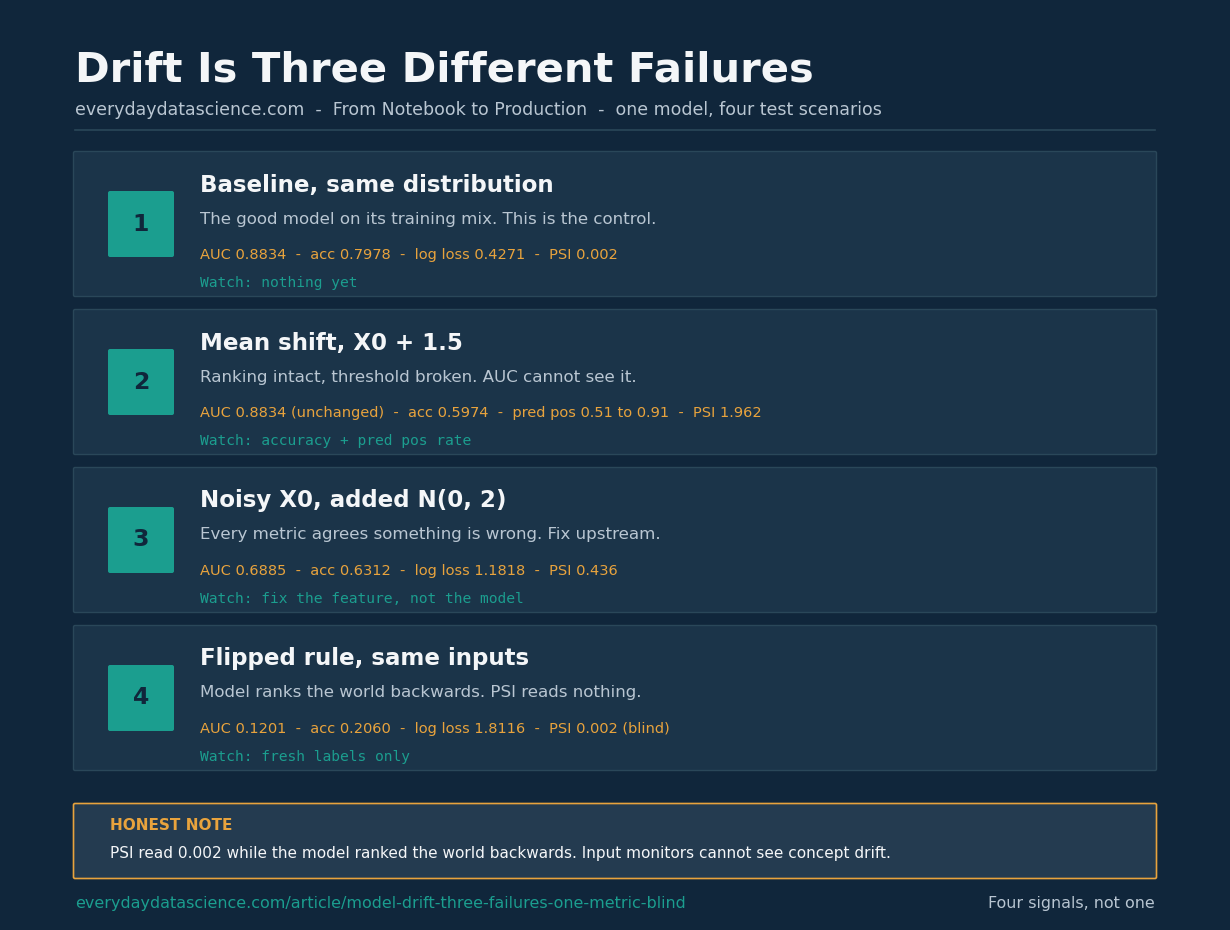
From the site this week: one logistic regression, four test scenarios. Each scenario broke a different metric.
One model, four scenarios, every number measured, not guessed. A mean shift left AUC exactly unchanged at 0.8834 while accuracy fell from 0.7978 to 0.5974. A flipped labeling rule scored AUC 0.1201 while PSI read 0.002, the same as baseline. Keep the honest note on the card in mind: input monitors cannot see concept drift. Four signals, not one.
One practical tip
Stop filtering date ranges with BETWEEN and a date-only end
Stop filtering date ranges with BETWEEN and a date-only end. Use a half-open range instead:
```sql
SELECT COUNT(*), SUM(amount)
FROM orders
WHERE ts >= '2026-03-01' AND ts < '2026-04-01';
```
On the site's five-order test table, BETWEEN '2026-03-01' AND '2026-03-31' returned 2 orders and $170. The true March figure is 4 orders and $420. A date with no time means midnight at the start of that day, so both March 31 orders fell after the cutoff, one by fifteen minutes. The half-open range returned the hand-counted truth, and it works for days, weeks and quarters without knowing how many days the month has.
Worth reading
What Does a Harness Buy? Tokens, Mostly
What Does a Harness Buy? Tokens, Mostly (arXiv:2610.04433, submitted October 3). Five models through three production harnesses on SWE-bench Verified, with ten rerun pairs to measure the noise floor. Swapping the harness flipped 13% of task outcomes. Rerunning the exact same harness flipped 13% too. Model swaps flipped 22%. The heaviest harness (Claude Code, about 16,000 preamble tokens per step) and the lightest (mini-SWE-agent, under 1,000) came out equivalent within five points on 447 tasks, while cost per task differed up to 3x.
Why it matters for builders: a two-point harness lead on a few hundred tasks is below what the benchmark can resolve. You need roughly 447 tasks to separate a five-point gap, and 45 tasks catch a 13-point gap only about half the time. The one real harness effect the study found was a loss: OpenCode trailed by up to 9 points, about half of it from runs its output cap cut short. Compare dollars per solved task, not pass rate alone. Our full breakdown is on the site today.
Africa AI
Three plans to share Africa's AI computing landed in six days, and none of them has all the numbers yet. On October 16, the African Development Bank and UNDP moved their $10 billion AI initiative into deployment, $1 billion a year over ten years across 54 countries, starting with five unnamed countries. On October 20, the World Bank launched its AI Infrastructure and Readiness Initiative in Seoul, built on shared, pay-as-you-go GPU access with Cassava Technologies and NVIDIA as knowledge partners, with no funding figure, no countries, and no GPU location published. On October 21, Nigeria proposed pooling GPUs with Rwanda, Senegal and Kenya, naming electricity, connectivity and chips as the constraints, and noting that about 20 million Nigerians are still offline.
The idea is right: sub-Saharan Africa holds about 18% of the world's people and about 0.6% of its data centre capacity. The test is what each plan publishes next. The World Bank needs a price per GPU hour and a location, because 39 countries in the region have data protection laws. The AfDB and UNDP need the five first countries and a first set of financed projects with dates. And remember the distinction the piece makes: $10 billion is a mobilisation target to be aligned and catalysed, not a fund already in hand. Our full analysis is on the site.
One opportunity
Girl Up Project Awards 2026, applications close October 31, 2026, no extensions
Girl Up Project Awards 2026, applications close October 31, 2026, no extensions. Trust-based grants for youth aged 13 to 25 with an idea to advance gender justice in their own community. Two tiers: Leader of Self, up to $500 for individuals and new clubs taking a first step; Leader of Peers, up to $1,000 for existing Girl Up Clubs+ that have already led at least one local action. You choose the issue, design the project and set the budget, and Girl Up does not ask for receipts. Funds go by international transfer in US dollars, starting in December. Selected projects run January to April 2027, with an Innovation Lab onboarding on November 28, a one-to-one session with an alumni mentor, and a final report due April 30, 2027.
Read the eligibility closely before you apply. Applicants under 18 need an adult co-signer. Your group does not need to be a registered organisation. A third tier, Leader of Change at up to $2,500 for projects designed by two or more Clubs+, opens in 2027, not this round. The application questions are published in advance, so draft your answers before you open the form. Results come in the last week of November.
Over to you
Which metric stayed green while your model failed in production: a ranking score, an input monitor, or a threshold that moved without anyone noticing?
Hit reply. The best answers go in next week's Brief.
This issue features work by Ibrahim Denis Fofanah.