The Everyday Brief · Issue #18
The Everyday Brief #12: five GROUP BY traps that rewrite totals, multi-agent teams lose to a sampled baseline, and an FDE fellowship closing December 31
A NULL region group held $410 of $1,860, and dropping it cut the total to $1,450. A 516-configuration meta-analysis finds multi-agent systems trail sampled single-agent baselines. Google's Africa Applied AI Lab picked 10 startups from thousands of applicants, and the a16z FDE Fellowship closes December 31.
November 24, 2026
Welcome to the Everyday Brief. Six things, sixty seconds, every Tuesday.
Cheat sheet of the week
Five GROUP BY Traps That Change Your Totals Without an Error
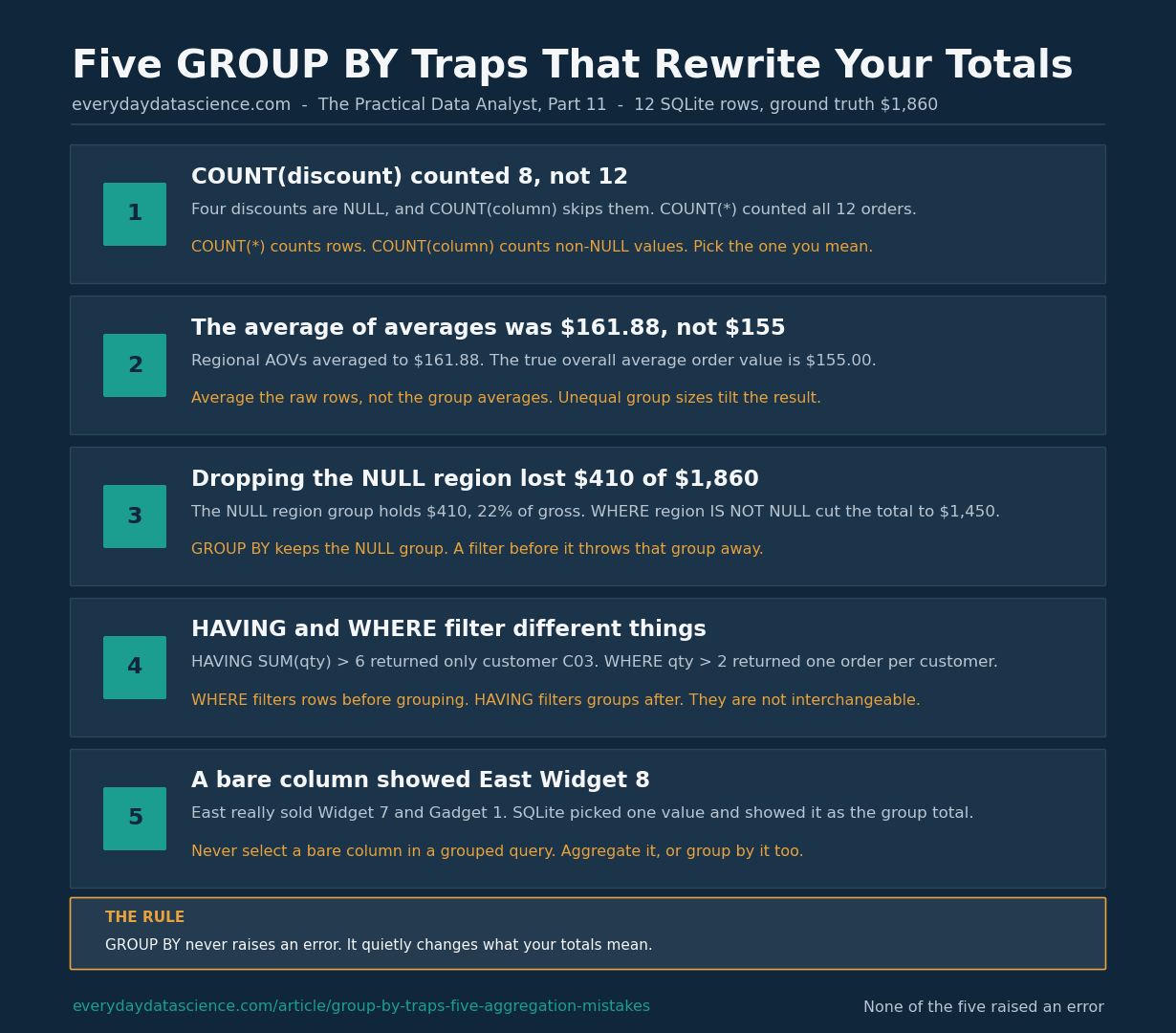
From the site this week: five GROUP BY traps, each measured on one 12-row SQLite table. GROUP BY never raises an error. It just changes what your totals mean while the query runs clean.
Link: https://everydaydatascience.com/article/group-by-traps-five-aggregation-mistakes
Five traps, every number measured, not guessed. COUNT(discount) counted 8 rows, not 12, because four discounts were NULL, and the average of regional averages came out $161.88 against a true $155.00. Keep the honest contrast in mind: GROUP BY keeps the NULL group, 1 row and $410, while a WHERE filter on the same column drops that group entirely and cuts the total to $1,450. Same value, two rules, and the difference is which clause you are in.
One practical tip
When 40% of Your Values Are Missing, the Imputer Matters More Than the Model
When 40% of your values are missing, the imputer you pick matters more than the model. On the Wisconsin breast cancer data, 569 rows and 30 features, with 40% missing at random in train and test, a logistic regression with iterative imputation scored AUC 0.9987 and log loss 0.0687, basically the complete-data result of AUC 0.9977 and log loss 0.0679. KNN imputation was worst at AUC 0.9813 and log loss 0.1583. And the surprise: adding missing-value indicators, the move the scikit-learn guide suggests tends to help, hurt instead, dropping AUC to 0.9868 and accuracy to 93.7%.
Fit the imputer inside a pipeline, on train only:
```python
from sklearn.experimental import enable_iterative_imputer
from sklearn.impute import IterativeImputer
from sklearn.pipeline import Pipeline
from sklearn.linear_model import LogisticRegression
pipe = Pipeline([
("impute", IterativeImputer(random_state=42)),
("model", LogisticRegression(max_iter=1000)),
])
pipe.fit(X_train, y_train)
```
Fit on train only and apply to test. Fitting on the full data before the split leaks test information into training. One honest limit: this was missing completely at random, on one dataset. Real missingness has a reason, and the reason can change the answer.
Worth reading
Multi-Agent Systems Lose to a Sampled Single-Agent Baseline
Multi-Agent Systems Lose to a Sampled Single-Agent Baseline (arXiv:2611.17610, submitted November 13, 2026). PACE, a meta-analysis from the University of Nevada, Reno, pools 9 studies and 516 multi-agent configurations. Across 474 contrasts, multi-agent systems trail a sampled single-agent baseline by 0.051 on average, and they are not ahead in 74% of comparisons. The clearest table comes from Jwalapuram and co-authors: multi-agent debate scores 0.448, plain chain of thought 0.455, and self-consistency voting 0.489, while the multi-agent setup costs 8.1 times a single call. The controlled experiment in the same paper is blunt: a debate setup on llama3.1:8b used 19,571 tokens per question to score 0.567, while a frontier single model scored 0.581. The debate was also wrong together 16.4% of the time, against 2.4% for the single model.
Why it matters for builders: if you are paying for agents to talk to each other, first check whether sampling the same model a few times and voting beats them. It usually does, for a fraction of the tokens. Our full breakdown is on the site.
https://everydaydatascience.com/article/multi-agent-systems-sampled-baselines-pace
Africa AI
Google's Africa Applied AI Lab Picked 10 Startups from Thousands of Applicants
Google's Africa Applied AI Lab picked 10 startups from thousands of applicants across 45 countries. Announced November 11, 2026, the first cohort includes AethexAI, Agrails, Crane AI Labs from Uganda, Intron, Satlyt from Kenya, Smile ID, Termii, Tolbi from Senegal, Vendy and Viamo. Three are Nigerian and four work across the continent. The startups get early access to Gemini and Gemma models, time with Google engineers, and introductions to venture partners including 4DX, Norrsken22, Novastar and Ventures Platform. A demo day is planned for December at the Accra AI Community Centre. What Google did not disclose: any cash amount or cloud-credit figure. In the same week, Enza Capital announced a $21M first close for its AI Africa Fund, targeting $60M, with first cheques of $250,000 to $3M from pre-seed to Series B. Money is moving toward African AI builders. The terms are still mostly undisclosed, so watch what actually lands. Our full analysis is on the site.
https://everydaydatascience.com/article/google-africa-ai-lab-ten-startups
One opportunity
a16z FDE Fellowship, Cohort 02
a16z FDE Fellowship, cohort 02, applications close December 31, 2026. An 8-week fellowship for forward deployed engineers and applied AI leaders building and deploying AI with real customers, starting mid-January 2027. The programme runs dinners and events every other week, mostly in San Francisco and New York City, but fellows can be based anywhere. Applications are reviewed on a rolling basis and spots are limited, so earlier is better. Apply through the a16z Build site before December 31.
https://build.a16z.com/fellowships/fde
Over to you
Have you ever shipped a GROUP BY total that was wrong, and only found out when someone checked the raw rows?
What was the trap, and what do you check first now? Hit reply. The best answers go in next week's Brief.
This issue features work by Ibrahim Denis Fofanah.