The Everyday Brief · Issue #16
The Everyday Brief #10: a CTE that returned $680 instead of $915, frontier models falling to chance at 10,000 tokens, and a $500 STEM scholarship closing December 18
Five CTE traps, each measured on twelve rows: a filter in the wrong place moved a total by $235. StateBench shows frontier models fall to chance on state tracking at 10,000 tokens. Sunflower V2 covers 67 African languages, and the WAAW Foundation scholarship for women in STEM closes December 18.
November 10, 2026
Welcome to the Everyday Brief. Six things, sixty seconds, every Tuesday.
Cheat sheet of the week
Five CTE Traps That Return the Wrong Answer Quietly
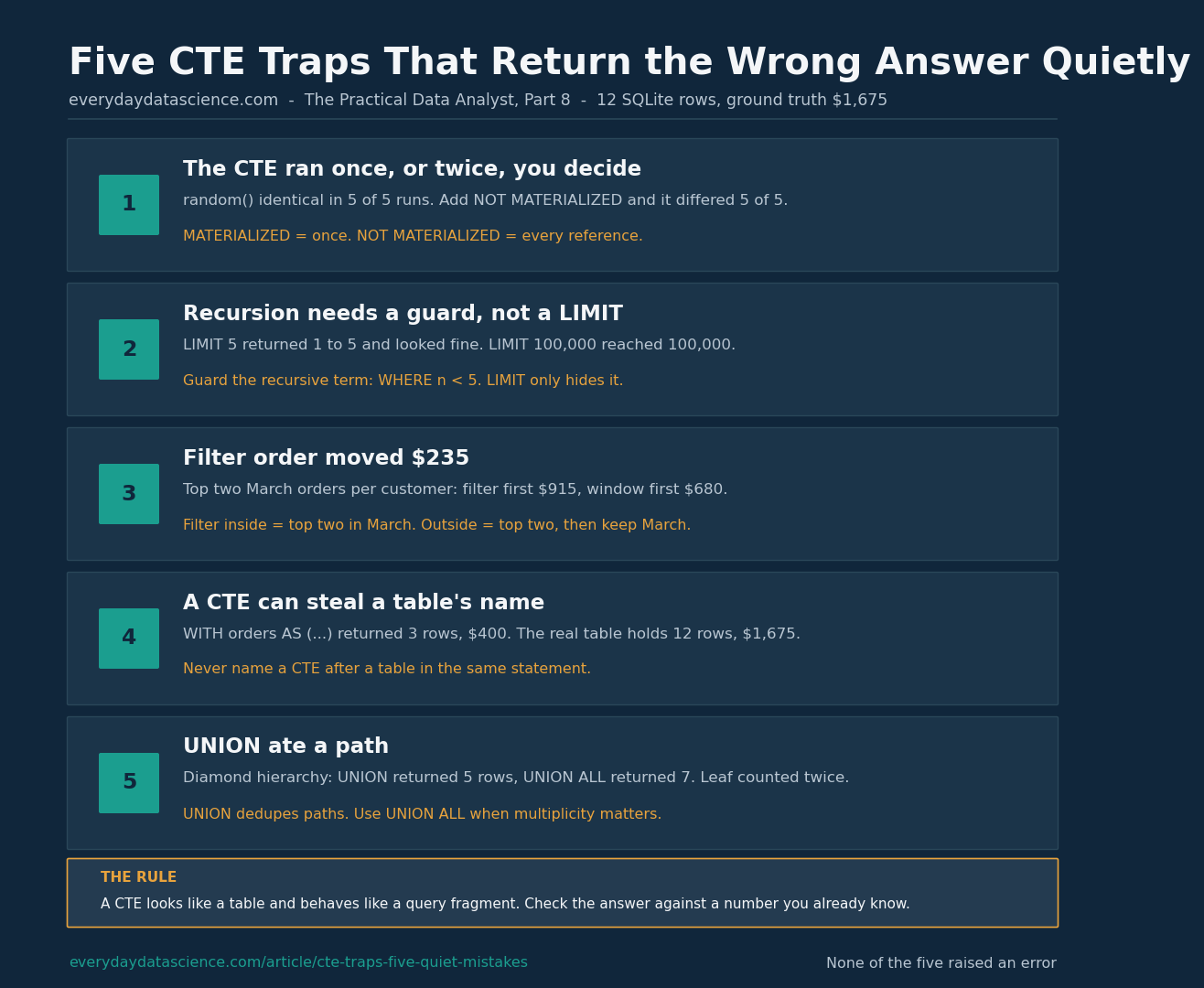
From the site today: five CTE traps, each measured on one 12-row SQLite table. A CTE feels like a temp table. It is not.
Five traps, every number measured, not guessed. A filter placed before a window function moved a total from $915 to $680, and a CTE named after a table returned 3 rows instead of 12. Keep the honest null result in mind: at 100,000 rows, joining through a CTE took 0.0648 seconds against 0.0666 seconds for a direct join, the same answer both ways. Do not rewrite working CTEs on plan-reading alone. Measure first.
One practical tip
Scaling Gave SVM 8 Points and Trees Nothing. I Ran Four Models Raw and Scaled.
Scale your features before you train a distance-based model. On the Wisconsin breast cancer set, 569 rows and 30 features, an SVM scored 88.81% on raw features and 97.20% after scaling. k-NN went from 92.31% to 95.80%. Logistic regression hit 1,000 iterations with a convergence warning on raw features and converged in 20 iterations after scaling, fitting 28 times faster. A random forest scored 95.80% either way. Trees do not care about scale. SVM and k-NN do, because both measure distance, and one feature measured in the hundreds will drown one measured in hundredths.
Three lines, fit on train only:
```python
from sklearn.preprocessing import StandardScaler
scaler = StandardScaler()
X_train = scaler.fit_transform(X_train)
X_test = scaler.transform(X_test)
```
Fit the scaler on the training set and transform the test set with it. Fitting on the full data before the split leaks test information into training. If your model measures distance and you have not scaled, your accuracy number is partly a unit-conversion accident.
Worth reading
The Best Models Track State Well. At 10,000 Tokens, They Fall to Chance
The Best Models Track State Well. At 10,000 Tokens, They Fall to Chance (arXiv:2611.03094, submitted November 2, 2026). Ai2 and NYU built StateBench, a four-tier test of whether a model can remember what changed across 8 to 64,000 assignments. Six architectures trained from scratch show the split is architectural, not a matter of scale. Transformers failed to generalize even on the simplest tier, while recurrent Gated DeltaNet models generalized perfectly on three of the four tiers. Pretrained 7B models reached only about 90% on the second tier and failed completely on the hardest. Four frontier models, Gemini 3.8 Flash, Claude Opus 5.5, GPT-6 Sol and GPT-6 Luna, handled the easy tiers well, then fell to at-chance accuracy on soluble and general finite tracking once inputs reached 10,000 to 64,000 tokens. A writeup of the paper reports the four models scored 13% or lower on the longest, hardest tasks. The same sequences formatted differently also gave different scores, so one format tests format familiarity as much as capability.
Why it matters for builders: long-context benchmarks mostly test retrieval, finding a fact in a long document. State tracking is what an agent actually does when it edits code, runs a multi-step workflow, or keeps a spreadsheet current. If your agent has to remember what changed over a long session, test that directly, in more than one format, and trust the worst score more than the best. Our full breakdown is on the site.
Africa AI
Sunflower V2 Covers 67 African Languages. The Speech Results Are the Real Story.
Sunflower V2 covers 67 African languages. The speech results are the real story. Uganda's Sunbird AI took Sunflower from 31 Ugandan languages to 67 across Africa, added speech recognition for 51 languages and text-to-speech for 20, and shipped a lightweight version that runs on a mid-range phone. The speech model posts a 0.227 macro word error rate on AfriVox-v2, the best published number on that benchmark, and 0.372 on SimbaBench. That still means roughly one word in four wrong on spontaneous speech, and the per-language spread matters more than the average: best on 30 of 51 languages means 21 where something else wins.
Read the counterweight in the same week. NaijaFacts (arXiv:2611.06504, submitted November 4, 2026) asks 100 factual questions about Nigeria in five languages. English-query accuracy runs 49 to 50% for the US and UK but 20% for Nigeria, and the strongest models reach 66 to 79% on the UK and the US but none exceeds 31% on Nigerian statistics. Coverage is moving fast. Whether models know anything about Africa is still an open question. Our full analysis is on the site.
One opportunity
WAAW Foundation Scholarship 2026/2027
WAAW Foundation Scholarship 2026/2027, applications close December 18, 2026 at 12 noon WAT. A one-time $500 award for female students of African origin, living and studying in Africa, pursuing an undergraduate STEM degree. You must be in your first or second year, or third year of a five-year course, under 32, and able to show financial need, an excellent academic record, and evidence of leadership and community service. Medicine and nursing students are not eligible, while pharmacy students may apply. Two reference letters and a school ID are required, and selected scholars are expected to join or start a WAAW STEM Chapter at their institution and take part in outreach. Apply through the official WAAW Foundation scholarship page before December 18.
Over to you
Which silent wrong answer have you shipped: a CTE that returned the wrong total, a model scored on one split, or a query whose plan you never read?
Hit reply. The best answers go in next week's Brief.
This issue features work by Ibrahim Denis Fofanah.