The Battle for the Agentic Interface: Meta Muse, OpenAI Dots and Grok Bot
The next AI competition may be less about who has the smartest chatbot and more about who builds the most useful agent that can keep working for you.
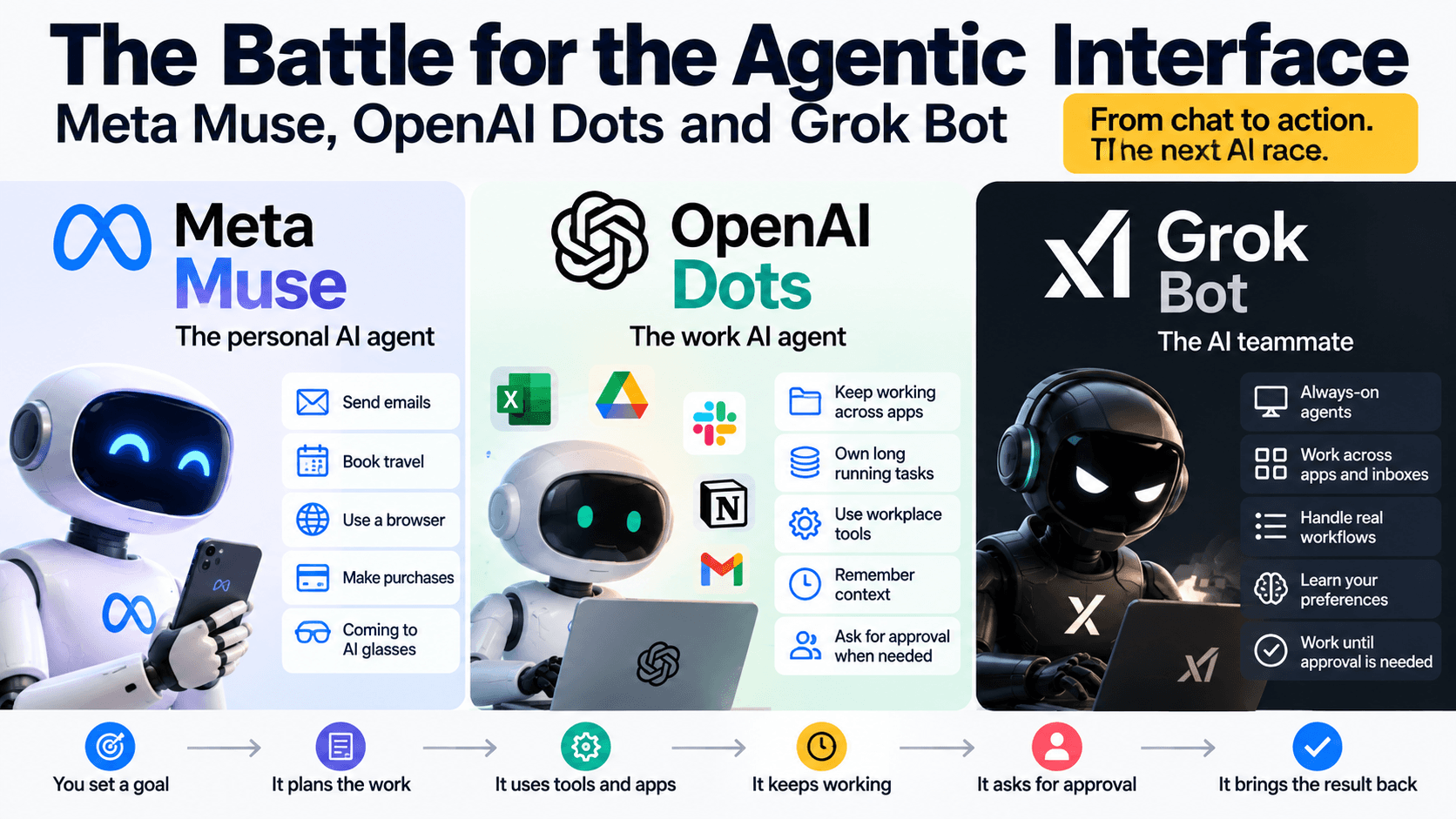
Three launches in less than two months make the direction of AI hard to miss. xAI introduced Grok Bot on August 11, Meta introduced Muse on September 8, and OpenAI introduced Dots on September 29. All three are built around the same basic idea: the AI should not stop working when the chat ends. SpaceXAI
For years, the dominant AI interface was simple. I type a question. The model generates an answer. I decide what to do next.
These products are trying to replace that loop with something different:
Give the AI a goal
        ↓
It plans the work
        ↓
It uses apps and tools
        ↓
It keeps working
        ↓
It asks for approval when necessary
        ↓
It brings the result back
That changes what I think the important AI engineering question is.
The competition is no longer only about who has the strongest model. It is increasingly about who can build the most useful, reliable and trustworthy agent runtime, the system around the model that gives it memory, tools, a computer, permissions and the ability to keep working.
Meta Muse: the agent as a personal operator
Meta calls Muse a personal AI agent.
The distinction matters.
Muse is not designed only to answer questions. Meta says it can send email, book travel, open a browser, fill out forms, negotiate on a user's behalf and continue working after the user closes the application. It can return when something changes or when it needs approval for an action such as sending an email or making a purchase. About Facebook
Muse has its own dedicated virtual machine, which Meta calls the Muse Secure VM. The agent can use that environment to interact with connected services while maintaining state between tasks. Meta also says a separate Sentinel agent reviews outbound activity and that users can control which services Muse can access. About Facebook
So the product is not simply:
LLM + prompt
It is closer to:
LLM
+ persistent computer
+ browser
+ memory
+ app connections
+ permissions
+ approval system
+ audit trail
That is a much larger engineering system.
Muse also shows how personal the agent race could become. Meta says the system can remember information that matters to the user and use that context when making future suggestions. It is also being extended beyond phones and the web. On September 23, Meta announced that Muse would be coming to its AI glasses. About Facebook
If agents eventually become something people interact with throughout the day, distribution across phones, messaging applications and wearable devices could matter almost as much as the model itself.
OpenAI Dots: the agent as ongoing responsibility
OpenAI introduced Dots on September 29.
OpenAI describes a dot as an always-on agent that can keep making progress between conversations. A dot has its own cloud computer, can work across connected applications and can remember context related to ongoing work. OpenAI
That phrase, ongoing responsibility, is the part I find most important.
Traditional assistants work one interaction at a time.
Human asks
AI answers
Human asks again
AI answers again
An agent changes the unit of work.
Instead of giving it a single prompt, I can give it a goal.
Goal
  ↓
Current state
  ↓
Next action
  ↓
Observe result
  ↓
Update state
  ↓
Continue
OpenAI says users can define what a dot is allowed to do independently and that the agent returns to the user when a decision requires human judgment. OpenAI Help Center
That sounds simple, but technically it creates several problems that a normal chatbot does not have.
The system needs to know:
What has already happened?

What still needs to happen?

Which tool should be used next?

What actions are permitted?

Which actions require approval?

What happens if the agent fails halfway through?

When should the user be interrupted?
Those are workflow and state-management problems as much as model problems.
Dots also show how quickly this interface is moving toward work rather than isolated conversations. Reuters described the launch as part of OpenAI's push toward agents that can pursue goals across applications with limited supervision. Reuters
Grok Bot: the agent as a teammate
xAI takes the idea even further in how it describes Grok Bot.
Grok Bot launched on August 11 as a team of always-on agents. According to xAI, each Bot has its own computer, can sign into existing tools, work across applications and inboxes, and continue working until something requires approval. SpaceXAI
The company describes the interaction more like handing work to a colleague than asking a chatbot a question.
That changes the mental model again.
A chatbot looks like this:
Question → Answer
A persistent agent looks more like this:
Responsibility
     ↓
Planning
     ↓
Tool use
     ↓
Execution
     ↓
Observation
     ↓
More execution
     ↓
Approval or completion
xAI says its internal teams used Bots for sales outreach, marketing campaigns, office operations and bug fixes before releasing the system more broadly. SpaceXAI
Whether users ultimately want to treat agents as digital teammates remains an open question. But the architecture is clearly moving in that direction.
The real competition may be the runtime
Looking at Muse, Dots and Grok Bot together, I think one thing becomes clearer.
The model is becoming only one component of the product.
A useful agent needs an entire execution environment around it.
                    AGENT
                      |
        +-------------+-------------+
        |             |             |
      Model         Memory         Tools
        |             |             |
   Reasoning       Context       Actions
        |             |             |
        +-------------+-------------+
                      |
               Persistent state
                      |
             Computer + browser
                      |
             Apps + credentials
                      |
           Permissions + approvals
                      |
                Audit history
The language model decides what might need to happen.
The runtime determines whether the system can actually make it happen.
That distinction matters.
A model may correctly tell me:
You should email the supplier,
update the spreadsheet,
check tomorrow's calendar,
and follow up next week.
An agent attempts to do those things.
Once AI crosses from recommendation into execution, the engineering requirements change.
Autonomy creates a permissions problem
Suppose an AI agent can access:
Email
Calendar
Documents
Browser sessions
Company systems
Payment information
Messages
Customer records
Now consider the difference between these two requests:
Draft an email to the client.
and:
Send the client an email.
The reasoning difference is tiny.
The consequences are not.
The first action is reversible. I can review the draft.
The second action affects another person.
The same problem appears everywhere.
Find a flight
versus
Buy the flight

Prepare a refund
versus
Issue the refund

Recommend a file change
versus
Delete the file

Draft a message
versus
Send the message
A serious agent therefore needs more than tool access.
It needs an authorization model.
Meta explicitly describes approval checkpoints for sensitive actions such as purchases and sending email. It also says Muse provides users with an audit trail of what the agent has done and plans to do. About Facebook
OpenAI similarly says users define what their dot can do independently and that it asks for human input when judgment is required. OpenAI Help Center
xAI says Grok Bots return when something requires approval. SpaceXAI
Three different companies are converging on the same architectural idea:
Autonomy should have boundaries.
Memory is becoming part of the product
Persistent agents also create a second difficult problem: memory.
A chatbot can forget everything after the conversation and still be useful.
A persistent agent cannot.
If I ask an agent to manage a project over three weeks, it needs to know:
What was the original goal?

What decisions have already been made?

What tasks were completed?

What failed?

What did I correct?

What preferences did I express?

What still needs my approval?
This makes agent memory different from merely saving chat history.
The system needs structured state.
For example:
task = { "goal": "Prepare weekly customer report", "status": "waiting_for_approval", "completed_steps": [ "fetch_customer_data", "calculate_metrics", "draft_summary" ], "next_step": "send_report", "requires_approval": True}
The important part is not the Python dictionary.
It is the distinction between a conversation and an ongoing job.
Once an AI system owns ongoing work, state becomes part of correctness.
Reliability becomes harder when the AI can act
There is another consequence.
Chatbot errors are often visible immediately.
If a chatbot gives me a bad answer, I can usually see the answer and reject it.
An autonomous system can make several decisions before I see anything.
Imagine an agent performing this workflow:
Read spreadsheet
      ↓
Identify customers
      ↓
Generate messages
      ↓
Send emails
      ↓
Update CRM
      ↓
Schedule follow-ups
An error at step two can propagate through every later step.
That means agent evaluation cannot stop at:
Was the final answer correct?
We also need to ask:
Did it choose the correct tool?

Did it use the correct data?

Did it perform actions in the correct order?

Did it respect permissions?

Did it recognize uncertainty?

Did it stop when human approval was required?

Could the user reconstruct what happened?
This is why I think auditability will become a major part of agent engineering.
If an agent performs work for hours, I need more than the final result.
I need to know what happened.
The interface may change too
The chatbot interface trained us to think of AI as a box waiting for prompts.
Persistent agents challenge that assumption.
The interaction may become:
Human sets direction
        ↓
Agent works
        ↓
Agent encounters uncertainty
        ↓
Human decides
        ↓
Agent continues
The human is still involved, but at a different level.
Instead of manually directing every step, the person manages goals, boundaries and exceptions.
That starts to look less like chatting with software and more like supervising software.
Whether users actually want that relationship at scale is still uncertain.
But Muse, Dots and Grok Bot are all testing versions of it.
For practitioners
If I were building an agentic system now, I would not start by asking:
Which model should I use?
I would start by drawing the execution loop.
Goal
 ↓
Plan
 ↓
Action
 ↓
Observation
 ↓
State update
 ↓
Continue, ask, or stop
Then I would design five pieces separately.
1. State
The system should know exactly where a task stands.
Do not rely entirely on conversation history.
Store important task state explicitly.
2. Permissions
Every tool should have a clear permission boundary.
Reading an email and sending an email should not automatically have the same authorization level.
3. Approval
Define which actions require a human before execution.
For example:
approval_required = { "read_email": False, "draft_email": False, "send_email": True, "make_purchase": True, "delete_file": True}
The exact rules will depend on the product.
The point is to make them explicit.
4. Auditability
Record what the agent did.
At minimum, I would want to know:
Time
Action
Tool
Input
Result
Approval status
Failure status
Without this, debugging a persistent agent becomes difficult very quickly.
5. Recovery
Assume tools will fail.
APIs time out.
Websites change.
Authentication expires.
Models misunderstand instructions.
A useful agent needs to know whether to:
Retry
Use another tool
Ask the user
Pause the task
Rollback
Stop
The recovery system may matter just as much as the happy path.
What would make me wrong
My claim is that the next major AI competition will depend increasingly on the quality of the agent runtime, not only on the underlying language model.
There are several ways that claim could turn out to be wrong.
First, users may try persistent agents and decide they prefer conversational AI. If people consistently return to manually prompting models instead of delegating ongoing work, then the agent interface will remain secondary.
Second, model capability may continue to dominate everything else. If users consistently choose the system with the strongest model even when competitors offer better persistence, integrations and permissions, then model quality would still be the primary competitive advantage.
Third, reliability may place a practical ceiling on autonomy. If agents cannot consistently complete long-running workflows without creating unacceptable errors, companies may retreat toward systems that recommend actions instead of executing them.
Those outcomes are measurable.
The next few years should give us much better evidence.
Key takeaways
- Meta Muse, OpenAI Dots and Grok Bot all move AI from single conversations toward persistent work.
- The important engineering stack now includes memory, tools, state, permissions, approvals, recovery and auditability, not only the model.
- The real test for agentic AI is not whether an agent can act. It is whether users can trust it to act correctly when they are not watching.
Sources
- Meta, "Introducing Muse: The World's First Personal AI Agent Built for Everyone," Meta Newsroom, September 8, 2026. Read the Meta announcement
- Meta, "Introducing Ray-Ban Meta Audio and More AI Glasses Styles," Meta Newsroom, September 23, 2026. Read the Meta glasses announcement
- OpenAI, "Introducing dots," OpenAI, September 29, 2026. Read the OpenAI announcement
- OpenAI, "Getting started with your dot," OpenAI Help Center. Read the OpenAI Dots guide
- xAI, "Introducing Grok Bot," xAI, August 11, 2026. Read the xAI announcement
- Reuters, "OpenAI takes on Meta with dots agent in autonomous AI push," September 29, 2026. Reuters
About the writer
AI Engineer
An AI Engineer who work the work and avoid the talks
Found this useful? Passing it on to someone who builds is the best way to help the publication grow.
Built something worth sharing? Write it up for us →