The Everyday Brief · Issue #09
Google's AI tutor worked. It worked best for the kids who needed it least.
Plus: the 20% of SQL that does 80% of the work, and a funded AI lab in Accra with a deadline.
July 14, 2026
Welcome to the Everyday Brief. Six things, sixty seconds, every Tuesday.
Practical AI and data science for people who build. Everything on the site is free to read. No paywall, ever.
Cheat sheet of the week
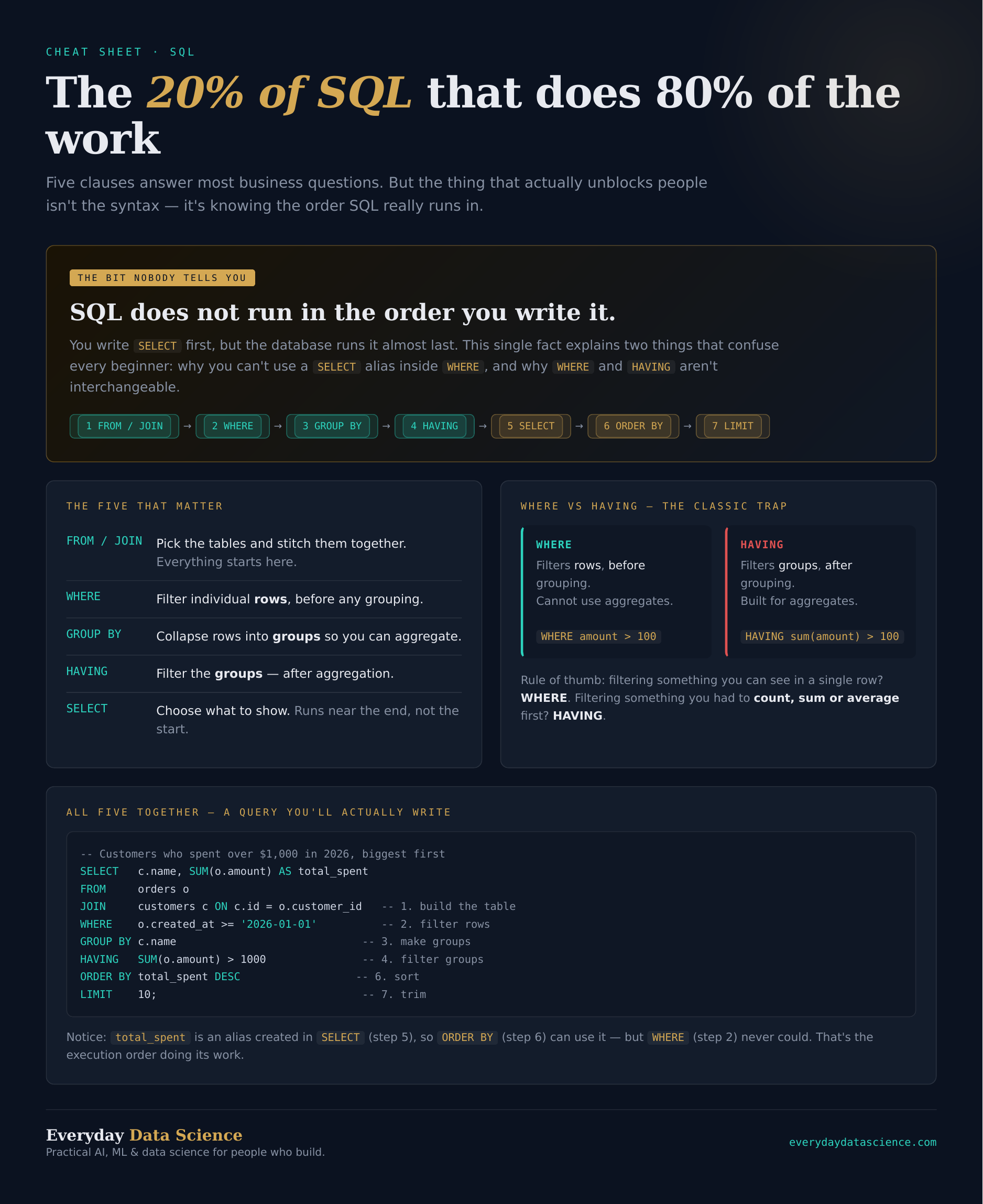
The 20% of SQL that does 80% of the work.
Five clauses answer most business questions. But the thing that actually unblocks people is not the syntax. It is knowing that SQL does not run in the order you write it.
You write SELECT first. The database runs it almost last. That one fact explains why a SELECT alias will not work inside WHERE, and why WHERE and HAVING are not interchangeable.
Save it before your next interview.
One practical tip
Fill missing values by group, in one line.
"Fill each missing salary with the median for that job title." Most people write ten lines for this. You need one:
`df["salary"] = df["salary"].fillna(df.groupby("title")["salary"].transform("median"))`
The key is `transform`. It returns a Series aligned to the original index, so it slots straight into `fillna`. Do not reach for `agg` here. It collapses each group to a single row, and your data will misalign silently. That is the most common bug in group-wise imputation.
Worth reading
Google's own technical report on its Sierra Leone AI tutor trial.
Why it matters: it is a genuinely rigorous randomised controlled trial, 1,763 students, preregistered, independently scored. Almost nothing in the AI-for-education space is this well evidenced. Read the PDF, not the press coverage. The findings that complicate the headline are in the document, and the coverage dropped them.
Africa AI
The AI tutor raised maths scores. It raised them most for students who were already ahead.
Buried in Google's own report: for each additional standard deviation of baseline maths ability, the treatment effect grew. The tool worked, and it worked disproportionately for the students who needed it least.
For a development intervention, that is not a footnote. An AI tutor that amplifies existing advantage is a fundamentally different policy object from one that closes gaps, and a ministry choosing how to spend a constrained budget needs to know which one it is buying.
The rule I would take from this: when someone quotes you an average effect, ask who it worked best for.
One opportunity
Google Africa Applied AI Lab, Accra.
Early access to Gemini, Gemma and Veo before general release, VC partners, and a demo day. Pre-seed and unfunded founders are eligible, and it is open to founders from across the continent, not just Ghana.
Applications close 31 August 2026. If you are building something, this is the one to move on.
Over to you
When you last saw an AI result quoted as an average, did you ask who it worked worst for? Hit reply. I read every one.
This issue features work by Ibrahim Denis Fofanah.