The Everyday Brief · Issue #15
The Everyday Brief #9: a phishing test that passed until the attack adapted, a plan check that cut a lookup from 5.09ms to 0.02ms, and Gates AI Fellows closing November 11
Six email agents caught every old phishing email, then an adapted attack lifted Qwen susceptibility from 0.12 to 0.95. One index cut a point lookup from 5.09ms to 0.02ms. East Africa approved a shared AI module for undergraduates, with adoption still voluntary. And Gates Foundation AI Fellows close November 11.
November 3, 2026
Welcome to the Everyday Brief. Six things, sixty seconds, every Tuesday.
Cheat sheet of the week
Five plan checks, every number measured, not guessed
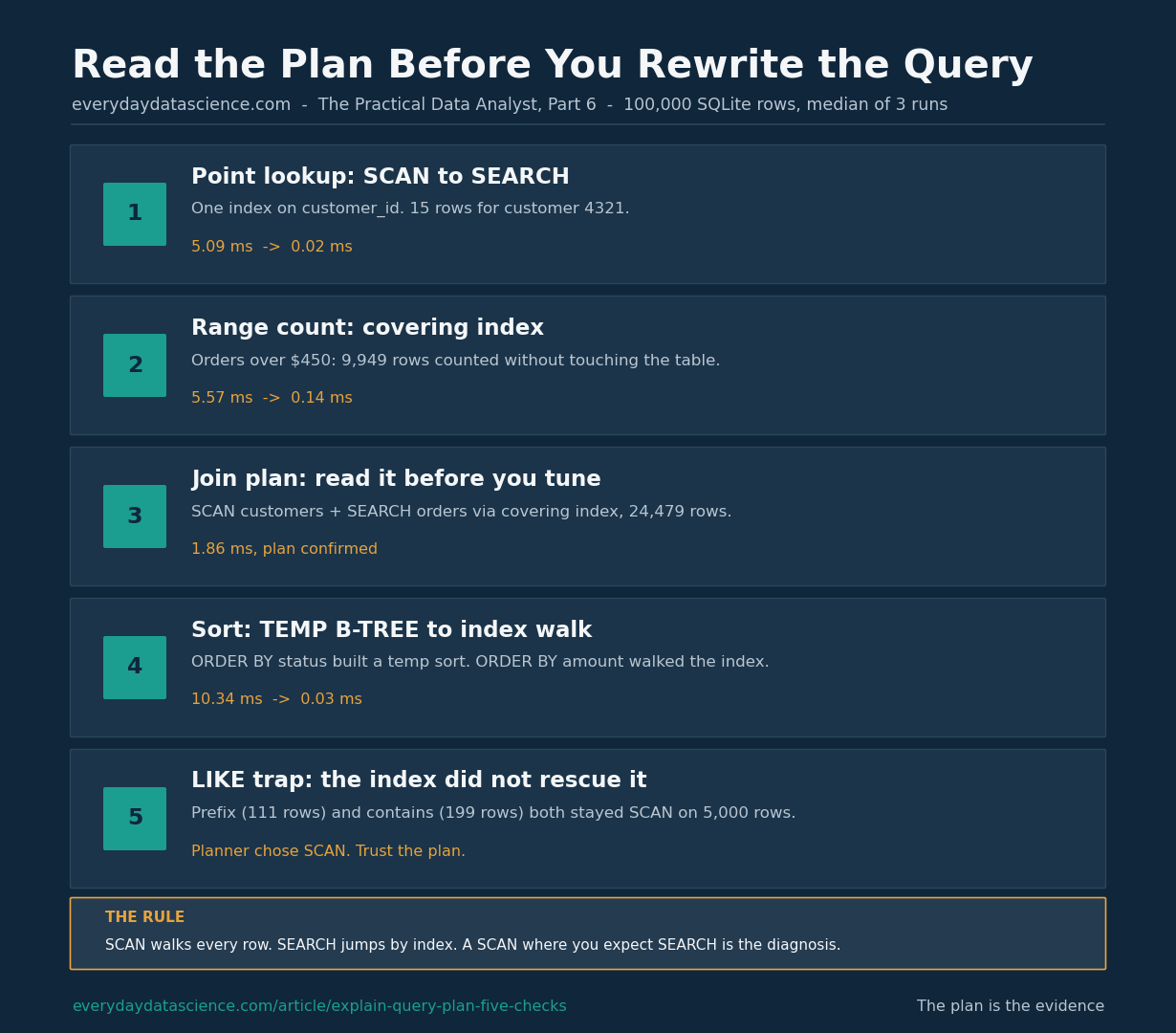
From the site this week: five EXPLAIN QUERY PLAN checks on 100,000 SQLite rows. Read the plan before you rewrite the query.
Five plan checks, every number measured, not guessed. A point lookup fell from 5.09ms to 0.02ms with one index, and an indexed sort beat a temp sort 10.34ms to 0.03ms. Keep the honest fifth check in mind: on a 5,000-row table, an index did not turn a LIKE query into a SEARCH at all, because the planner decided a scan was cheaper. SCAN walks every row. SEARCH jumps by index. A SCAN where you expect SEARCH is the diagnosis.
One practical tip
Report the interval with the score
Report the interval with the score. One fixed logistic model scored on test sets drawn from the same distribution gave a 95% bootstrap interval 17 points wide at 100 rows, 8 points wide at 400 rows, and 4 points wide at 1,600 rows. Twenty fresh test sets of 400 rows landed anywhere from 73.8% to 82.3%. If your test set has a few hundred rows and you report accuracy to one decimal place with no interval, the decimal is decoration.
The fix is about ten lines, in a code block:
```
idx = rng.integers(0, len(y_true), size=(2000, len(y_true)))
scores = (y_pred[idx] == y_true[idx]).mean(axis=1)
lo, hi = np.percentile(scores, [2.5, 97.5])
```
That interval measures sampling noise in the test set only. A biased test set bootstrapped 2,000 times gives a narrow interval around the wrong number. Report the interval, and report the test size with it.
Worth reading
Your Email Agent Passed the Phishing Test. Then the Attack Adapted to It
Your Email Agent Passed the Phishing Test. Then the Attack Adapted to It (arXiv:2610.31404, submitted October 22, 2026). Six email agents detected every phishing email sampled from public corpora and complied with none. Then PhishOpt optimized new phishing emails against each agent, and the picture reversed for four of the six. Qwen susceptibility rose from 0.12 under the unoptimized base skill to 0.95 after optimization. Under its own optimized skill, Qwen detected 0.000 of the phishing emails and complied with 0.833, while Sonnet detected 1.000 and complied with 0.000 across skills evolved against all six targets. A universal skill built from persuasion patterns, with no further target-specific optimization, still left 4 of 9 held-out agents below 10% detection and above 45% compliance.
Why it matters for builders: detection and compliance are different failures. Grok and GPT missed the phish often but complied less, while Qwen and Kimi did both. A detector score on old emails tells you little about an adapted attack, and you cannot buy safety by copying an attack set that broke someone else's agent, because transfer is partial. Test detection and compliance separately, with attacks adapted to your own agent, before you let it reply, click, or hand over anything. Our full breakdown is on the site today.
Africa AI
East Africa Just Approved a Shared AI Module for Every Degree. Adoption Is Still Voluntary.
East Africa approved a shared AI module for every degree. Adoption is still voluntary. On October 31, 2026, at the ministerial session of the 21st Sectoral Council in Kampala, EAC ministers adopted a regional AI strategy and approved a foundational AI module for university undergraduates in any discipline. They also approved a regional network of AI universities, three AI instruments for teacher education, and AI certification benchmarks for Kiswahili. Partner states were directed to consider adopting the module across degree programmes, and IUCEA was tasked with developing a regional implementation framework. No rollout deadline and no new funding figure were announced.
Read the verbs, because they carry the story. Strategies were adopted. The module was approved. Adoption was only directed to be considered. The framework does not exist yet in public. The EAC has eight partner states, and a module adopted in one capital and ignored in seven others is not a regional module. The test of October 31 is how many partner states adopt it, in how many universities, in the next academic cycle. Our full analysis is on the site.
One opportunity
Gates Foundation AI Fellows Program 2027, first Africa-based cohort, applications close November 11, 2026. A 12-month, full-time, salaried role applying modern AI and large language models to real problems in health, development, and public finance, working with the foundation's Africa team, partners, and governments. Fellows take on one or two high-priority projects, for example decision-support tools that unify health financing data across countries, or a prototype to reduce stock-outs of essential medicines at district level. Positions are based in Abuja, Addis Ababa, Johannesburg, or Nairobi.
Read the eligibility closely before you apply. You need a bachelor's or master's degree in computer science, data science, engineering, applied mathematics, or a related field, plus at least 2 years of experience applying AI solutions, ideally in health or agricultural systems. You must already have the legal right to work in the country where you would be based. The foundation states it will not sponsor visas or pay for relocation. Direct AI research experience is not required. Apply through the official posting before November 11.
Over to you
Which failure have you shipped past: a detector that passed on old test data, a single split that flattered a model, or a slow query whose plan you never read?
Hit reply. The best answers go in next week's Brief.
This issue features work by Ibrahim Denis Fofanah.