The Everyday Brief · Issue #11
The Everyday Brief #5: a harness that doubled an agent's score, five SQL patterns that beat self-joins, and a fellowship closing October 15
A visual-memory harness took Claude Opus from 40.68 to 100.00 on ARC-AGI-3 without a smarter model. Five window-function patterns cover most analytics SQL. Google backed 15 revenue-generating South African AI startups. And a fellowship auditing AI products in local context closes October 15.
October 6, 2026
Welcome to the Everyday Brief. Six things, sixty seconds, every Tuesday.
Cheat sheet of the week
The five window-function patterns behind most analytics SQL
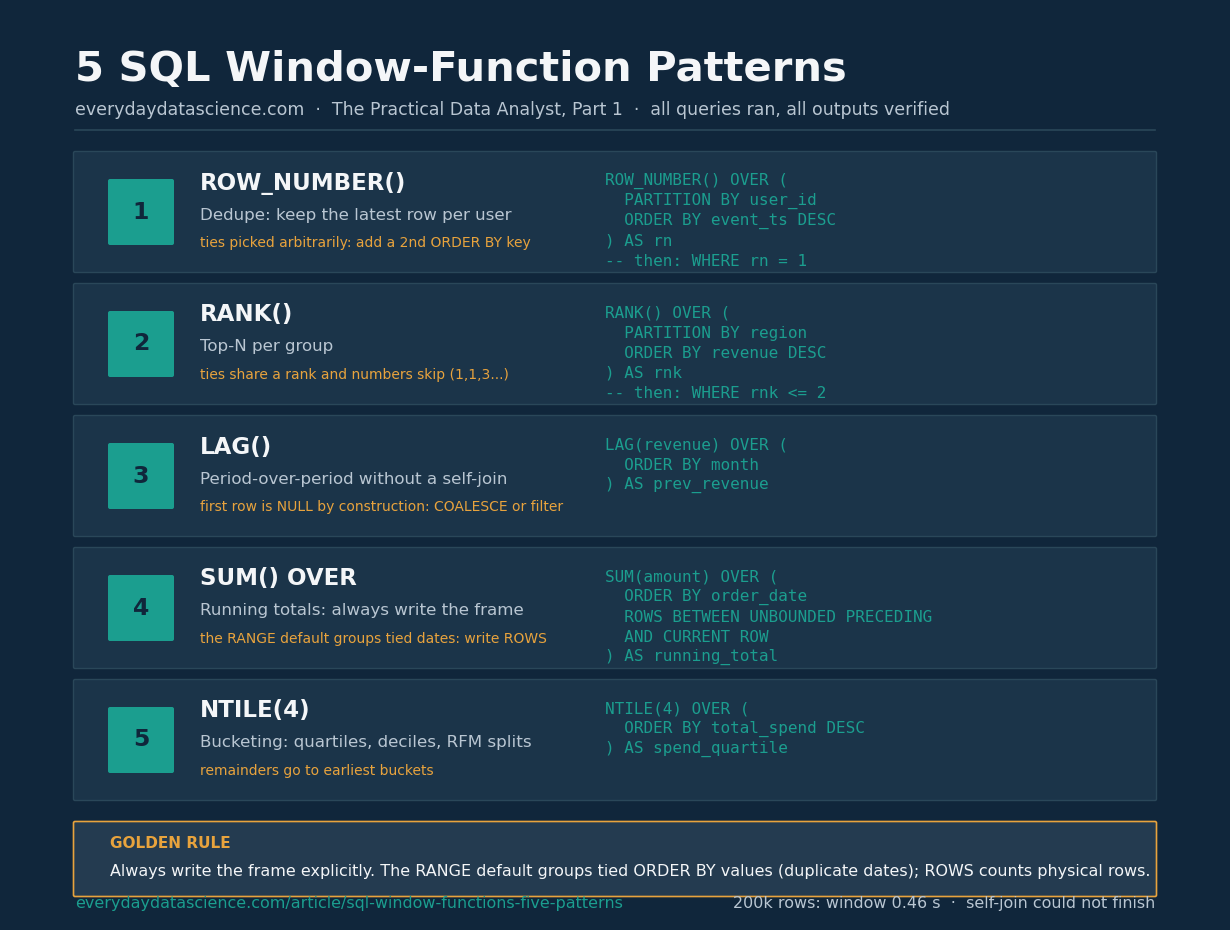
Fresh off the site this morning: the five window-function patterns behind most analytics SQL, from Part 1 of The Practical Data Analyst.
Five patterns, every query run and output verified. The one to tape to your monitor: always write the frame explicitly, because the default RANGE frame silently groups tied dates and inflates running totals. On 200,000 rows, the window function finished in 0.46 seconds while the equivalent self-join could not finish at all.
One practical tip
Share of total in one line, no GROUP BY
The fastest way to add a "share of total" column, no GROUP BY required:
```sql
SELECT region, sales,
sales / SUM(sales) OVER (PARTITION BY region) AS share_of_region
FROM store_sales;
```
SUM() OVER () puts the grand total on every row; with PARTITION BY it puts each group's total on every row of that group. The rows are not collapsed, so every row keeps its own result. One line, and your GROUP BY stays out of it.
Worth reading
VISTA: the harness did the work, not the model
VISTA: the harness did the work, not the model.
On October 1, Qiushi Han, Kaiming He and colleagues released VISTA, a visual harness for reasoning agents in interactive environments. The headline result: Claude Opus 5.0 went from 40.68 to a perfect 100.00 on ARC-AGI-3's Relative Human Action Efficiency score, completing all 25 public games with 57.4% fewer actions than first-time human players. The lift came from perception, not a smarter model: VISTA gives the agent raw visual observations plus a lossless visual memory that archives every past frame, so it can retrieve and re-inspect any frame mid-reasoning. GPT-5.6 Sol hit 99.00 under the same harness (baseline 13.33), and the code is public, so builders can borrow the visual-memory pattern with no training involved. The honest caveat: all headline numbers are on the 25 public games, so generalization to unseen environments is still the open question.
Africa AI
Google picks 15 South African startups for its 2026 AI accelerator
Google picks 15 South African startups for its 2026 AI accelerator.
Google announced on October 5 that 15 South African-led startups were selected for the 2026 Google for Startups Accelerator: South Africa cohort, from a record 1,057 applications. Each gets up to 1 million rand (about $55,000) in equity-free cash, plus access to Google's AI models and cloud, engineering mentorship, and product training. All 15 are already revenue-generating: the named ones include Ambani Africa (African-language learning), Anvaya Legal AI (legal research automation), Boleka Africa (fintech for underbanked adults), Buddy Learning (multilingual AI tutoring over WhatsApp), and Daedalis (verified supply-chain data). Demo Day is set for December 2026. This reads like a who's-who of the applied-AI problems founders on the continent are actually getting paid to solve: mother-tongue learning, WhatsApp-based tutoring, legal and fintech tooling. The honest caveat: it is an accelerator announcement, not a funding round, and the R1 million is a per-startup ceiling. Still, revenue-generating beats demo-stage, and this is where to look if you want to see which AI use cases survive contact with customers.
One opportunity
Polyfoni Social Sciences for AI Fellowship 2026-2027: audit an AI product in its real context
Polyfoni Social Sciences for AI Fellowship 2026-2027: audit an AI product in its real context.
A four-month, part-time fellowship where you run a "cultural audit" of a real AI product deployed in a region you know: what assumptions it bakes in about its context, and where those assumptions break. Example audit targets on the official page include a health AI chatbot in East Africa and an agricultural AI tool in West Africa, which makes it unusually relevant to Africa-based practitioners. You get an academic mentor and an AI industry mentor, training in Polyfoni's Cultural Audit Method, and a published report under your name. Honest caveats: eligibility skews toward MSc/PhD students and early-career researchers in the humanities and social sciences (no prior AI experience needed), there is no stated stipend, and it is about 5 hours a week from November 2026 to March 2027. Applications are open now with rolling review; opportunity trackers put the close at October 15, so apply this week if it fits.
Over to you
Which SQL habit do you still catch yourself using even though you know there is a better way: the self-join, the correlated subquery, or the copy-paste GROUP BY?
Hit reply. The best answers go in next week's Brief.
This issue features work by Ibrahim Denis Fofanah.