The Everyday Brief · Issue #10
The Everyday Brief #4: the frontier price war, an honest benchmark, and a compute grant closing tomorrow
Frontier API prices fell 40 to 60% in 48 hours. DuckDB swept our 3.5M-row benchmark. A Nigerian startup rents GPUs under $1 an hour. And a compute grant for African AI closes tomorrow.
September 29, 2026
Welcome to the Everyday Brief. Six things, sixty seconds, every Tuesday.
Cheat sheet of the week
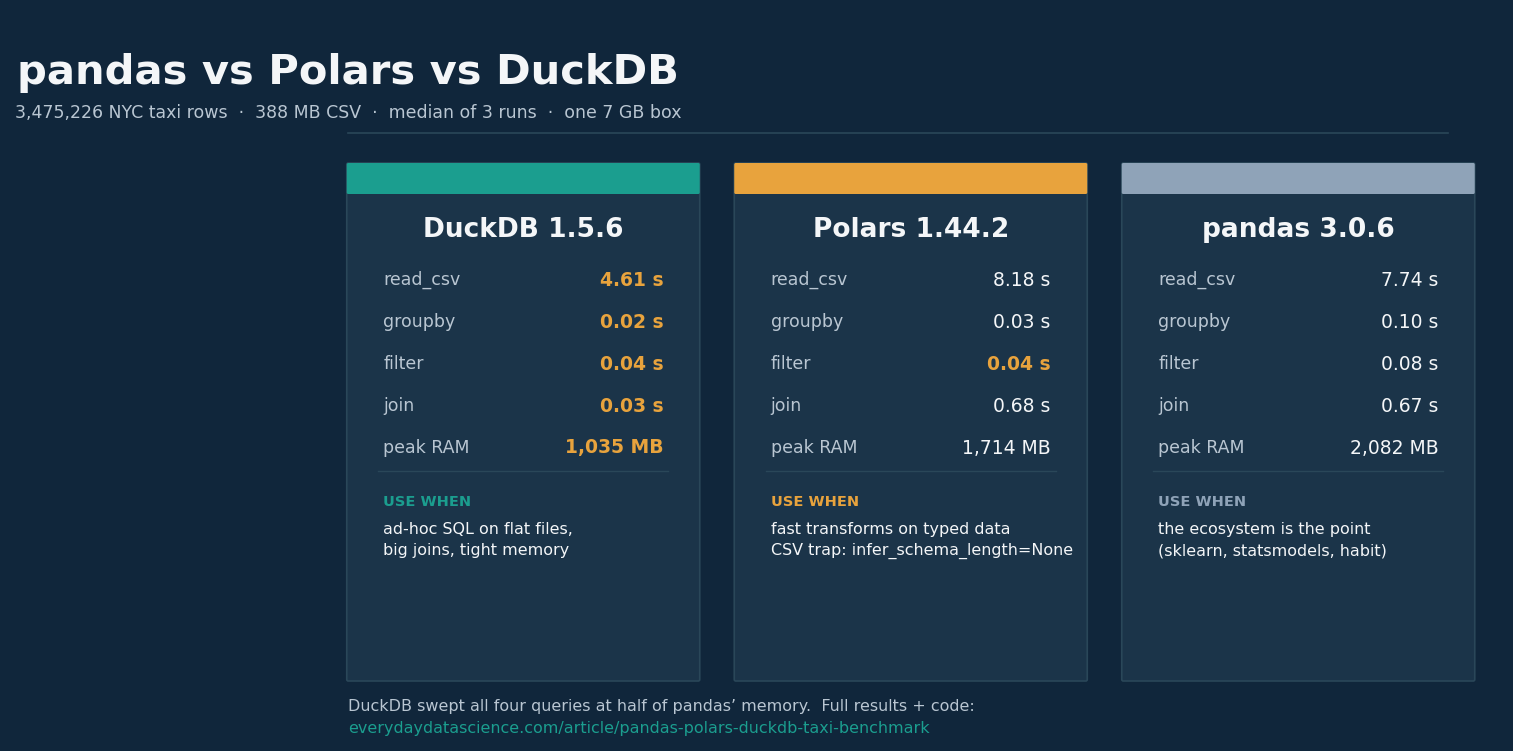
From our own benchmark desk: which engine for which job, from real timings on 3.5 million NYC taxi rows.
DuckDB won every query at half of pandas' memory. But the most useful row on this card is Polars': default schema inference silently misread the fee columns. Scan the whole file first. Full numbers and code in the article.
One practical tip
Polars guesses column types from the first 100 rows of a CSV. In our benchmark the fee columns looked like integers for the first hundred rows, then decimals showed up later and the read failed. One line fixes it:
```python
pl.read_csv("yellow_2025-01.csv", infer_schema_length=None)
```
That tells Polars to scan the whole file before guessing types. Reads get slower, schemas come out right. Rule of thumb: on any CSV you did not generate yourself, set it.
Worth reading
Weekly AI Dev News Digest: September 19-25, EveryDev. Three frontier labs shipped models within 48 hours. The part that changes your work is the pricing. Anthropic released Claude Opus 5.5 at $4/$20 per million tokens, about 40% under Opus 5, with cache reads cut 60% to $0.20. OpenAI answered the same day with GPT-6 Sol and Luna at half the 5.6-series price. xAI went the other way: Grok 4.7 doubles the rate for prompts over 200k tokens. If you run agents in production, your unit economics changed this week. Also in the digest: Claude Code made Opus the default on paid plans, and Cursor measured AI review cutting average review time from 4.8 to 3.8 minutes.
Africa AI
GPUs under $1 an hour, rented from Lagos. Nigerian startup Udu Technologies launched its Africa GPU Hub with pre-configured environments (PyTorch, TensorFlow, vLLM, LoRA) and says it has H100 and Blackwell Pro 6000 clusters running in Kenya, Malawi, Rwanda, South Africa, Togo and Zambia. It claims 2,000 developers and more than 30 government AI use cases so far. The honest caveat: the sub-$1 headline does not say which chip you get at that price. It is not an H100. Still, this is the compute gap being attacked from below while the big sovereign buildouts come from above, and for a team that needs to train this week, that matters more than a 2027 data center.
One opportunity
AISCA Compute Grant, Cohort 4: GPU hours, not cash. The AI Skills and Compute Africa Foundation is granting compute to African AI builders. Track A is for ventures deploying AI products in live markets; Track B is for university and institute teams advancing datasets, models, methods or benchmarks. Deadline: September 30, 2026, which is tomorrow. Honest caveat: Track B is written for university and institute teams, so independent researchers will need a strong case. If compute is the missing piece between your project and its next step, apply today.
Over to you
What is the most misleading number you have ever seen in a benchmark or model eval, and what gave it away? Hit reply. The best answers go in next week's Brief.
This issue features work by Ibrahim Denis Fofanah.